
Summary
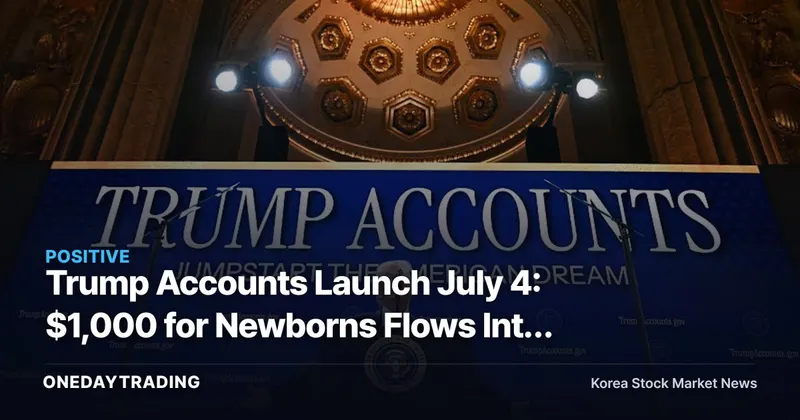
The US government will officially launch Trump Accounts on Independence Day, July 4. Each newborn will immediately receive a $1,000 federal grant, and parents can contribute up to an additional $5,000 per year. What the market has yet to price in is the structural supply-demand (order flow) shift: these funds are automatically invested in broad US stock indexes.
Details of the Development
Included in the Republican budget bill known as the "One Big Beautiful Bill," Trump Accounts cover every child with US citizenship born on or after January 1, 2025. The federal government deposits $1,000 as soon as an account is opened, and until the child turns 18, parents and guardians can contribute up to $5,000 per year on top of that. The funds are invested in a broad stock index managed by the US Treasury Department, and the structure is designed as a Roth-style account, meaning returns are not taxed.
Withdrawal conditions are limited. After the beneficiary turns 18, funds can only be withdrawn for education expenses, a home purchase, or start-up capital. Given that roughly 3.6 million babies are born in the US each year, the federal government will inject at least $3.6 billion into the market in the first year alone. The choice of Independence Day is symbolic, but the signal the market should take away isn't policy sentiment — it's the structure of the fund flow.
Structural Background
The key is the automatic investment mechanism. If this money flows into the US stock market via passive index tracking rather than active management, it will create trillions of dollars in long-term passive demand over the next 18 years. What the market has priced in so far is the welfare-policy nature of a child savings account. What it has not yet priced in is the supply-demand (order flow) shift created by this money becoming a stable buyer of S&P 500 constituent stocks. This isn't a short-term price catalyst — it's a factor that will lower the index risk premium over a period of years.
Stock (Ticker) and Sector Impact
- BlackRock (BLK): The primary beneficiary of Trump Account funds is broad-index asset managers. If account funds flow into index funds via the US Treasury, BlackRock's assets under management — including its iShares ETFs — will expand, boosting its management-fee revenue.
- Top S&P 500 constituents (Big Tech and financials): Because of the market-cap-weighted structure, passive fund inflows are concentrated in the largest names. Given that the top 10 S&P 500 stocks account for 35% of total market capitalization, automatic investment effectively translates into concentrated buying of large-cap tech stocks.
- Mirae Asset Securities (006800): Among domestic Korean brokerages, it has the largest scale of US ETF-related asset management and overseas stock brokerage. If the long-term structural demand base for US equities strengthens, its fee income and asset-management revenue tied to US assets will be directly affected.
- Domestic investors in US index ETFs: For Korean retail investors holding SPY or QQQ, this adds a long-term structural supply-demand (order flow) argument. However, this effect accumulates over several years rather than producing an immediate reaction.
Bullish vs. Bearish Scenarios
Bullish scenario: Based on roughly 3.6 million births per year, if parental contributions on top of the $1,000 federal deposit ramp up in earnest, the US stock market will see hundreds of billions of dollars in additional long-term demand within a decade. Index volatility would decline, with the added benefit of more stable entry prices for long-term holders.
Bearish scenario: Expanded fiscal spending increases the supply of US government bonds, pushing up long-term interest rates. If the US 10-year yield climbs back above 4.5%, it will place direct downward pressure on the S&P 500's earnings multiple (P/E). In this structure, the fiscal cost offsets the equity demand created by Trump Accounts. Consensus reads this program as a simple positive catalyst, but the fiscal headwind is not yet priced in.
Investor Action Points
- Track actual account-opening numbers and enrollment pace after the July 4 launch. If participation falls short of expectations, the supply-demand (order flow) effect will come in well below estimates.
- Watch for disclosures on which index the US Treasury uses for investment. Whether it tracks the full S&P 500 or a total-market index will change the impact on small- and mid-cap stocks.
- Monitor US 10-year government bond yield trends in parallel. If yields stay above 4.5% for an extended period, the multiple-expansion scenario becomes conditional.
- For Korean investors, the case for holding US index ETFs long-term has strengthened, but they should also factor in the exchange rate variable — if fiscal-sustainability concerns flare up, it could coincide with a stronger dollar and a weaker won.
Mirae Asset Securities: Real-Time Data Snapshot
Mirae Asset Securities' most recent closing price was 43,650 won (+2.11% vs. the previous day), and the composite signal — combining foreign/institutional supply-demand (order flow) with news and momentum — reads 🟡 Neutral / Wait-and-see. Positive and negative signals are mixed, making this a stock to watch.
- ▼ Order-flow continuity — foreign investors have been net sellers for 5 consecutive days (−7.5 billion won)
Recent related news is favorable, with 1 positive catalyst and 0 negative catalysts.
※ Price and foreign/institutional order-flow data are provided by Korea Investment & Securities (KIS) and are current as of publication.
This article is automatically summarized and analyzed based on original news reporting. Read the original (CNBC)