
3-Line Briefing
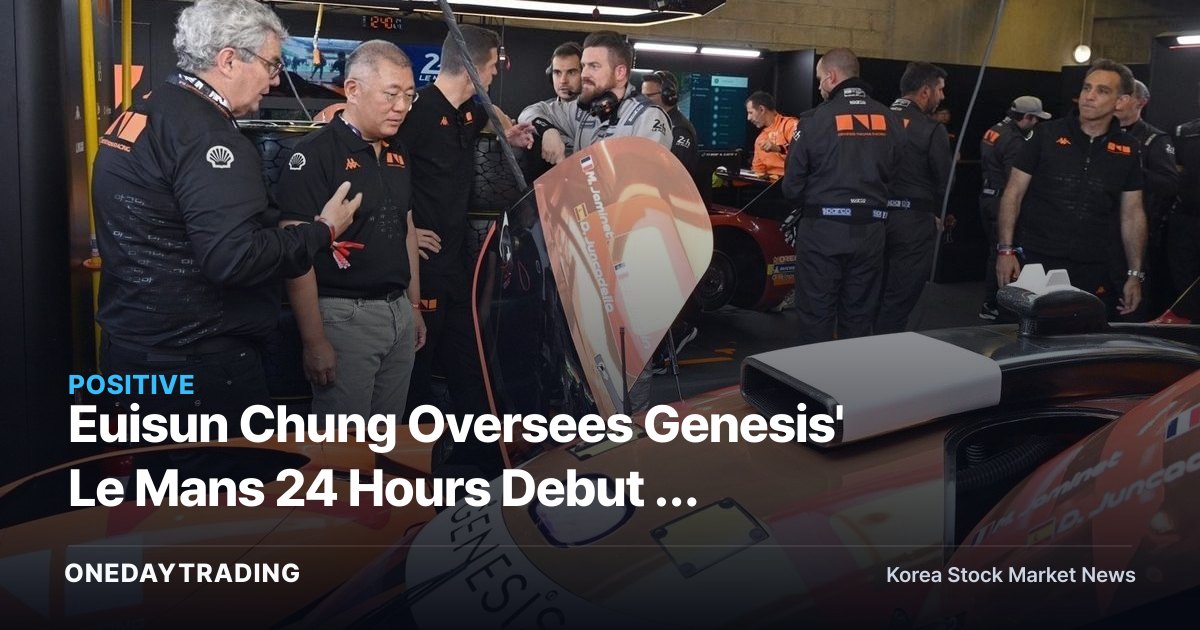
- Euisun Chung, Chairman of Hyundai Motor Group, visited the site of the Le Mans 24 Hours endurance race in France in person to oversee the debut of luxury brand Genesis.
- The top executive's on-site presence is interpreted as an extension of a strategy to elevate the brand and boost global recognition through motorsport.
- While racing results do not translate directly into earnings, the strengthening of Genesis' premium positioning is viewed as a positive for medium- to long-term brand value.
What's Changing
Hyundai Motor Group has been accelerating its push into the luxury car market with Genesis at the forefront, moving away from its mass-production, value-for-money image. Genesis' first challenge at the Le Mans 24 Hours endurance race — considered one of the world's three greatest motor races — is more than a mere marketing event; it is closer to a declaration that it intends to prove its technological prowess and durability on the global stage.
In particular, the fact that the group's chairman visited the site in person is read as a commitment to nurturing motorsport not as a one-off promotion but as a long-term brand asset. Just as German premium brands such as Mercedes-Benz, BMW, and Audi have actively leveraged their motorsport heritage in marketing, Genesis is following the same formula in an attempt to shift perceptions in the luxury car market.
By the Numbers and Context
Since its launch, Genesis has grown sales in the luxury car markets of North America and Korea, but it has continued to be seen as still having low recognition in the European market compared with traditional premium brands. The Le Mans entry could serve as a channel to imprint the brand on European consumers. That said, the effects of motorsport investment tend to emerge slowly as a rise in brand value over several years rather than as immediate revenue, so caution is warranted in interpreting it as short-term earnings momentum.
Beneficiary and Affected Stocks
- Hyundai Motor: As the core entity that owns the Genesis brand, it is a direct beneficiary, with expectations of a stronger premium lineup and a higher average selling price.
- Kia: The group-wide enhancement of its premium and technology image could act as an indirect halo effect on sales of higher-end lineups such as the EV6 and EV9.
- Hyundai Mobis: As a key parts supplier, it could benefit if demand for the development of high-performance, durable component technology increases.
- Auto parts and materials suppliers: Opportunities to supply lightweight materials and high-spec components could open up as high-performance vehicle development expands.
Risk Check
- The effects of motorsport marketing are difficult to quantify, and the contribution to earnings relative to the massive investment may be uncertain.
- Poor race results or accidents could instead weigh on the brand image.
- Earnings are more heavily swayed by macro variables such as a slowdown in global auto demand, the cost of the EV transition, and exchange rate fluctuations.
- The European premium market has high entry barriers, making it difficult to expand market share in the short term.
Bottom Line
Genesis' Le Mans debut and the chairman's hands-on involvement are positive signals demonstrating the sincerity of the brand premiumization strategy, but since the actual share price and earnings hinge on global sales and electrification results, the rise in brand value needs to be watched from a medium- to long-term perspective.
This article is content automatically summarized and analyzed based on the original news report. View original (Yonhap News, Industry)