
Summary
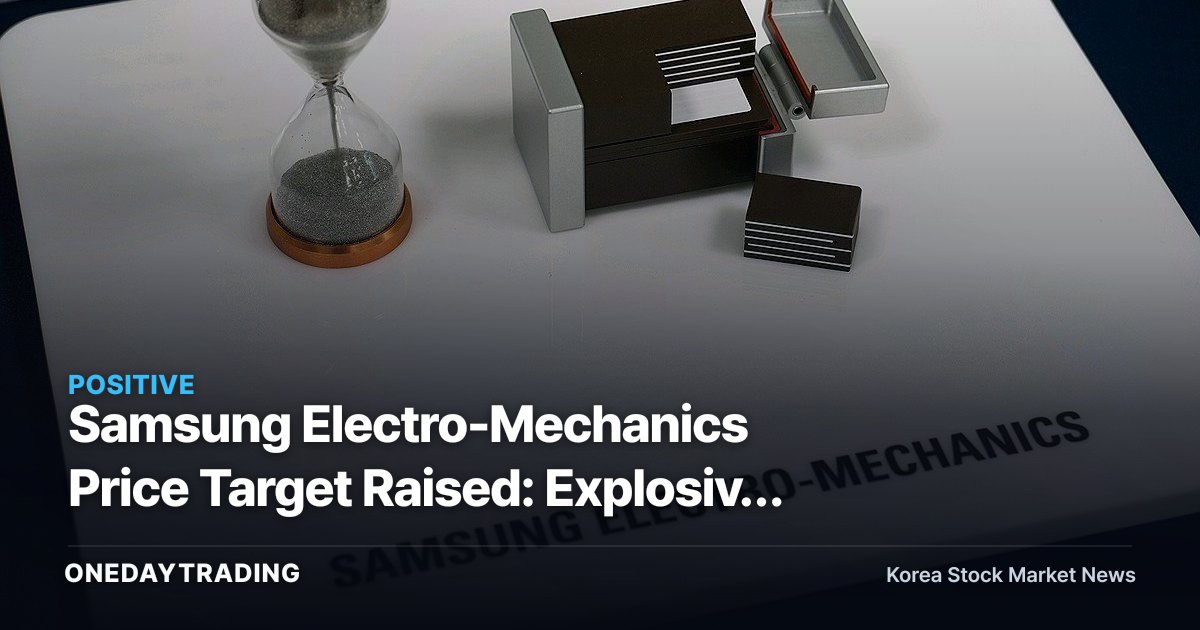
The core of KB Securities' price-target hike on Samsung Electro-Mechanics is the simultaneous expansion in demand for multilayer ceramic capacitors (MLCCs) and packaging substrates used in AI servers. This matters because it is not merely a short-term cyclical rebound but a structural shift in which both the unit price of components and the quantity installed are rising together. Investors need to separate the durability of the boom from the expectations already priced into the stock.
What Happened
On the 19th, KB Securities assessed that the spread of AI servers is driving a sharp surge in demand for MLCCs and packaging substrates, and that a super-cycle would continue for at least two years. On this basis, it raised its price target. The key logic is that the quantity and unit price of high-value components going into a single AI server increase substantially compared with a standard server.
MLCCs are ultra-compact components that stabilize current flow. AI accelerator boards performing high-performance computation carry far more of them than a typical PC or smartphone — and predominantly high-reliability products that can withstand high temperatures and high voltages. Packaging substrates, too, serve as the pathway connecting the chip to the mainboard, and as the area and pin count of AI chips grow, larger and more sophisticated high-layer-count substrates are required. With rising quantities and higher specifications overlapping, the average selling price (ASP) is rising alongside them.
Structural Background
Until now, Samsung Electro-Mechanics' earnings have been heavily swayed by demand for IT sets such as smartphones and PCs. When the set market stagnated, the company suffered the weakness of MLCC utilization rates and unit prices being squeezed at the same time. The new end-market demand from AI servers diversifies this dependence and increases the share of high-value segments such as industrial and automotive applications, where unit prices are higher and replacement cycles are more stable. The essence of the structural change is that it can lower not only the intensity of the boom but the very volatility of earnings.
Impact on Stocks and Sectors
- Samsung Electro-Mechanics: As a simultaneous supplier of high-capacity, high-reliability MLCCs and packaging substrates for AI servers, it has the largest direct benefit. This is a path where both revenue and margins improve together.
- Samsung Electronics: It shares the same broad trend of expanding demand for HBM and packaging used in AI accelerators. However, it is more directly affected by the memory price cycle.
- SK hynix: As a flagship beneficiary of the same theme of AI server end-market demand, it tends to move in step with the component industry cycle.
- Daeduck Electronics: As a member of the domestic packaging-substrate supply chain, it is expected to see trickle-down effects from expanding demand for high-layer-count substrates.
- Electronic Components Sector: The increase in component content per AI server acts as a common catalyst lifting the unit prices and utilization rates of passive components and substrates across the board.
Bull vs. Bear Scenarios
The bull case is clear. As long as AI data-center investment continues, demand for high-value MLCCs and substrates expands on both quantity and price, which can lift the profit level by a notch for more than two years. Conversely, a bear scenario clearly exists as well. If much of the AI-benefit expectation is already priced into the stock, valuation burden grows, and if Big Tech moderates the pace of capital expenditure or set demand weakens at the same time, the outlook for utilization rates and unit prices could waver. Movements in the exchange rate and raw-material prices are also variables for profitability.
Investor Action Points
- Verify with hard numbers in next quarter's earnings whether MLCC ASP, the share of industrial and automotive applications, and packaging-substrate utilization rates actually improve.
- Track changes in global Big Tech data-center capex guidance as a leading indicator of end-market demand.
- Compare the stock's position after the price-target hike with its valuation relative to earnings to gauge whether expectations are already priced in.
- Monitor the won-dollar exchange rate and the trends in key raw-material prices together as variables for profitability.
Samsung Electro-Mechanics by Real-Time Data
Samsung Electro-Mechanics' latest closing price is 2,305,000 won (+4.77% versus the previous day), and the signal light combining foreign and institutional order flow with news and momentum is 🟢 Buy Bias. News and momentum are positive, making it worth watching.
- ▲ Trend Alignment — Short- and mid-term upward alignment (today +4.8% · 1 week +27.8% · 1 month +123.8%)
- ▲ 52-Week Position — In the upper 99% of the 52-week range — new-high territory
- ▲ News Flow — 4 positive catalysts vs. 0 negative catalysts — positive bias
Recent related news is favorable, with 4 positive catalysts and 0 negative catalysts.
※ Price and foreign/institutional order-flow data are provided by Korea Investment & Securities (KIS) and are as of the time of publication.
This article is content automatically summarized and analyzed based on the original news. View original (Maeil Business Newspaper, Securities)