
At a Glance
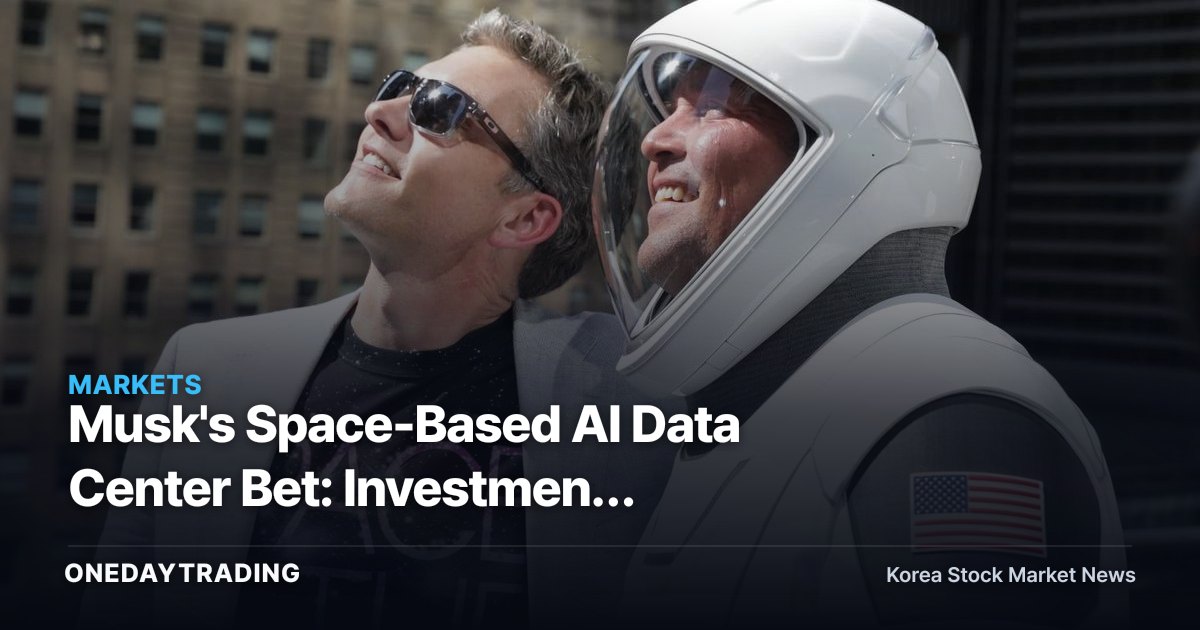
Elon Musk's SpaceX is moving forward in earnest with a plan to put AI data centers into Earth orbit. The idea is to bypass local resident opposition to ground-based data centers, as well as the strain on power and water resources, but once launch, cooling, and communication costs are factored in, the economics remain unproven. For investors, it is more reasonable to read this not as near-term earnings momentum, but as an early signal of a long-term theme where aerospace and AI infrastructure intersect.
Why It Matters Now
At the heart of this issue is the fact that, as AI computing demand surges, power and land have emerged as the biggest bottlenecks to data center expansion. On the ground, grid-connection delays, water sourcing, and environmental opposition from local communities all come into play at once. Orbital data centers tout the rationale of harnessing near-limitless solar power and the cold environment of space, but in practice, dissipating heat in a vacuum is difficult, and challenges remain in the form of mass launch costs and data transmission between ground and orbit.
Even so, there is a clear point worth noting for Korean investors. SpaceX is privately held and therefore not a direct investment target, but whether this concept advances toward realization or reverts to ground-based expansion, there are areas where demand rises in common across both outcomes—namely, the high-bandwidth memory (HBM) that goes into AI accelerators, data center power sources, and satellite communication components. In other words, the safety net from an investment perspective is that the structural demand for AI infrastructure itself holds up regardless of whether the space data center succeeds or fails.
Conversely, if the orbital approach is blocked by cost barriers, the solution ultimately comes back to securing power for ground-based data centers. In that case, the value of stable baseload power sources such as nuclear power and small modular reactors (SMRs) comes to the fore. In either scenario, the underlying structure—that power and memory are the key chokepoints—does not change.
Frequently Asked Questions
- Will space data centers be commercialized soon? — Not in the near term. Launch costs must fall and orbital heat-dissipation technology must be proven; at present it is closer to a proof-of-concept stage.
- Why space rather than the ground? — On the ground, grid connection, water, and resident opposition are bottlenecks. Space bypasses these but takes on new costs in the form of expense and communication latency.
- Is there a direct impact on Korean companies? — Since SpaceX is privately held, the impact is indirect. The link runs through the supply chains for HBM, power equipment, and satellite components.
- Is this a theme to buy now? — It is a theme at the expectation stage, not the earnings stage. Until real revenue linkages such as orders and deliveries are confirmed, volatility will be high.
Related Stocks and Sector Impact
- Hanwha Aerospace — With high exposure to launch vehicle and space businesses, it is cited as a leading domestic beneficiary candidate of the space infrastructure theme. That said, it is far removed from direct data center revenue.
- SK Hynix — If AI accelerator demand holds up, whether in orbit or on the ground, the structural growth thesis for HBM shipments strengthens. It is directly tied to the memory market cycle.
- Samsung Electronics — Holding HBM and advanced DRAM alongside foundry operations, it has broad pathways to benefit from expanding AI computing demand.
- Doosan Enerbility — The more the data center power crunch reverts to a ground-based solution, the more it stands to benefit from heightened demand for nuclear and SMR baseload power.
- Hanwha Systems — Through its satellite and communications businesses, a linkage for supplying components and systems could emerge if orbital infrastructure expands.
Points to Watch When Investing
- This is currently a theme based on expectations rather than revenue. Share-price volatility will be high until actual launch schedules and supply contracts are confirmed.
- Because the economic viability of orbital data centers is itself unproven, if the concept founders, the near-term momentum of space theme stocks could cool quickly.
- HBM and semiconductor stocks already have AI expectations substantially priced in, leaving valuation concerns. A slowdown in the memory price cycle is a variable.
- News stemming from a privately held company has a loose linkage to Korean stocks, so caution is warranted to avoid being swept up in theme-driven sharp swings.
Overall Outlook
In the optimistic scenario, AI computing demand pushes past the physical limits of the ground, lending a long-term growth narrative to space infrastructure and the power and memory supply chains. If this trend continues, there is room for the cluster of stocks where aerospace and AI infrastructure overlap to be re-rated. The risk, on the other hand, is clear. The cost and technology barriers of the orbital approach may prove higher than expected, raising a strong likelihood that the concept is delayed or reverts to ground-based expansion—in which case the near-term expectations around the space theme could be unwound. Ultimately, the indicators to watch are the trajectory of SpaceX's launch costs, the HBM demand and price cycle, and actual order disclosures from domestic power and satellite companies. An approach that first checks the linkages that translate into revenue, rather than the direction of the theme, is the effective one.
Hanwha Aerospace Through Real-Time Data
Hanwha Aerospace's most recent closing price is 1,122,000 won (-5.63% versus the prior day), and the signal light that combines foreign and institutional investor order flow with news and momentum reads 🟡 Neutral · Wait-and-See. With positive and negative signals mixed, this is a zone to monitor.
- ▲ Order-Flow Continuity — Foreign investors net buyers for 3 straight days (+9.2 billion won)
- ▲ News Flow — 14 positive catalysts vs. 3 negative catalysts — positive catalysts in the lead
Recent related news is favorable, with 14 positive catalysts and 3 negative catalysts.
※ Price and foreign/institutional investor order-flow data are provided by Korea Investment & Securities (KIS) and are as of the time of publication.
This article is content automatically summarized and analyzed based on the original news. View Original (CNBC)