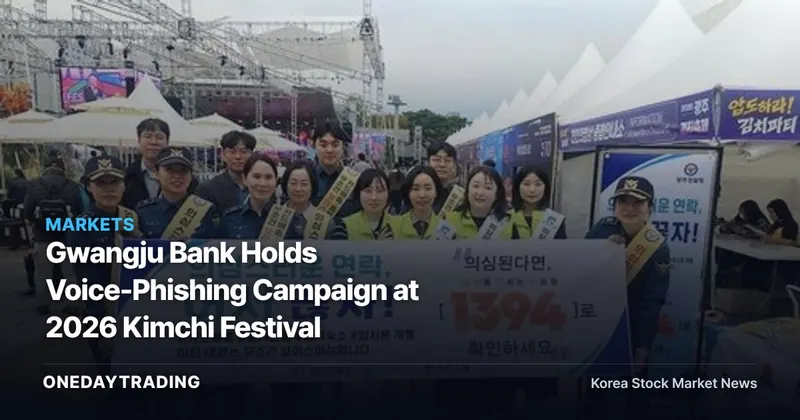

Gwangju Bank’s voice-phishing prevention campaign gives investors insight into the scope of its financial-consumer protection efforts rather than any direct change in corporate value. According to Yonhap News Agency’s securities coverage, Gwangju Bank conducted a joint campaign with the Gwangju Metropolitan Police Agency and the Financial Supervisory Service’s Gwangju-Jeonnam branch at the ‘2026 Gwangju Kimchi Festival’ on October 23, 2026, and announced the initiative on October 26, 2026. While the event itself is confirmed, no figures were provided for participation, costs, or its impact on reducing losses, making it premature to link the campaign to earnings or share-price direction.
What Gwangju Bank’s Voice-Phishing Prevention Campaign Revealed
- Gwangju Bank explained common voice-phishing tactics, financial-fraud prevention guidelines, and its financial transaction safety-blocking service.
- The Gwangju Metropolitan Police Agency provided guidance on detecting and blocking malicious mobile apps.
- The Financial Supervisory Service’s Gwangju-Jeonnam branch outlined recent criminal tactics and key precautions.
This joint campaign can be characterized as a prevention initiative that brought guidance from the participating institutions together at one venue. Gwangju Bank covered preventive measures for financial transactions, the Gwangju Metropolitan Police Agency explained how to respond to malicious apps, and the Financial Supervisory Service’s Gwangju-Jeonnam branch discussed criminal tactics and precautions. The available information confirms only this division of responsibilities and that the campaign took place.
Practical Significance of the 1394 Counseling Hotline
Gwangju Bank advised people who suspect they have been victimized to seek counseling by calling 1394, the hotline for the Integrated Response Unit for Telecommunications-Based Financial Fraud. A key practical feature of the campaign was that it went beyond describing types of fraud by also identifying a counseling channel for suspicious situations.
The only phone number confirmed in the Yonhap News Agency report is 1394 for the Integrated Response Unit for Telecommunications-Based Financial Fraud. The guidance advises recipients of suspicious text messages or calls to stop, verify the facts, and contact the hotline if they suspect harm. Malicious-app checks for mobile phones and information about the financial transaction safety-blocking service were presented as part of the same prevention process.
What Cannot Yet Be Linked to Gwangju Bank’s Investment Outlook
From an investor’s perspective, confirmed activities must be distinguished from unquantified outcomes. Although the campaign and guidance on preventive measures are confirmed, the materials provide no data on participant numbers, campaign costs, or reductions in losses. There is therefore no basis for translating the event into changes in Gwangju Bank’s profits, cost burden, or corporate value.
The scope of this news is limited to voice-phishing prevention activities. As the factual materials identify no listed company that directly benefits or suffers harm, it would be inappropriate to attach an arbitrary related stock (ticker). Although the news can be classified within the financial industry sector, interpreting it as a share-price catalyst for a specific listed company would go beyond the available evidence.
Conditions for Assessing Results
The campaign’s results can be evaluated separately only if evidence later confirms a reduction in losses. Such an assessment would require currently undisclosed data, including participant numbers, implementation costs, and changes in losses before and after the prevention initiative. None of these items was included in the announcement.
- Confirmed scope: The joint campaign conducted by Gwangju Bank, the Gwangju Metropolitan Police Agency, and the Financial Supervisory Service’s Gwangju-Jeonnam branch, along with the guidance provided by each institution
- Unconfirmed scope: Participant numbers, campaign costs, and any reduction in losses resulting from the prevention initiative
- Investment criterion: Until follow-up data are released, it is reasonable not to quantify any impact on earnings or valuation.
One Point for Investors to Remember
Gwangju Bank’s initiative was an on-site campaign publicizing financial-fraud prevention measures and a counseling channel; assessing its investment impact will first require undisclosed data on costs and reductions in losses.
This article was automatically summarized and analyzed from the original news report. View the original article (Yonhap News Agency)