
Key Takeaways
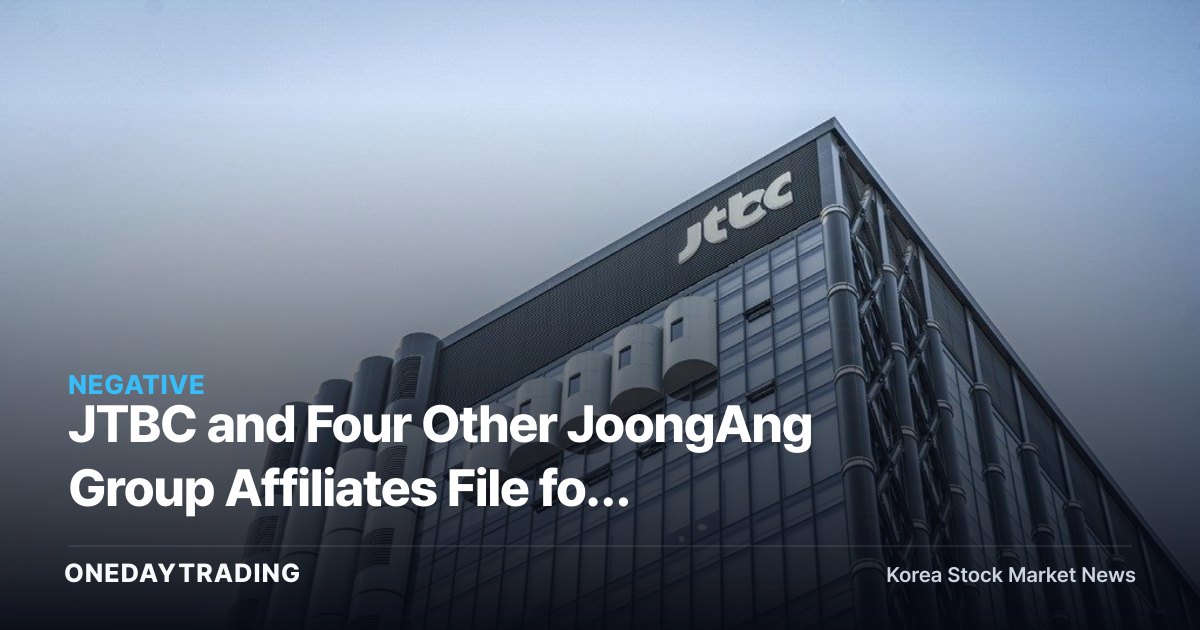
Five JoongAng Group affiliates, including the general-programming cable channel JTBC, have filed for court receivership (corporate rehabilitation), while the group's flagship newspaper, the JoongAng Ilbo, is pursuing a creditor-led workout. Although this is the distress of unlisted companies, it exposes deteriorating profitability across Korea's advertising-dependent media industry, and as such it functions as an industry-sector signal for listed media stocks as well.
The development reflects accumulated structural slowing in advertising revenue and rising production-cost burdens at broadcasting and content companies, putting cost control and business restructuring across the sector into focus as a short-term investment theme.
What Happened
Several JoongAng Group affiliates and subsidiaries, squeezed by a liquidity crisis, have filed for corporate rehabilitation proceedings with the court. The filing covers five legal entities, including the general-programming channel JTBC. A rehabilitation filing temporarily suspends debt repayment and seeks debt restructuring and business normalization under court supervision.
The group's core media outlet, the JoongAng Ilbo, by contrast, is reportedly pursuing a workout rather than rehabilitation — that is, a voluntary financial-restructuring agreement with its creditors. Handling the two separately suggests that the group has made differentiated judgments about the rehabilitation prospects and recovery rates of each asset and business line.
Background and Context
Korea's broadcasting and newspaper businesses are structurally dependent on advertising and sponsorship revenue. As ad budgets have shifted to digital and mobile and the slowing economy has trimmed corporate marketing budgets, the revenue base of traditional media has weakened. At the same time, content costs — production budgets for dramas and entertainment programs, sports broadcasting rights fees, and the like — have risen steeply, squeezing profitability. As this asymmetric cost structure accumulates, the cash flow of debt-reliant media companies can deteriorate rapidly.
Impact on the Market and Stocks
- SBS: A leading listed media name that shares in the contraction of the broadcast advertising market spanning both terrestrial and general-programming channels; its earnings are directly tied to ad rates and household viewership trends.
- CJ ENM: Engaged in both broadcasting and content production, it faces the dual pressure of production-cost inflation and advertising slowdown, but the degree of revenue diversification — such as global OTT sales — is a key differentiating variable.
- Studio Dragon: As an outsourced content producer, it is exposed to downstream-demand slowdown risk, since cuts in broadcasters' programming and orders can flow through to its revenue.
- Cheil Worldwide: Its advertising-agency revenue is directly linked to corporate marketing budgets, making it a barometer of the chill in the media advertising market.
- Nasmedia: As a digital advertising platform, it can absorb ad budgets migrating away from traditional media, raising the possibility of a relative offsetting benefit.
Investor Checkpoints
- In quarterly earnings releases, check the year-over-year change in advertising revenue and the operating margin trend at broadcasting and content companies.
- Examine the magnitude of content cost increases — production budgets, broadcasting rights fees and the like — and their share relative to revenue.
- Monitor industry-rippling disclosures during the JoongAng Group's rehabilitation and workout process, such as advertiser defections and channel-value reassessments.
- Compare the pace of budget migration to digital advertising against the results of revenue diversification, such as OTT and overseas sales.
Outlook
Companies with cost restructuring and competitive content can see their earnings leverage grow when the advertising market recovers. Media companies with high advertising dependence and heavy debt burdens, by contrast, may see cash-flow deterioration come back into focus if the economic slowdown drags on. Whether this episode remains a single group's problem or spreads into a sector-wide restructuring will be determined by the advertising market and production-cost trends.
SBS Through Real-Time Data
SBS's latest closing price is 12,600 won (+1.04% versus the previous day), and its signal light — combining foreign and institutional supply-demand (order flow) with news and momentum — is 🟡 Neutral · Wait-and-See. With positive and negative signals mixed, it is a stretch to watch.
- ▼ 52-week position — 3% above the 52-week low
Recent related news is negative, with 0 positive catalysts and 2 negative catalysts.
※ Price and foreign/institutional supply-demand (order flow) data are provided by Korea Investment & Securities (KIS), as of the time of publication.
This article is content automatically summarized and analyzed based on the original news. View original (Yonhap News, Industry)