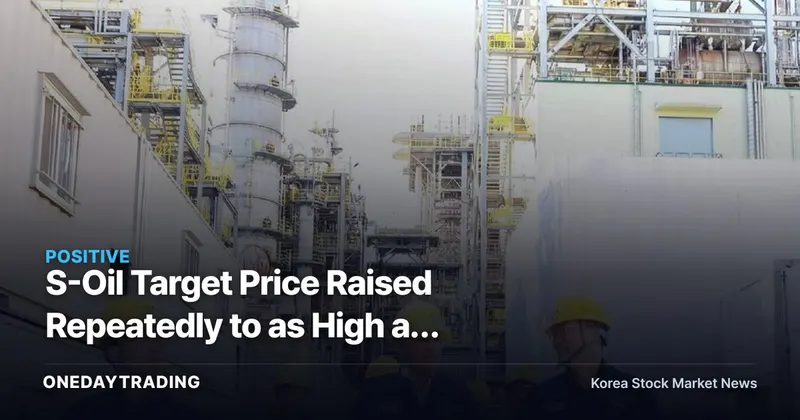

At a Glance
Even as international oil prices decline, brokerages are repeatedly raising their target prices for S-Oil. The rationale isn't refining margins but a forecast for record-high earnings in the base oil (lubricant) segment. Along with expectations of a second-quarter earnings surprise, the stock's high-dividend appeal—expected to continue into next year—is once again coming into focus.
Why It Matters Now
The market habitually lumps refiners together with oil prices and refining margins alone—a simple equation where falling oil prices mean falling refiner stocks. But this time, the basis for the target price hikes isn't refining margins—it's base oil (lubricant feedstock). Base oil is a high-value-added petroleum product used as the raw material for lubricants such as engine oil, and it's more sensitive to Group III base oil spreads and demand from automobiles and industrial machinery than to crude oil itself. This means earnings in this segment can hold up even as international oil prices fall, and that's the backdrop for brokerages' record-high earnings forecasts.
Looking at valuation, the picture becomes clearer. Refiners typically trade at low P/B ratios as an industry sector. Raising target prices to as high as 200,000 won means justifying a premium over the sector's average multiple, with brokerages citing dividend yield and the growing share of base oil profit as the basis. What the market has yet to fully price in is whether this base oil boom is a structural trend that will continue into next year, or merely a temporary spread widening. That distinction will determine whether the target price hikes hold or get reversed.
The opposing scenario also deserves attention. If international oil prices fall further, inventory valuation losses in the refining segment could widen. Precisely when consensus is skewed toward target price increases, it's worth examining the scenario in which improved base oil profits fail to offset inventory losses in the refining business.
FAQ
- Why is the target price rising when oil prices are falling? Because the basis for the target price hikes isn't refining margins but the forecast for record-high earnings in the base oil segment.
- What exactly is base oil? It's a high-value-added petroleum product used as feedstock for lubricants such as engine oil, and it's driven more by Group III base oil spreads and industrial demand than by international oil prices.
- Why is the high-dividend appeal back in focus? With expectations of improved earnings coinciding with forecasts that the dividend payout ratio will be maintained, the stock's dividend yield appeal is expected to continue into next year.
- What should be checked now? Whether the base oil segment's margin and profit contribution are confirmed in actual figures when second-quarter earnings are released.
Related Stocks (Tickers) and Sector Impact
- S-Oil: The direct subject of this target price hike, and a direct beneficiary as both its base oil earnings and dividend appeal come into focus simultaneously.
- SK Innovation: A refiner competing in the base oil and chemicals value chain, worth watching for a similar segment-level re-rating potential.
- GS: A holding company with a refining subsidiary that could be affected by a broader valuation reassessment across the refining industry sector.
- Refining Industry Sector Overall: The likelihood has grown that stock prices will diverge based on individual business-unit earnings structures, moving away from the simple formula that falling oil prices automatically mean weaker earnings.
Investment Considerations
- If international oil prices fall further, inventory valuation losses in the refining segment could widen, meaning improved base oil earnings may not fully offset overall results.
- Base oil margins are driven by Group III base oil spreads and Asian demand, carrying a volatility factor distinct from oil prices themselves.
- Target prices are merely brokerage estimates; actual confirmation will come with the second-quarter earnings release expected between late July and early August.
- The high-dividend appeal presumes the dividend payout ratio is maintained—if earnings volatility increases, the dividend policy itself could change.
Overall Outlook
The optimistic scenario sees the base oil boom continuing into next year, driving a valuation re-rating across the refining industry sector. Conversely, if international oil prices fall sharply again, inventory losses in the refining segment could offset the improvement in base oil earnings, leaving room for the target price hikes to be reversed. The next indicators to watch are the base oil segment margin revealed in the second-quarter earnings release, the trend in Group III base oil spreads, and the price level at which international oil prices find stability again.
S-Oil in Real-Time Data
S-Oil's most recent closing price was 132,100 won (-1.05% versus the previous day), and the signal combining foreign investor/institutional investor order flow with news and momentum shows 🟢 Buy-Leaning. With both foreign investors and institutional investors positive, this stock (ticker) may be worth watching.
- ▲ Double Buying — Foreign investors +10.6 billion won · Institutional investors +1.7 billion won, bought in tandem
※ Price and foreign/institutional order-flow data are provided by Korea Investment & Securities (KIS) and reflect figures as of publication time.
This article is automatically summarized and analyzed content based on the original news source. View Original (Maeil Business Newspaper Securities)