
Kakao and Naver Reveal Cracks Beneath the Market Plunge
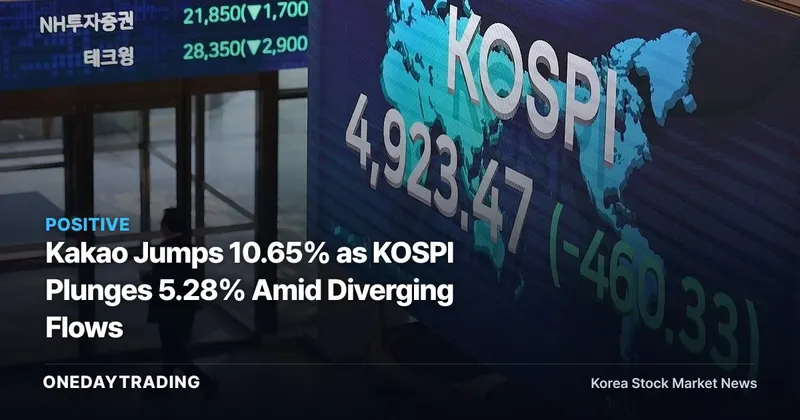
The rebounds in Kakao and Naver do not signal a recovery in the broader KOSPI. Instead, they show that buying capital diverged by industry sector even amid the sharp drop (plunge). According to Maeil Business Newspaper Securities’ report on MaeKyung AX’s analysis of Korea Exchange (KRX) data, 302 of the 805 common stocks on the main market closed higher on Nov. 5, when the KOSPI fell 5.28%.
Sector rotation refers to capital shifting into certain industry sectors against the broader market trend, causing individual stocks to move in different directions. The key investment implication lies less in the index’s decline than in the widening supply-demand (order flow) gap between platforms, biotech and autos on one side and semiconductors on the other.
302 of 805 Stocks Rose, a Market the Index Alone Could Not Show
A total of 302 stocks, or 37.5%, advanced, while 475, or 59.0%, declined and 28, or 3.5%, were unchanged. The fact that gainers coexisted with a 5.28% KOSPI decline shows that this was not a market in which every stock moved in the same direction.
It is important to distinguish what has been confirmed from what has not. Strength in platform, biotech and auto stocks, along with sharp drops (plunges) in some semiconductor and electronics names, has been confirmed. The data do not provide each stock’s exact closing price, market capitalization or subsequent performance. A single day’s move is also insufficient to conclude that the trend has reversed.
Kakao Gains 10.65%, Naver 8.26%, Backed by the Same Buyers
Kakao rose 10.65% and Naver gained 8.26% in the previous session. Naver attracted 71.4 billion won in foreign investor net buying and 54.3 billion won in institutional net buying, while Kakao drew 26.6 billion won and 19.6 billion won, respectively. Both investor groups moving in the same direction supports the relative strength of platform stocks from a supply-demand (order flow) perspective.
Kakao’s third-quarter revenue increased 6.3% year over year to 2.0867 trillion won, while operating profit rose 7.4% to 240.3 billion won. The company filed an amended spin-off plan, setting Jan. 15 next year for the extraordinary shareholders’ meeting to approve the transaction and Feb. 1, 2027, as the effective date. The earnings growth and spin-off timetable are confirmed, but the information provided is insufficient to calculate Kakao’s post-spin-off valuation or the potential share-price impact.
Shinhan Securities analyst Shim Ji-hyun said application software stocks held up relatively well while technology shares broadly weakened. If platform stocks continue to outperform, the first point to monitor is whether joint net buying by foreign investors and institutional investors persists.
Institutional Buying Spreads to Celltrion and SK Biopharmaceuticals
- Celltrion rose 7.50% in the previous session, with trading value reaching 428.0 billion won. Institutional net buying totaled 223.3 billion won, accompanying both the share-price gain and active trading.
- SK Biopharmaceuticals gained 12.27% in the previous session, with institutional net buying of 31.3 billion won.
- Hanmi Pharmaceutical advanced 9.80% in the previous session, with institutional net buying of 47.5 billion won.
The common factor among the biotech stocks was institutional buying. However, because no clinical-trial results, regulatory schedules or company-specific earnings details were provided, the three stocks’ gains should not be attributed to a single business-related cause.
Hyundai Motor, Kia and Hyundai Mobis Defy the Market Plunge
- Hyundai Motor rose 3.53% in the previous session.
- Kia gained 5.22% in the previous session.
- Hyundai Mobis advanced 2.54% in the previous session.
Institutional investors recorded combined net buying of 106.2 billion won in Hyundai Motor, Kia and Hyundai Mobis during the previous session. The three stocks rose together as institutional capital moved in the same direction. Whether that combined buying proves more than a one-off event will be crucial to sustaining their strength.
Net Buying Fails to Shield SK Hynix and Daeduck Electronics
SK Hynix fell 9.46% as foreign investors recorded 1.5345 trillion won in foreign net selling, outweighing 297.0 billion won in institutional net buying during the previous session. The supply-demand (order flow) dynamic was clear: foreign selling, which exceeded institutional buying, weighed on the share price.
During the same period, Daeduck Electronics fell 19.80% as 95.6 billion won in institutional net selling outweighed 44.6 billion won in foreign investor net buying. The case shows that buying by one investor group alone is insufficient to predict a rebound. Mirae Asset Securities analyst Seo Sang-young pointed to the possibility of delays in regulatory approvals and capital deployment for new projects.
Indicators to Watch for the Next Divide Between Strength and Weakness
The bullish scenario is for the buying seen in platforms, biotech and autos to continue while foreign selling of SK Hynix eases. Bearish triggers would include continued semiconductor selling and widening delays in actual AI investment deployment. The former would support the durability of stock-specific rotation, while the latter would increase the burden on the index and technology shares.
- Monitor whether joint net buying by foreign investors and institutional investors continues in Kakao and Naver.
- Track any disclosed changes through Kakao’s extraordinary shareholders’ meeting on Jan. 15 next year and the spin-off date of Feb. 1, 2027.
- Check whether foreign net selling of SK Hynix subsides and whether its supply-demand (order flow) gap with institutional buying narrows.
- No actual change in AI investment deployment has been confirmed. Delays in approvals and spending for new projects will be decisive in assessing a semiconductor rebound.
Kakao Key MetricsAs of 2026-11-06
| Period Returns | 1 Week +11.21% 1 Month -0.91% |
|---|---|
| Trading Value · Trading Volume | 8.3 billion won · 2,596,854 shares |
| Supply-Demand (Order Flow) | Foreign Investors 3.1 billion won net buying (3 consecutive days) Institutional Investors 1.2 billion won net buying |
| Recent News Tone | Positive Catalysts 0 · Negative Catalysts 1 |
Real-time price and supply-demand (order flow) data are sourced from Korea Investment & Securities (KIS), while supply-demand (order flow) and news-tone tallies are calculated independently by One Day Trading.
Supply-Demand and Momentum Assessment🟢 Buying Advantage
Foreign investor, institutional investor and momentum indicators are showing positive signals.
- ▲Supply-Demand ContinuityForeign net buying for 3 consecutive days (+3.1 billion won)
- ▲Joint BuyingForeign investors +3.1 billion won · Institutional investors +1.2 billion won
- ▼52-Week PositionNear the bottom of its 52-week range (12% position)
Upcoming Dates to Watch
- 11.12Index Options ExpirationLowKOSPI 200 options expiration
- 11.26Bank of Korea Monetary Policy BoardHighBenchmark interest rate decision meeting
- 12.09FOMC Policy Rate DecisionHighU.S. Federal Reserve monetary policy announcement — direction of rates and the dollar
- 12.10Futures and Options ExpirationMediumQuadruple witching — watch for volatility and supply-demand (order flow) disruptions
This article was automatically summarized and analyzed from the original news report. View Original Article (Maeil Business Newspaper Securities)