
3-Line Briefing
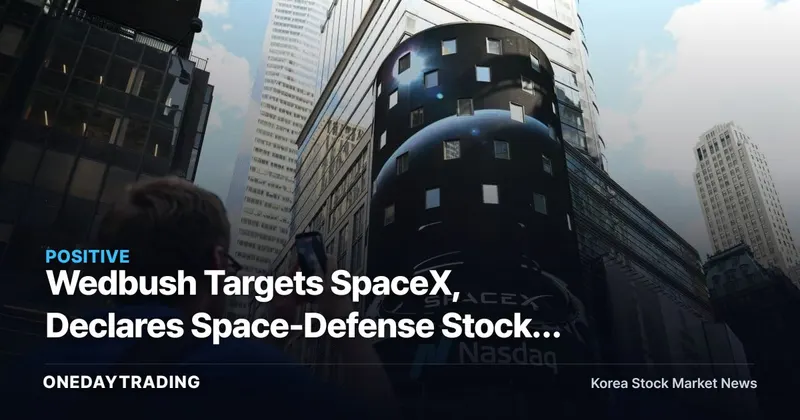
- Wedbush initiated new coverage on the space and defense sector, including SpaceX, delivering a strongly optimistic call that this is a once-in-a-generation buying opportunity.
- The comment is a valuation re-rating call rather than one backed by concrete order-backlog or utilization-rate figures, so there will be a lag before it's confirmed by actual volume data.
- Since privately held SpaceX cannot be directly invested in, listed defense stocks (tickers) such as Hanwha Aerospace and Korea Aerospace Industries are being cited as the realistic alternative plays on this theme for Korean investors.
What's Changing
When an analyst initiating coverage uses the phrase "once in a generation," it's typically rhetoric meant to convey conviction that the cycle has already bottomed. The problem is that this comment wasn't accompanied by physical evidence — such as a specific company's order announcements or a rise in launch cadence. The space-defense industry follows a classic lagged structure: order backlogs build first, then production utilization rises, and margins improve last of all. The optimism voiced now hasn't yet been proven by numbers at any of these three stages — in other words, it amounts to front-of-cycle expectation.
That said, the underlying direction isn't unfamiliar. The trend of growing order books at launch-vehicle and satellite makers, driven by rising commercial launch demand and the accelerating rollout of low-earth-orbit satellite communication networks, has already been confirmed over several quarters. Layered on top of that is a policy backdrop in which defense budgets in the U.S. and other major countries are increasingly allocating funds to space-based defense and reconnaissance assets. Wedbush's latest comment is closer to putting an exclamation point — a re-rating — on this already-accumulating trend.
Numbers and Context
Because SpaceX is privately held, the stocks (tickers) that would actually see an immediate buy signal from this coverage initiation are elsewhere. On the U.S. market, pure-play space stocks (tickers) vertically integrated from launch vehicles to satellites, like Rocket Lab, along with large-cap defense names such as Lockheed Martin, Northrop Grumman, and L3Harris, are being cited as direct beneficiary candidates of this narrative. Turning to Korea, Hanwha Aerospace, Korea Aerospace Industries (KAI), and LIG Nex1 span the space-launch-vehicle, satellite, and reconnaissance-asset value chain and get grouped under the same theme. It should be made clear, however, that these are not among the names Wedbush actually covers. Korean defense stock (ticker) prices will ultimately be validated by their own order backlogs and confirmed government budget figures — there's no reason they should move in lockstep with a U.S. analyst's tone.
Winners and Losers
- Hanwha Aerospace — With both launch-vehicle/engine operations and a satellite division, it's grouped as Korea's sector bellwether for the space-defense theme, though the stock's actual direction will be driven by its own order-backlog growth rate.
- Korea Aerospace Industries (KAI) — A beneficiary candidate as its aircraft-system manufacturing capability extends into localizing space-launch-vehicle components, though its aircraft order cycle and space-business contribution still need to be assessed separately.
- LIG Nex1 — Linked to demand for defense electronics tied to reconnaissance and communication satellites, but ground-based defense systems still account for the bulk of its revenue, so its sensitivity to the space theme is relatively low.
- Rocket Lab (RKLB) and other U.S. pure-play space stocks (tickers) — Direct targets of Wedbush's coverage, where the real test for any stock re-rating will be whether launch cadence and order backlogs actually increase.
- Lockheed Martin, Northrop Grumman, and other large-cap defense names — The ultimate beneficiaries of expanding space-asset defense budgets, but with much of that already priced into their valuations, further upside hinges on the scale of new orders.
Risk Check
- This comment is an individual analyst's view issued without order or utilization-rate data, and there will be a lag of at least one to two quarters before it's confirmed by actual earnings.
- Since SpaceX is private, this optimism cannot be translated into a direct purchase, and the listed space-defense stocks (tickers) that serve as alternatives have already built up valuation pressure from a recent rally.
- Because the U.S. defense budget must clear congressional approval every year, the risk of political negotiation delays or cuts is ever-present.
- Korean defense stocks (tickers) have a different business structure from U.S. space stocks (tickers), so even if grouped under the same theme, their price correlation may not last long.
Bottom Line
Wedbush's optimism can be read as a signal that the theme still has life left in it, in that it reaffirms the consensus view that the space-defense industry has entered its next growth phase. However, since the comment itself doesn't prove any improvement in order backlogs or utilization rates, Korean investors would be wise to check the next order announcements from Hanwha Aerospace and Korea Aerospace Industries, along with the timeline for confirming the U.S. defense budget, before deciding whether to add this theme to their portfolios.
Hanwha Aerospace: A Real-Time Data Snapshot
Hanwha Aerospace's most recent closing price was 1,091,000 won (0.00% versus the previous day), and its composite signal — combining foreign and institutional investor order flow with news and momentum — reads 🟡 Neutral / Wait-and-see. With positive and negative signals mixed, this is a stock (ticker) to watch closely.
- ▼ Trend Alignment — Short- and medium-term downward alignment (today +0.0% · 1 week -0.3% · 1 month -4.1%)
Recent related news skews favorable, with 2 positive catalysts and 0 negative catalysts.
※ Price and foreign/institutional investor order-flow data are provided by Korea Investment & Securities (KIS) and reflect figures as of publication time.
This article is automatically summarized and analyzed content based on the original news report. Read Original (MarketWatch)