
Key Summary
The government's expansion of information security clusters into the regions reads as more than a one-off administrative announcement — it is a medium- to long-term policy signal aimed at growing the demand base and talent pool of the cybersecurity industry. As the security ecosystem, long concentrated in the greater Seoul area, disperses to other regions, security orders from the public and manufacturing sectors are likely to increase, which could gradually broaden the revenue base of listed security companies.
That said, cluster development centers on infrastructure and workforce training, so it is not a structure that feeds directly into earnings; its effects unfold over several years, and this distinction needs to be kept in mind.
What Happened
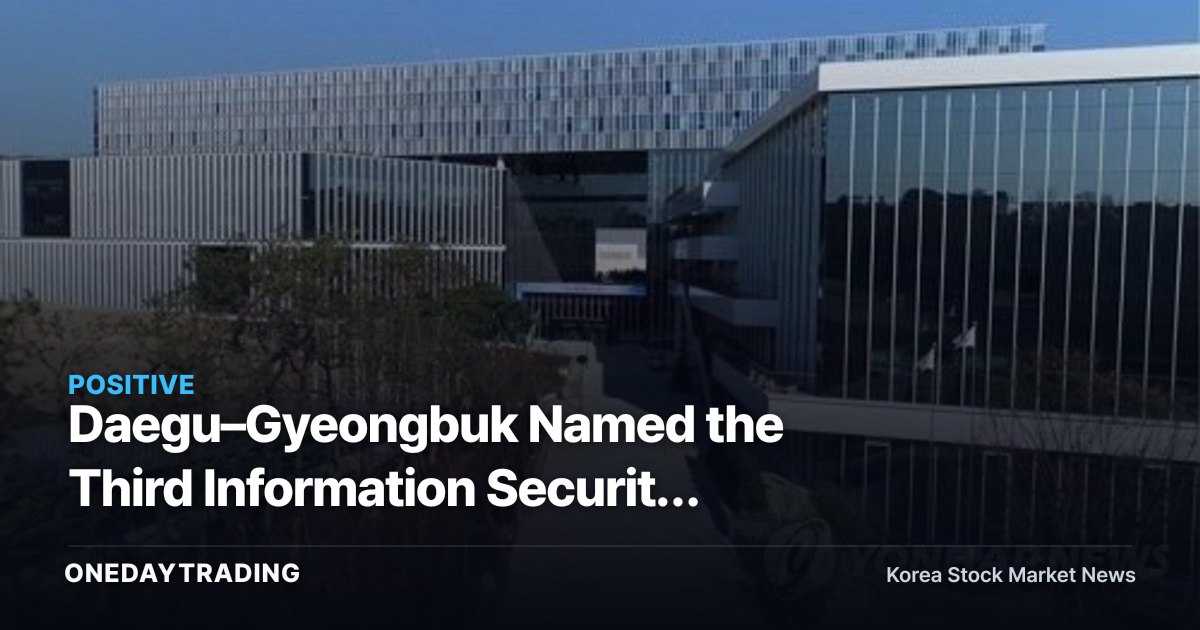
The Ministry of Science and ICT has selected the Daegu–Gyeongbuk region as its third regional information security cluster. Moving away from the existing Seoul-area-centric security hub structure, the move adds a regional base that ties together security companies, talent, and proof-of-concept environments at the local level.
A cluster typically provides a package that includes tenant space for security companies, workforce training programs, technology proof-of-concept and testbeds, and security consulting for local firms. Because Daegu–Gyeongbuk is a region with a high concentration of manufacturing, it has room to connect with demand for smart-factory and industrial control system security — interpreted as one pillar behind the selection.
Background and Context
Korea's information security industry has long had its talent and companies concentrated in the greater Seoul area, including Seoul and Pangyo, leaving regional firms and institutions struggling to build security capabilities. At the same time, as the threats from ransomware, supply chain attacks, and industrial facility breaches grow, the need for security investment in the manufacturing and public sectors is structurally expanding. The expansion of regional clusters aligns with the policy intent of drawing this demand out into the regions.
Impact on the Market and Stocks
- AhnLab: With a comprehensive security lineup spanning endpoints and managed monitoring, it is a direct candidate to benefit from a broader business base as regional public and manufacturing security demand rises. That said, this is more about medium- to long-term market expansion than near-term order wins.
- WINS: With strengths in network security and intrusion prevention equipment, it has relevance on the equipment demand side as the build-out of security infrastructure for regional institutions and industrial networks expands.
- Genians: Centered on network access control (NAC), it could dovetail with demand for endpoint control at dispersed regional worksites.
- Raonsecure / Fasoo: In the authentication and data security space, there is room for order opportunities to open up amid the public-sector digital transformation and the trend toward mandatory security.
- IGLOO Corporation: As a security monitoring (SIEM/SOC) operator, it could connect with demand for operational services as regional monitoring hubs expand.
Investor Checkpoints
- Check the cluster's budget size, execution schedule, and the timing of public calls for tenant and proof-of-concept projects. Policy effects hinge on the pace of budget execution.
- In security companies' earnings releases, examine the share of revenue from the public and manufacturing segments and any commentary on new orders.
- Monitor security order disclosures from regional public institutions and local governments, as well as procurement bidding trends.
- Track the schedule of follow-up policy announcements, including changes in the government's budget for fostering the information security industry.
Outlook
On the optimistic side, the spread of clusters could simultaneously grow regional security demand and talent supply, broadening the foundation for top-line growth at listed security companies. Given Daegu–Gyeongbuk's character as a manufacturing hub, there is also a chance that a relatively new source of demand — industrial control and smart-factory security — opens up.
Conversely, it is hard to argue that this announcement alone will improve individual companies' earnings in the near term. Because clusters center on infrastructure and training, there is a long lag before revenue becomes visible, and the security sector itself is a competitive landscape of many small and mid-sized players, so the policy benefit may not concentrate in any particular stock. If expectations run ahead and valuations move first, the actual intensity of policy execution could become a swing factor.
This article is auto-summarized and analyzed content based on the original news report. View original (Yonhap News, Industry)