
At a Glance
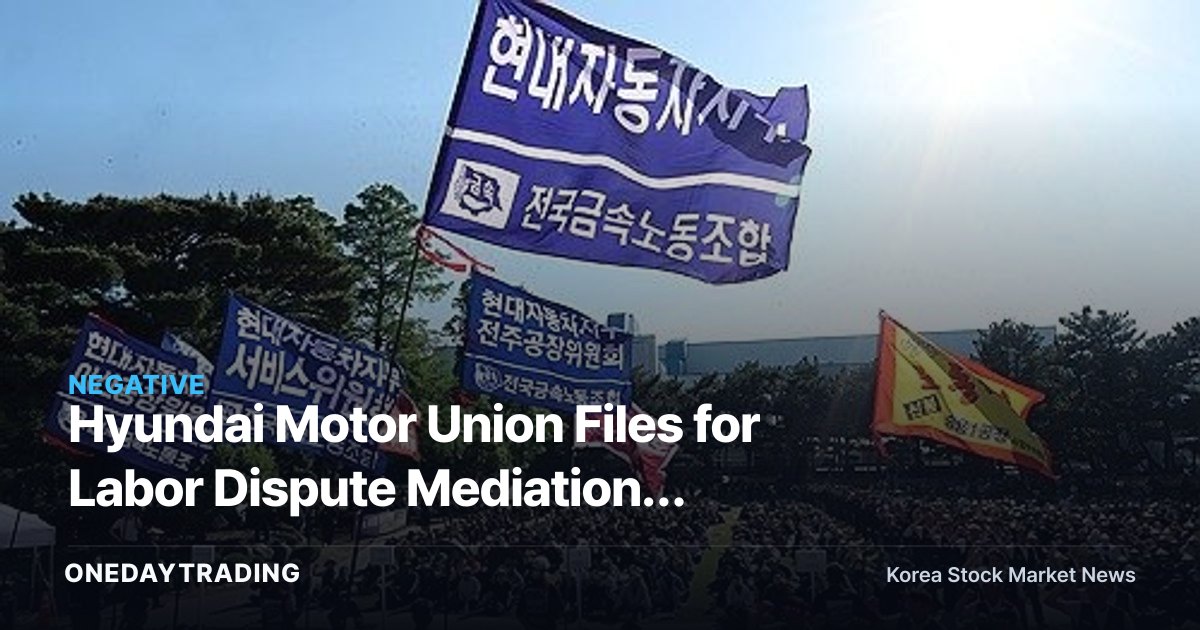
The Hyundai Motor branch of the Korean Metal Workers' Union, Hyundai Motor's labor union, has filed for labor dispute mediation with the National Labor Relations Commission, citing a deadlock in this year's wage negotiations. The union plans to hold a strike vote among all members on the 24th, and if it passes, the union will secure the right to a legal strike. While labor-management conflict during wage and collective bargaining recurs every year, the market is paying attention because a realized strike could lead to production disruptions and short-term earnings pressure.
Why It Matters Now
Filing for labor dispute mediation is the legal procedure that follows when labor-management negotiations fail to be settled voluntarily. If no agreement is reached during the Commission's mediation period, a decision to suspend mediation is issued, and if the strike vote passes, the union gains the right to legally launch a strike. In other words, the vote on the 24th is less a turning point that determines whether a strike actually happens, and more a pressure card aimed at strengthening the union's bargaining position.
Hyundai Motor is a core pillar of domestic finished-vehicle production and sits at the center of an industrial ecosystem encompassing numerous tier-1 and tier-2 suppliers. As a result, a strike at the parent company's union affects the operating rates across the entire upstream and downstream industry — including parts, logistics, and steel — beyond Hyundai Motor as a single company. At a time of intense global auto demand and fierce competition in the transition to electric vehicles, a production halt could weigh on the company in terms of delivery delays and defending market share.
That said, past cases show that labor and management have ultimately settled their wage and collective bargaining agreements even after going through mediation procedures and partial strikes, so the market places more importance on the actual intensity and duration of a strike — and on the size of the labor-cost increase from the final agreement — than on the negotiation process itself.
Frequently Asked Questions
- Does filing for labor dispute mediation mean a strike is imminent? No. Filing for mediation is the legal procedure that follows a breakdown in negotiations; a legal strike is only possible after the strike vote passes and a decision to suspend mediation is issued.
- If the vote on the 24th passes, will operations stop immediately? It is merely the stage of securing the right to industrial action; the actual timing and form of any strike depend on the tactical judgment of the union leadership.
- How does it affect the stock? Strike concerns weigh on short-term investor sentiment, but in many cases the stock rebounds as uncertainty is resolved once a swift settlement is reached.
- Is this a recurring issue every year? Similar procedures appear during every wage and collective bargaining season, and the market tends to price in a more limited shock than in the past due to the learning effect.
Impact on Related Stocks and Sectors
- Hyundai Motor: As a party to the wage negotiations, it is the core stock (ticker) most directly affected by production disruptions and labor-cost pressure if a strike materializes.
- Kia: As a finished-vehicle affiliate within the same group, the outcome of its wage and collective bargaining is compared and spreads in a chain reaction, and it is affected by labor-cost guidelines.
- Hyundai Mobis: As a core parts supplier, its revenue flow is directly tied to changes in the parent company's operating rate.
- Hyundai Wia and Hyundai Glovis: Responsible for parts machining and finished-vehicle logistics, their operating rates and transport volumes are affected when production schedules are disrupted.
- The finished-vehicle and auto parts sectors overall: The impact ripples across the entire industrial ecosystem through suppliers' earnings and operating rates.
Points to Watch When Investing
- The mediation filing and the strike vote are procedural steps, so investors should avoid making excessive assumptions before the actual intensity and duration of a strike are confirmed.
- Investors should also review how the future labor-cost increase, depending on the size of the agreed wage hike, affects medium- to long-term profitability.
- It is important to consider that variables beyond the labor-management issue — such as the exchange rate, global demand, and competition in the EV transition — move the stock simultaneously.
- While it is useful to reference the settlement patterns and stock reactions from past wage and collective bargaining cases, it is risky to assume the same pattern repeats every time.
Overall Outlook
The optimistic scenario is one in which labor and management use the mediation procedure as a means of securing bargaining leverage and then settle their wage and collective bargaining agreement at a relatively early point. In that case, the stock could find stability as uncertainty is resolved and accumulated concerns clear. Conversely, if partial strikes drag on or the agreed labor-cost hike far exceeds market expectations, short-term production disruptions and profitability concerns would come to the fore at the same time, potentially weighing on the finished-vehicle and auto parts sectors as a whole. Ultimately, the key is the actual intensity of the strike and the time it takes to reach a settlement, and investors need to closely track the progress of mediation and the terms of any agreement.
This article is content automatically summarized and analyzed based on the original news report. View original (Yonhap News Industry)