
At a Glance
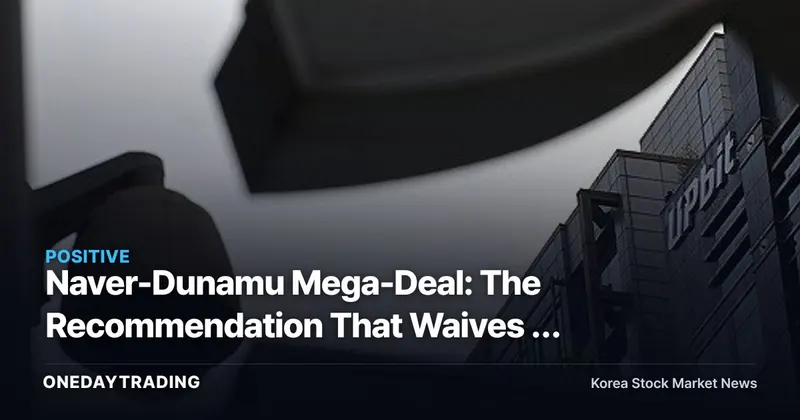
If Naver shares rise, it won't be because of virtual asset prices — it will be because of a shrinking regulatory discount. On July 24, the Regulatory Reform Committee issued a recommendation to improve the major-shareholder eligibility standards for virtual asset business operators under the enforcement decree of the Special Financial Transactions Act, easing one legal risk that had been blocking Naver Financial's consolidation of Dunamu.
From Jung Han-gyeol's perspective, the core point is simple: it isn't that Upbit's trading value narrative attaches directly to Naver's stock price — rather, the present value of platform optionality spanning payments, authentication, digital wallets, and stablecoins is being recalculated.
Why It Matters Now
The issue at stake is eligibility to become the major shareholder of a crypto exchange. The proposed revision to the Special Financial Transactions Act's enforcement decree would add violations of economy-related laws — the Fair Trade Act, the Punishment of Tax Offenses Act, and the Act on the Aggravated Punishment of Specific Economic Crimes — as grounds for rejecting a virtual asset business operator's registration. As originally drafted, there was little mechanism to weigh whether a violation was minor or whether the penalty imposed on the corporation was a fine under joint-liability provisions.
The Regulatory Reform Committee recommended revising this to match standards under the Capital Markets Act. Under the Capital Markets Act and the Act on Corporate Governance of Financial Companies, even where economy-related law violations exist, exceptions to disqualification are recognized for minor matters or cases involving corporate fines under certain conditions. Applying a broader, blunter standard solely to virtual asset business operators risked functioning less as exchange soundness screening and more as a barrier to industry restructuring.
This decision matters concretely for Naver. Naver is preparing to fully consolidate Dunamu as a subsidiary through its affiliate Naver Financial via merger. However, Naver received a first-instance fine last September on charges of violating the Fair Trade Act, and the appeal is ongoing. Without the exception, if the fine were upheld by the Supreme Court down the road, a dispute over Naver Financial's major-shareholder eligibility could have jeopardized deal closing.
Still, it would be premature to conclude that regulatory risk has disappeared. Delays in the Fair Trade Commission's business combination review have already pushed the deal-closing timeline from June 30 to December 31. Another remaining variable is that the government's planned Digital Asset Basic Act, targeted for enactment this year, is reportedly considering capping an exchange's major shareholder's stake at around 20%. This recommendation has opened one door — it hasn't lit up the whole corridor.
Frequently Asked Questions
- Does this recommendation approve the Naver-Dunamu merger? No. It is a recommendation to ease major-shareholder eligibility standards under the Special Financial Transactions Act's enforcement decree. The Fair Trade Commission's business combination review and other licensing procedures remain separate and outstanding.
- Why is this linked to Naver's stock price? If the Dunamu consolidation goes through, Naver Financial could add a crypto exchange, digital wallet, and stablecoin business option onto its payments and financial platform. The market is pricing in reduced regulatory uncertainty first, ahead of whether this option actually succeeds.
- Can investors buy Dunamu directly? Dunamu is unlisted. Naver is the entity whose direct market reaction can be observed on the listed market, with fintech and platform operators potentially moving as a comparison group.
- Is this a positive catalyst for the entire virtual asset industry? It's a positive catalyst in the sense that entry barriers are lowering for large platforms. Conversely, it increases pressure on smaller exchanges, which now must compete against operators with greater capital strength and customer bases.
Related Stocks and Sector Impact
- Naver is the direct party pursuing full 100% consolidation of Dunamu through Naver Financial. If the regulatory exception is reflected in the enforcement decree, the major-shareholder eligibility burden that had raised the probability of the merger falling through is eased.
- Kakao Pay serves as a comparison from a payments and financial platform standpoint. If Naver Financial expands into crypto wallets and stablecoins, it could shift the valuation benchmark for domestic fintech.
- Kakao has touchpoints across platform, finance, and digital assets and is indirectly affected by the regulatory direction, though the direct benefit from this particular issue is smaller than for Naver.
- Virtual asset exchange sector could see greater potential for industry restructuring if major-shareholder screening standards incorporate exceptions on par with the Capital Markets Act. This isn't a lowering of the regulatory bar so much as a more refined set of criteria for judging it.
Investment Considerations
- The final wording of the enforcement decree needs to be confirmed. The first checkpoint is how broadly the Regulatory Reform Committee's recommendation is actually reflected as an exception provision.
- The outcome of the Fair Trade Commission's business combination review could be a bigger price variable. The deal-closing timeline has already been pushed back to December 31.
- Watch discussions on the Digital Asset Basic Act's major-shareholder stake limit. If a roughly 20% cap is institutionalized, it could conflict with the plan for full-subsidiary consolidation.
- Estimating Naver's earnings based solely on Upbit's trading value and coin prices carries a wide margin of error. Actual profit contribution will only become clear once the fee structure for the payments, wallet, and stablecoin business models is finalized.
Overall Outlook
The optimistic scenario is clear: if the exception provision is included in the Special Financial Transactions Act's enforcement decree, set to take effect in August, and the Fair Trade Commission's review concludes within the year, Naver secures a path to bring Korea's largest virtual asset exchange into its fintech platform. In that case, the market may begin to re-rate Naver not just as an advertising and commerce platform but as a digital asset infrastructure operator.
The bearish scenario has two triggers. One is if the Fair Trade Commission takes a strong view that the combination of data, payments, and exchange businesses is anti-competitive. The other is if the Digital Asset Basic Act firmly locks in a major-shareholder stake limit. The next indicators to watch for Naver's stock price are not coin prices, but the final version of the enforcement decree, the business combination review timeline, and this year's draft of the Digital Asset Basic Act.
Naver in Real-Time Data
Naver's most recent closing price was 207,500 won (-5.68% versus the previous session), and the signal combining foreign investor and institutional investor supply-demand (order flow) with news and momentum reads 🟡 neutral / wait-and-see. Positive and negative signals are mixed, making this a segment to watch closely.
Recent related news shows 2 positive-catalyst items versus 0 negative-catalyst items, a favorable balance.
※ Price and foreign/institutional investor supply-demand (order flow) data are provided by Korea Investment & Securities (KIS) and reflect the time of publication.
This article is auto-summarized and analyzed content based on the original news report. View Original (Yonhap News Agency, Markets)