
Key Summary
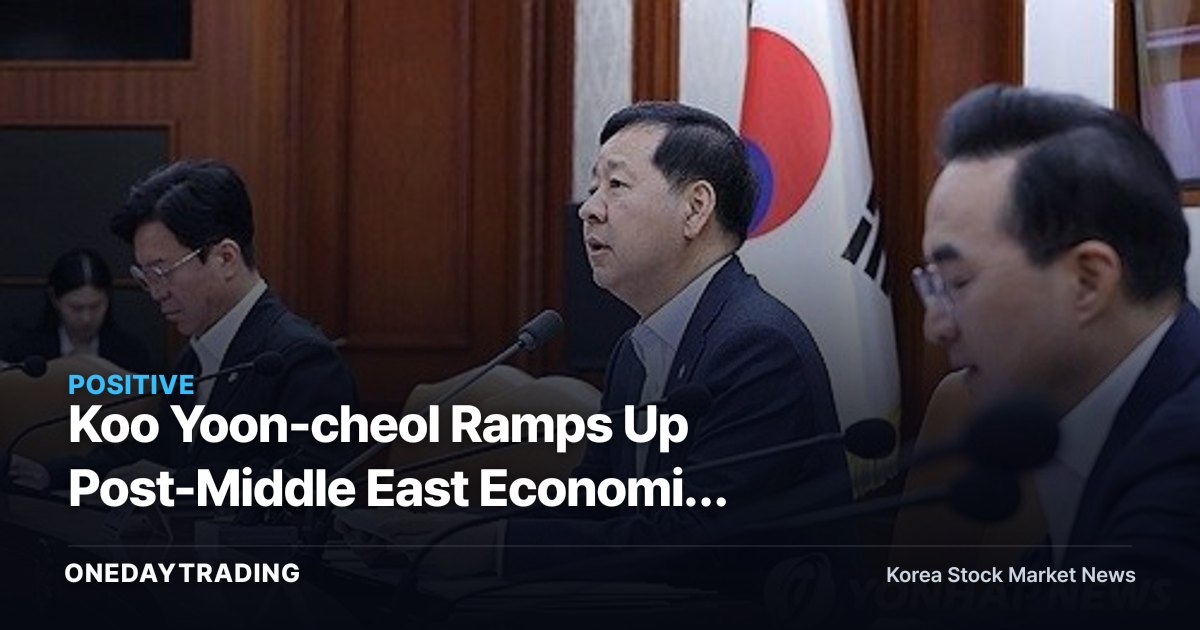
Deputy Prime Minister and Minister of Finance and Economy Koo Yoon-cheol characterized the postwar MOU as both an opportunity and a challenge, and said the government will fully roll out a whole-of-government post-Middle East external economic policy. The policy is focused on translating post-conflict reconstruction demand and infrastructure orders into contract wins for Korean companies. From an investor's standpoint, the key is not the declaration itself but how quickly the actual order pipeline and the government's financial and diplomatic support take concrete shape.
What Happened
Deputy PM Koo assessed that the MOUs signed in the postwar phase open up new business opportunities while also leaving challenges that the Korean economy must address. Accordingly, the plan is to activate an integrated response system in which the industry, foreign affairs, and finance ministries move together under the lead of the Ministry of Finance and Economy, in order to get ahead of changes in the post-Middle East economic environment.
The core message is to turn the reconstruction and infrastructure investment phase in regions where conflict has subsided into order-winning opportunities for Korean firms. Industries that have traditionally been heavily dependent on the Middle East — construction, plant, defense, and energy — are likely to be the primary targets of policy support.
Background and Context
The Middle East has long been the largest market for Korea's overseas construction orders, and in post-conflict reconstruction phases there is a tendency for infrastructure orders — housing, roads, power, and desalination — to flood in all at once. That said, an MOU is a letter-of-intent stage agreement with weak legal binding force, so a lesson from past cycles is that it takes time to progress to a definitive contract and order, and a fair number of such deals fall through along the way.
Impact on the Market and Stocks
- Overseas construction: Hyundai E&C, Samsung C&T, Daewoo E&C, and GS E&C have a high proportion of Middle East revenue, so an expansion of reconstruction orders could deliver direct benefits in the form of order-backlog recovery. However, the risk of margin erosion remains ever-present if low-priced bidding recurs.
- Defense: Hanwha Aerospace, LIG Nex1, and Korea Aerospace Industries are expected to see additional export momentum in tandem with Middle Eastern countries' demand for weapons modernization.
- Plant and energy: EPC firms such as Samsung Engineering would see improved upstream demand if orders for refining, petrochemical, and desalination plants recover.
- Nuclear and power: Doosan Enerbility has a path to benefit amid expanding Middle Eastern power infrastructure and nuclear power demand.
Investor Checkpoints
- Check whether the government's follow-up announcements specifically spell out the scale of financial support and the package-order target projects.
- Track how fast the MOUs convert into actual contracts through the quarterly earnings releases and new-order disclosures of construction and defense companies.
- Monitor international oil prices (WTI and Brent) as well, since they are a leading indicator of oil-producing nations' capacity to place orders.
- Examine how local political stability and exchange rate fluctuations affect profitability.
Outlook
If policy support and reconstruction orders progress into definitive contracts, the order cycle for the long-depressed overseas construction and plant sectors could recover, and defense exports could also gain momentum. Conversely, if things stall at the MOU stage or orders are delayed, stocks that have already priced in expectations could be exposed to valuation pressure. Ultimately, the variable that will determine the direction of share prices is not the policy declaration but whether actual contracts are signed and whether order wins come with margins attached.
Hyundai E&C Through Real-Time Data
Hyundai E&C's latest closing price is 133,400 won (+0.15% versus the previous day), and its signal light — which combines foreign and institutional investor order flow with news and momentum — reads 🟡 Neutral / Wait-and-See. With positive and negative signals mixed, it is a zone to watch.
- ▲ News flow — 5 positive catalysts vs 0 negative catalysts — positive bias
Recent related news is favorable, with 5 positive catalysts and 0 negative catalysts.
※ Price and foreign/institutional investor order-flow data are provided by Korea Investment & Securities (KIS), as of the time of publication.
This article is content automatically summarized and analyzed based on the original news report. View original (Yonhap News Securities)