
Three-Line Briefing
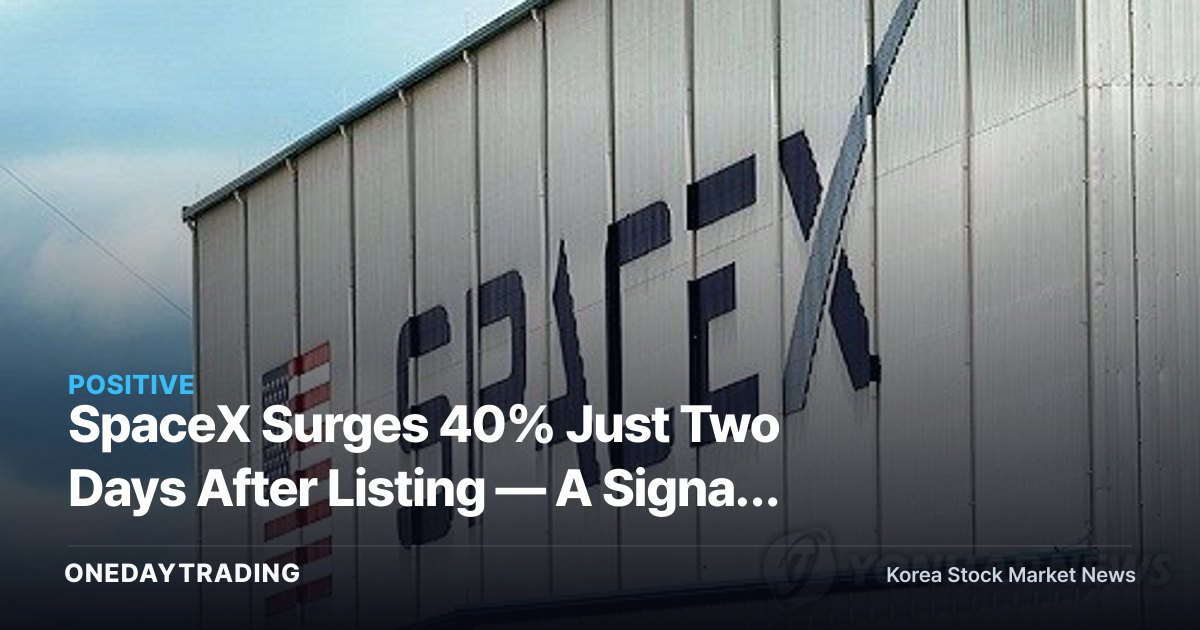
- Shares of U.S. aerospace and AI company SpaceX rose again on the 15th, its second day of trading, surging roughly 40% over the two-day span.
- The key point is that a space company once valued only through private transactions while unlisted now has a public-market valuation benchmark.
- With investor sentiment spreading across the entire satellite-communications and launch-vehicle value chain epitomized by Starlink, the possibility of Korean aerospace stocks moving in tandem is coming into focus.
What Changes
For Korean investors, the significance of this development lies not in a positive catalyst for any single stock but in the fact that a new valuation benchmark has emerged for the entire space economy sector. Until now, space businesses were often in a pre-revenue stage, making it difficult to apply traditional earnings-based valuation, and the theme as a whole had been discounted accordingly. When a flagship company is strongly valued in the public market, pressure builds for a multiple re-rating of Korean listed companies operating similar or comparable businesses as well.
The mechanism worth particular attention is the structure of the cash-generating engine. The satellite internet business generates recurring revenue from a subscriber base, which provides more stable earnings visibility than one-off launch orders. If the market awards a high score to this revenue model, companies that supply low-earth-orbit satellite-communications equipment, terminals, and ground stations stand in a relatively more direct path to benefit than companies that build launch vehicles.
That said, it must be clearly distinguished that most Korean companies are not direct partners of SpaceX but rather a peer group belonging to the same industry theme. In other words, the linkage is one of sentiment and valuation, not earnings.
By the Numbers and Context
The key figure is simple. A second-day surge following the listing-day gain has created short-term momentum of roughly 40% over two days. It is reasonable to view a surge of this magnitude as the combined result of order-flow concentration in the early days of a new listing and a scarcity premium, rather than a fundamental re-rating. Accordingly, rather than mechanically applying the same magnitude of tandem gains to Korean stocks, it is more realistic to expect a sorting of winners and losers to unfold during a phase of heightened interest in the theme.
Beneficiaries and Losers
- Hanwha Aerospace: As the center of Korea's space value chain, spanning launch vehicles such as Nuri and satellite systems, it is highly likely to play the role of sector bellwether in any re-rating of the space theme.
- Intellian Technologies: As a supplier of antennas for low-earth-orbit satellite communications, it stands in a direct path to benefit from the narrative of expanding satellite internet demand.
- Satrec Initiative: With businesses in satellite bodies and ground stations, it has relatively higher earnings linkage when demand for satellite manufacturing and operation rises.
- Korea Aerospace Industries (KAI): Through satellite manufacturing and its next-generation mid-size satellite business, it serves as a policy-beneficiary channel for the expansion of the government's space development budget.
- AP Satellite: Handling satellite-communications terminals and components, it could be cited as a volatile follow-on tandem stock during a phase of theme diffusion.
Risk Check
- Because the short-term 40% surge owes much to new-listing order-flow effects, there is a risk of pullback driven by heightened volatility and profit-taking supply.
- Since many Korean stocks are linked to the theme by sentiment rather than direct revenue, valuation burdens could quickly come to the fore once momentum cools.
- Space businesses persistently carry launch-schedule delays, technology risks, and the burden of large-scale capital investment, creating significant uncertainty about the timing of profit realization.
- The intensity of the policy benefit could vary depending on macro variables such as the exchange rate and interest rates, as well as the pace of government space-budget execution.
Bottom Line
The successful debut of a flagship space company is a positive catalyst that strengthens the case for re-rating Korean aerospace and satellite stocks, but because this is a phase driven by sentiment rather than earnings, it is a period to approach while also monitoring next quarter's satellite-order disclosures, the government's space-budget schedule, and whether order flow stabilizes after the short-term surge.
Hanwha Aerospace Through Real-Time Data
Hanwha Aerospace's latest closing price is 1,134,000 won (+4.61% from the previous day), and its signal light — combining foreign and institutional investor order flow with news and momentum — is 🟢 Buy Bias. News and momentum are positive, making it worth keeping an eye on.
- ▲ News Flow — 15 positive vs 4 negative — positive bias
Recent related news stands at 15 positive items and 4 negative items, a favorable balance.
※ Price and foreign/institutional investor order-flow data are provided by Korea Investment & Securities (KIS) and are as of the time of publication.
This article is auto-summarized and analyzed content based on the original news. View Original (Yonhap News Securities)