
3-Line Briefing
- With capital pouring into massive private growth bets like SpaceX, there is fresh evidence that investor risk appetite remains strong.
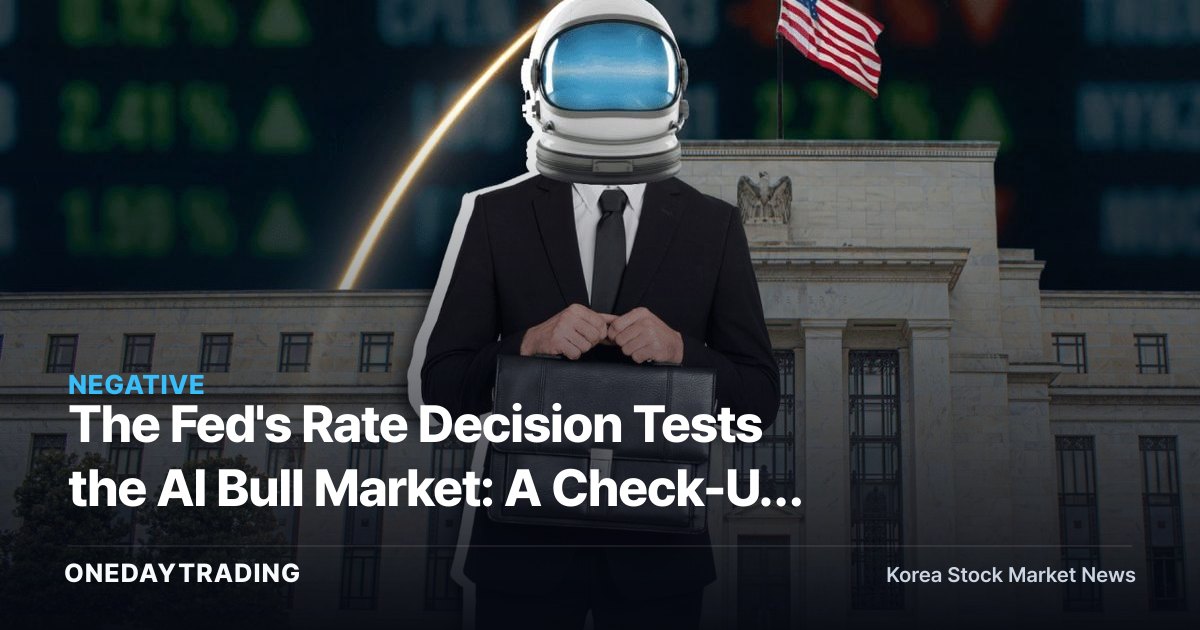
- This week's Federal Reserve (Fed) monetary policy meeting is seen as a watershed that will test the staying power of a bull market leaning on the AI growth story.
- The longer rates stay elevated, the harder it becomes to justify the valuations of AI and growth stocks that depend on profits far in the future.
What's Changing
The continued inflow of capital into so-called moonshot investments, epitomized by SpaceX, shows that investors are still willing to pay a high price for long-term growth potential over near-term returns. This risk-on sentiment has been the key force underpinning the U.S. equity bull market centered on AI-related names.
The problem is that the value of these growth bets is highly sensitive to the interest-rate environment. Because a large share of growth stocks' earnings lies far in the future, their present value shrinks quickly as rates—which act as the discount rate—rise. If the Fed this week delays the timing of rate cuts or signals a "higher for longer" stance, it will become even harder to justify lofty valuations on the AI growth story alone.
Conversely, if the Fed sends a dovish signal, risk appetite would strengthen further and the growth-stock rally could be extended. In other words, this meeting is close to a two-way fork that will determine whether the bull market continues.
By the Numbers and Context
The key lies not in the absolute level of rates but in expectations for the future path. Because the market has already priced in a certain amount of cuts, high-valuation growth stocks are structured to take the first hit if the dot plot and the chair's remarks are read as more hawkish than current expectations. The AI investment cycle is accompanied by enormous capital expenditure, and if funding costs stay elevated, the market's patience over payback periods will also be tested.
Stocks to Benefit / Be Hurt
- SK Hynix, Samsung Electronics: Direct beneficiaries of AI memory demand, but grouped under the high-valuation growth theme, they react sensitively to the rate path.
- Naver, Kakao: As internet growth stocks heavily reliant on future earnings, their valuation burden grows when the discount rate rises.
- Semiconductor Equipment / Materials-Parts-Equipment Sector: A core beneficiary of the AI capex cycle, but rising funding costs pose a risk of slowing the pace of investment.
- Secondary Battery / Bio Growth Stocks: Industry sectors leaning on long-term growth narratives, prone to relative weakness in a high-rate environment.
Risk Check
- Potential for heightened volatility in high-valuation growth stocks if the Fed sends hawkish signals.
- A broad correction across the related value chain if concerns over delayed AI capex payback come to the fore.
- Swings in foreign investors' supply-demand (order flow) tied to the correlation between the won-dollar exchange rate and U.S. interest rates.
- An overhang of profit-taking supply when bullish expectations have been excessively priced in.
One-Line Conclusion
Risk appetite is still alive, but this week's Fed decision is the proving ground for the AI bull market's stamina. With a two-way scenario—a dovish signal extending the growth-stock rally, a hawkish signal triggering a correction in high-valuation stocks first—a phased, staggered approach remains valid.
This article is content automatically summarized and analyzed based on the original news. View Original (MarketWatch)