
Key Takeaways
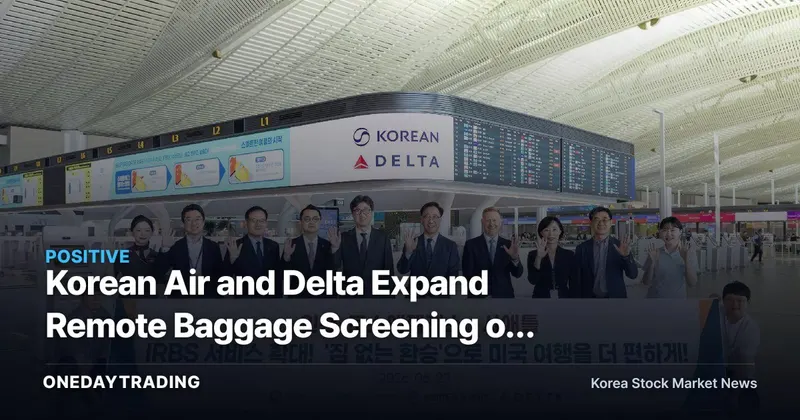
Korean Air and Delta Air Lines have expanded their remote baggage screening service for U.S.-bound flights departing Incheon to Los Angeles (LA) and Seattle. By cutting transfer time by roughly 20 minutes and reducing contact with customs officers by 65%, this process improvement goes beyond mere convenience—it reads as an operational strategy to cement Korean Air's position in the route competition for trans-Pacific transfer demand.
What Happened
The core of this move is eliminating the hassle of having to personally retrieve and re-check baggage at the first U.S. point of arrival. Previously, transfer passengers had to collect their checked baggage at the first U.S. entry airport, clear customs, and then re-check it for their connecting flight. With remote screening applied, baggage is automatically forwarded all the way to the final destination.
The service covers five major U.S. airports for flights departing Incheon, with LA and Seattle now added. The improvements highlighted include a 65% reduction in face-to-face contact with customs officers, and the ability for passengers whose first arrival is delayed to still make their connecting flight. Saving 20 minutes in the transfer process can have the effect of attracting demand that previously gave up on transfers due to tight connection times.
Background and Context
Korean Air operates a trans-Pacific route joint venture (JV) with Delta and has been developing Incheon into a transfer hub between the Americas and Asia. Because transfer passengers have both their origin and destination overseas, they have a wide range of route options, so process convenience directly drives airline choice. U.S.-bound routes are long-haul routes with high fares and thick margins, so improving the transfer experience is a point where load factors and unit prices can be lifted together.
Impact on the Market and Stocks
- Korean Air: Greater capacity to absorb trans-Pacific transfer demand is favorable for improving load factors and profitability on long-haul routes. Strengthening the Americas network through the JV partnership is the key driver.
- Asiana Airlines: With integration procedures with Korean Air underway, strengthening trans-Pacific transfer competitiveness could work to raise the value of the combined network after the merger.
- Incheon International Airport-related beneficiaries: If trans-Pacific transfer demand routing through Incheon grows, indirect effects are expected on related activities such as airport usage, duty-free, and ground handling.
- Low-cost carriers (LCCs): While the long-haul transfer market is not a direct competition zone, the major carriers' focus on long-haul routes indirectly affects the competitive landscape for domestic and short-to-medium-haul routes.
Investor Checkpoints
- Check whether passenger yield and load factors on U.S. routes improve in next quarter's earnings.
- Review the Korean Air–Asiana integration timeline and the direction of the Americas network restructuring.
- Watch international oil prices and the won-dollar exchange rate together, as they directly affect long-haul route costs.
- Monitor trends in trans-Pacific transfer passenger numbers and whether any additional airport expansions are announced.
Outlook
If the streamlined process creates an edge in transfer passengers' route choices, it could gradually add to the market share and unit prices of trans-Pacific long-haul routes. However, airline earnings are heavily swayed by external variables such as oil prices, exchange rates, and global travel demand, and whether this move itself is of a scale that immediately translates into earnings figures is a separate matter. Convenience improvements are only one pillar of competitiveness; one must also bear in mind that the effects become visible only when the cost structure and demand environment provide support.
Korean Air Through Real-Time Data
Korean Air's most recent closing price is 25,900 won (-4.25% versus the prior day), and the signal light combining foreign and institutional investor order flow with news and momentum is 🟡 Neutral · Wait-and-See. With positive and negative signals mixed, this is a zone to watch.
- ▼ Trend Alignment — Short- and medium-term downward alignment (intraday -4.3% · 1-week -11.6% · 1-month -2.1%)
- ▲ News Flow — 8 positive catalysts vs 3 negative catalysts — positive catalysts prevail
Recent related news is favorable, with 8 positive catalysts and 3 negative catalysts.
※ Price and foreign/institutional investor order flow data are provided by Korea Investment & Securities (KIS), as of the time of publication.
This article is content automatically summarized and analyzed based on the original news. View original (Maeil Business Newspaper, Corporate)