
Key Takeaways
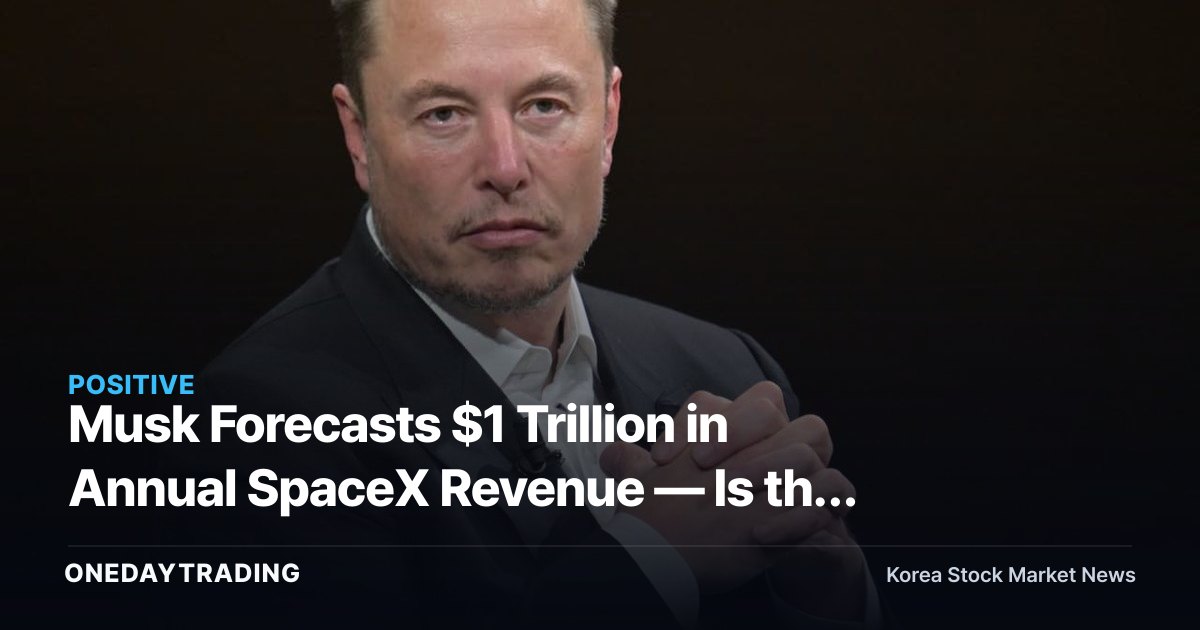
Elon Musk has put forward an eye-popping long-term annual revenue target of $1 trillion for SpaceX, the space company he leads. That figure is well over double the size that his advising investment banks have estimated internally. While the feasibility remains in question — this is classic Musk-style aggressive goal-setting — it is a catalyst that stokes growth expectations for the satellite internet and launch-vehicle markets.
What Happened
Musk projected that SpaceX's future revenue could reach the $1 trillion mark. That is more than double the estimates that had been circulating in the market, and given SpaceX's current actual revenue, it is a highly ambitious goal.
At the center of this revenue vision sit Starlink, the low-Earth-orbit satellite internet service, and Starship, the next-generation heavy-lift launch vehicle. Starlink is rapidly growing its global subscriber base and lifting its communications-service revenue, while the idea is that once Starship enters full commercial operation, it could sharply lower satellite launch costs and expand launch-service revenue.
That said, Musk has a track record of presenting bold timelines and figures — on full self-driving, the Mars colonization schedule, and production targets — only to push them back or fail to meet them. This $1 trillion forecast likewise lacks a concrete timeline and roadmap, so it is more reasonable to read it as a sense of direction than to take it at face value.
Background and Context
The global space industry is expanding rapidly around satellite internet, Earth observation, and launch services. In particular, the revenue model for low-Earth-orbit satellite communications that Starlink has proven has triggered a race among later entrants to build large satellite constellations, and with national security and communications demand from various governments layered on top, market expectations have risen.
In Korea as well, companies tied to satellite components, ground antennas, and launch vehicles and defense are cited as potential beneficiaries of this trend. SpaceX is privately held, so direct investment is not possible, but as a symbolic presence that lifts investor sentiment across the space theme as a whole, it also indirectly influences the share prices of related Korean stocks.
Impact on the Market and Stocks
- Hanwha Aerospace: A domestic aerospace sector bellwether with launch-vehicle and engine capabilities, and a direct beneficiary candidate of expectations for an expanding global space market.
- Hanwha Systems: Pursuing satellite communications and observation businesses, it stands to benefit from the theme when competition in low-Earth-orbit satellite internet comes into focus.
- AP Satellite / Intellian Technologies: Companies handling satellite communications terminals and ground antennas, which could see rising demand for components and equipment as Starlink-style services spread.
- Satrec Initiative: Engaged in satellite-body and imaging businesses, it is a stock that reacts sensitively to the space industry's growth narrative.
- Tesla: Although its direct business ties to SpaceX are small, it is a flagship listed stock that shares in Musk-related investor sentiment.
Investor Checkpoints
- Because SpaceX is privately held, direct purchases are not possible, and investors should note that Korean space-related stocks carry high volatility driven by thematic expectations.
- Musk's stated goals often lack clear timing and grounds, so it is more important to track actual progress indicators — such as Starlink subscriber numbers and Starship test results — than the announcements themselves.
- Korean stocks tend to move on expectations before earnings, so investors should keep in mind the potential for heightened volatility following a short-term sharp gain (surge).
- It is necessary to review the macro environment, such as exchange rates and interest rates, together with individual companies' order-backlog and earnings fundamentals.
Outlook
In an optimistic scenario, Starlink revenue growth and Starship commercialization combine to strengthen the growth story across the space industry as a whole, which could lead to a medium- to long-term re-rating of Korean satellite, launch-vehicle, and defense-linked stocks. On the risk side, however, if the $1 trillion target turns out to be just another of Musk's bold forecasts, it could lead to a correction in theme stocks where expectations have already been priced in. Investment burdens from intensifying constellation competition and regulatory variables are also factors. In conclusion, this forecast is a catalyst that stokes long-term growth expectations for the aerospace theme, but a prudent approach — scaling in gradually while confirming concrete earnings progress — is advisable.
This article is auto-summarized and analyzed content based on the original news report. View original (MarketWatch)