
3-Line Briefing
- Roughly a year has passed since Meta hired Alexandr Wang and set its new AI model strategy in motion, yet the market's assessment remains lukewarm.
- Zuckerberg-led large-scale investment has ramped up in earnest, but a lack of visible model results is fueling growing debate over cost efficiency.
- The key question is now shifting away from the technology itself and toward the ability to convincingly sell those results to investors and users.
What's Changing
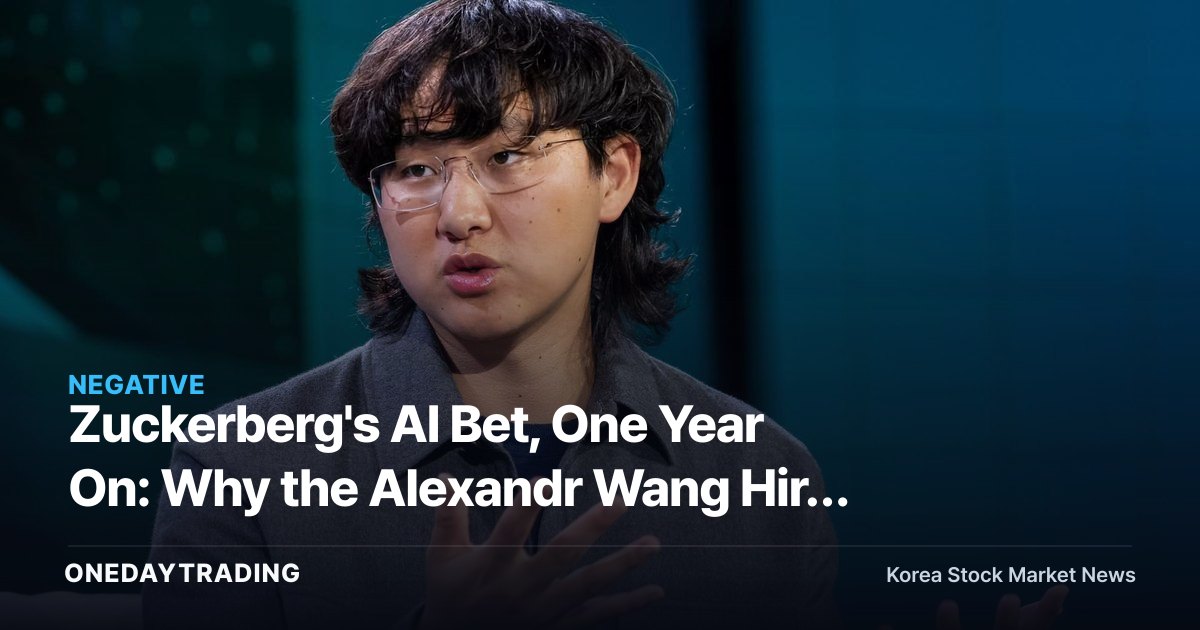
A year ago, Meta hired Alexandr Wang and recalibrated the center of gravity of its AI strategy. The plan was to draw in data-labeling and model-refinement capabilities to build a next-generation model, and to that end the company poured aggressive funding into talent acquisition and infrastructure. According to reports, however, the dominant assessment is that the results so far have fallen short of market expectations.
The crux is that the strategy has entered a new phase. Whereas the early stage was about amassing capabilities through massive investment, the company must now prove that this investment translates into genuine model competitiveness and a contribution to revenue. The notion that Zuckerberg himself must make the case for results lays bare the burden of having already spent the money while still needing to demonstrate the payoff.
By the Numbers and Context
In recent quarters, Meta has laid out capital expenditure plans running into the tens of billions of dollars for AI infrastructure, data centers, and chip procurement. The problem is that the pace at which this spending converts into new revenue beyond advertising has been slow. The market believes that if Meta fails to show a clear edge in the model competition against the likes of OpenAI and Google, doubts about the timing of any return on investment could mount.
Beneficiary and Affected Stocks (Tickers)
- Meta Platforms: The investment burden is clear, but it is a double-edged stock (ticker) with room to rebound if its follow-up models deliver results in ad targeting and generative services.
- Nvidia: Continued AI capital expenditure by Big Tech, including Meta, is a direct beneficiary factor for GPU demand.
- SK Hynix: As a core supplier of HBM, which is essential for AI accelerators, it is a flagship beneficiary of the Big Tech investment cycle.
- Samsung Electronics (005930): Stands to gain indirectly from continued AI investment on expectations of expanded supply of HBM and high-performance memory.
Risk Check
- If the large-scale investment fails to translate into revenue and profit, the cost-efficiency debate could exert downward pressure on the stock.
- A failure to differentiate in the model competition against OpenAI, Google, and others could damage both market share and reputation.
- The race to recruit top talent comes with side effects such as rising labor costs and reduced organizational stability.
- If expectations around AI investment overheat, there is a risk of broader volatility across Big Tech should future earnings disappoint.
Bottom Line
Meta's AI bet carries both potential and burden at once. If its follow-up models prove themselves through results, it could become a powerful rebound driver; if not, the massive investment could boomerang—warranting cautious observation until the payoff is demonstrated.
This article is content automatically summarized and analyzed based on the original news report. View Original (CNBC)