
3-Line Briefing
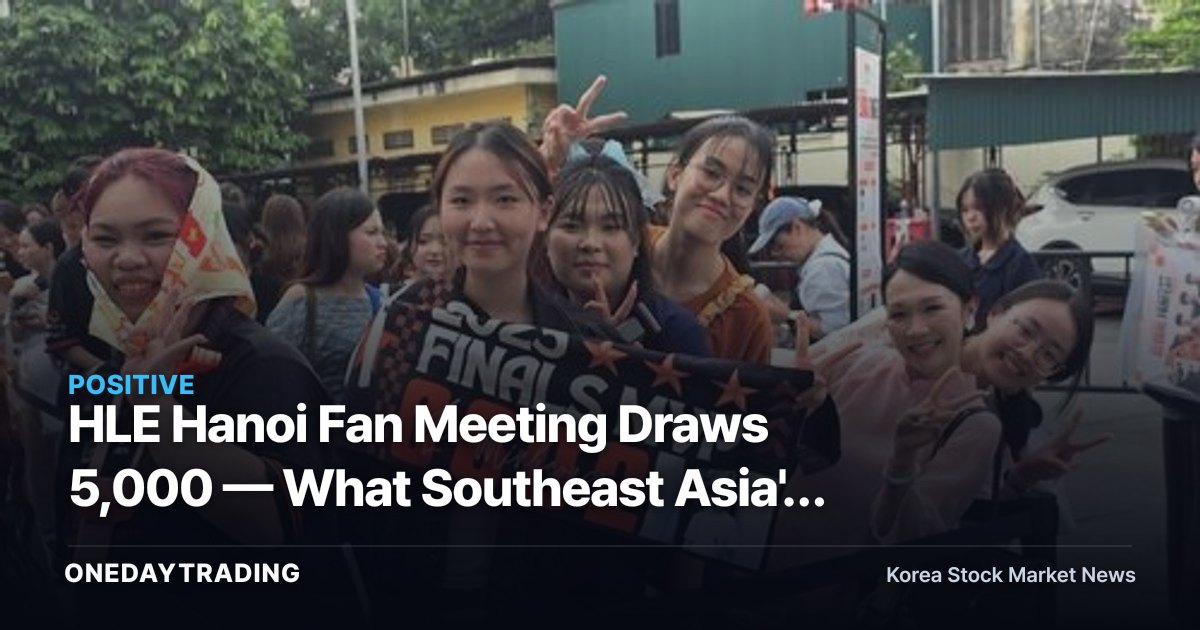
- Some 5,000 fans packed HLE's Hanoi fan meeting, confirming the real scale of Korean esports fandom in Southeast Asia's LoL market.
- The key point is not popularity itself, but the fact that Vietnam is emerging as a next-generation revenue base for game and content companies.
- Hanwha Life, which is after brand-exposure effects, game stocks with high Southeast Asian revenue exposure, and fan-platform stocks all fall within the indirect-beneficiary zone.
What's Changing
The significance of this event for investors lies not in the success of a single team's gathering, but in the signal that Southeast Asian esports fandom is approaching a tipping point where it can be converted into advertising and commerce. The ability to mobilize roughly 5,000 people offline shows that the content power of LoL and Korean esports teams in the region has risen to a measurable level. This is a shift in upstream demand that lifts the value of sponsorship rates and local marketing channels.
For Hanwha Life, HLE is a marketing asset that extends the conservative image of the insurance business into a young, global consumer base. Vietnam is a growth market with a population of 100 million, an average age in the early 30s, and low insurance penetration — and securing brand awareness through esports fandom becomes intangible infrastructure for future expansion of Southeast Asian operations. The cost is booked as marketing expense, but its effect works to lower the cost of entering a new market.
For the game and content industry, the impact is more direct. Southeast Asia has a high mobile share, and the weak offline fandom for PC IPs like LoL had been cited as a shortcoming — but this turnout suggests that the local base for PC esports is thickening.
By the Numbers and Context
The roughly 5,000 people gathered at this fan meeting is a meaningful figure for an overseas event by a single team. That said, it must be made clear that event turnout itself is not a revenue metric. From an investment standpoint, the meaningful figures are the trends in average revenue per paying user and advertising rates in the Southeast Asian market, and it is reasonable to read offline fandom as a leading indicator of these. In other words, this event is less an earnings variable than a qualitative signal that provides grounds to check whether Southeast Asian revenue exposure actually expands in upcoming quarterly earnings.
Beneficiary / Adversely Affected Stocks
- Hanwha Life — The listed parent company that owns HLE. Expanded brand exposure in Southeast Asia lowers the entry barrier for long-term overseas insurance operations, though the near-term contribution to earnings is limited.
- Krafton — Has a thick user base across Southeast Asia and India through titles like PUBG. A broader local esports base aligns with the expansion of tournament and advertising revenue for its own IP.
- Netmarble — With a high share of Southeast Asian mobile revenue, it falls within the direct-beneficiary structure of expanding K-game fandom.
- Dear U — As a fan subscription and communication platform, there is room to expand into new onboarding categories as the digital transition of team fandom progresses.
- Wemade — With exposure to Southeast Asian game publishing and blockchain businesses, it is within the indirect sphere of influence of rising local content demand.
Risk Check
- Offline mobilization is merely a brand indicator with a weak link to revenue, so it should not be overinterpreted as earnings momentum.
- Hanwha Life's share price is governed by the fundamentals of its core insurance business — interest rates, surrender-value reserves, and the like — with the esports effect being a lower-priority variable.
- Southeast Asia has low payment values and high exchange-rate and regulatory volatility, so user growth may not translate directly into profitability.
- Reliance on the single LoL IP and the burden of team operating costs are structural cost factors for the content business.
One-Line Conclusion
K-esports' penetration into Southeast Asia is a positive trend in terms of the top-line expansion of game and content exports and Hanwha Life's brand equity — but it is too early to tie event success directly to earnings; it is reasonable to use next quarter's Southeast Asian revenue exposure and the trend in local advertising and payment rates as confirmation indicators.
Hanwha Life Through Real-Time Data
Hanwha Life's latest closing price is 5,440 won (-4.56% vs. the prior day), and its signal light — combining foreign investor and institutional investor supply-demand (order flow) with news and momentum — is 🟢 Buy Bias. With foreign investors and institutional investors turning positive, it may be worth watching.
- ▲ Order-flow continuity — Foreign investors net buyers for 5 consecutive days (+2.7 billion won)
- ▲ Dual-engine buying — Foreign investors +2.7 billion won · institutional investors +100 million won buying in tandem
※ Price and foreign investor/institutional investor supply-demand (order flow) data are provided by Korea Investment & Securities (KIS) and are as of the time of publication.
This article is content automatically summarized and analyzed based on the original news report. View original (Yonhap News)