
At a Glance
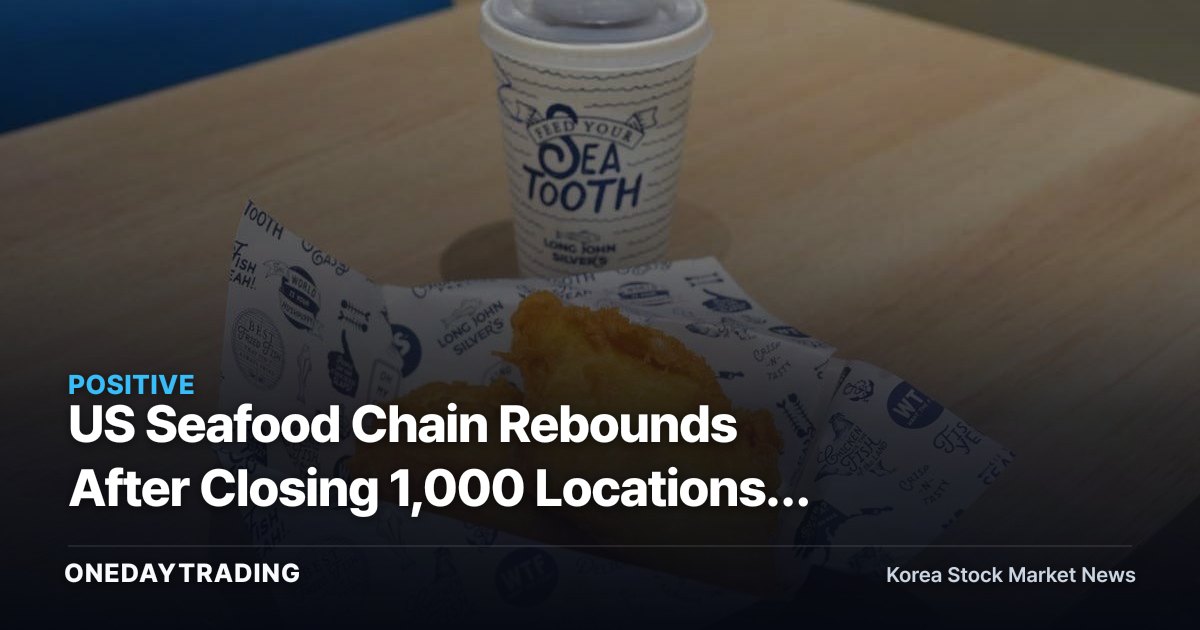
The case of a US seafood restaurant chain whose earnings have returned to a stable footing after a large-scale store cleanup offers Korean investors a reference signal that a restructuring-driven turnaround in the dining and fisheries sectors can actually work. The key is not top-line revenue but rather a strategy of weeding out loss-making locations to lift profitability per store—a yardstick that applies directly to discussions about structural improvement at domestic restaurant franchises and seafood processing and distribution companies.
Why It Matters Now
Only after closing roughly 1,000 underperforming locations did this chain stop its losses and return to a normal operating footing. In the restaurant business, profit and loss are heavily weighted toward fixed and semi-fixed costs—rent, labor, and ingredients—so a location with customer traffic below breakeven only deepens losses the longer it operates. Cutting the number of stores may therefore look like a contraction in scale, but it is a head-on approach that improves per-store margins and cash flow at the same time.
This carries no small significance for the Korean market either. Dining demand has recovered since COVID, but many franchises have seen store-level economics deteriorate amid rising ingredient prices and minimum wages. In addition, for seafood processing and deep-sea fishing companies that supply core ingredients such as shrimp, crab, and salmon, the stability of orders from large dining channels is directly tied to revenue. In other words, the normalization of an overseas seafood chain can be read as a signal that global seafood demand is forming a bottom.
Frequently Asked Questions
- How can closing 1,000 locations be called a recovery? — In the restaurant business, the higher the proportion of loss-making locations, the faster overall profit and loss collapses. Clearing out underperforming stores is a classic recovery path that lifts operating margins and cash flow even as it reduces revenue.
- Is there a direct impact on Korean listed companies? — The chain in question is privately held, so the direct link is weak. Still, as a theme of seafood demand and dining-sector restructuring, it serves as a reference case for domestic fisheries and food stocks.
- What should investors watch to make a judgment? — You need to look together at changes in store counts, revenue per store, and cost ratios (ingredients and labor) at domestic dining and fisheries companies to confirm whether a contraction in scale translates into improved profitability.
Impact on Related Stocks and Sectors
- Dongwon Industries — With its tuna and seafood processing operations and global distribution network, it has an indirect path to benefit through more stable orders for raw and processed products as overseas seafood dining demand bottoms out.
- Sajo Industries and Sajo Daerim — With a large share of deep-sea fishing and seafood processing, they are relatively more sensitive on both price and volume during a phase of recovering global seafood demand.
- CJ CheilJedang — Its processed-food and ingredient businesses are linked to a recovery in dining channels, serving as a gauge of global food demand trends.
- Domestic restaurant franchise sector — The overseas case of lifting profitability through store restructuring becomes a benchmark demonstrating the effectiveness of underperforming-store cleanup and renovation strategies.
Points to Note When Investing
- Because the chain is privately held, its connection to domestic stocks is thematic and indirect, and it should not be overinterpreted as a direct earnings linkage.
- A recovery based on store reduction comes with slower top-line growth, so quarterly earnings must be checked to verify that margin improvement sufficiently offsets the revenue decline.
- Fisheries stocks are heavily exposed to swings in catch volumes, exchange rates, and international seafood prices, making it difficult to determine direction from the single variable of dining demand alone.
- If ingredient prices and labor costs rise again, the cost burden on both dining and fisheries would grow, potentially shaking the recovery scenario.
Overall Outlook
The optimistic scenario is one in which clearing out underperforming locations lifts per-store profitability and cash flow, allowing global seafood dining demand to form a bottom, which in turn leads to more stable orders for deep-sea fishing and seafood processing companies. Conversely, a combination of renewed increases in ingredient and labor costs, slowing consumption, and exchange-rate and catch-volume variables could leave only a contraction in scale while delaying margin improvement. A reasonable approach for domestic investors is to check the quality of the recovery in the next quarter's earnings by looking together at revenue per store, cost ratios, and the price and volume metrics of fisheries companies.
Dongwon Industries Through Real-Time Data
Dongwon Industries' latest closing price is 31,800 won (-2.75% from the previous day), and the signal light—combining foreign investor and institutional investor order flow with news and momentum—is 🟡 Neutral / Wait-and-See. With positive and negative signals mixed, this is a zone to watch.
- ▼ Trend alignment — Short- and mid-term downward alignment (intraday -2.8% · 1-week -7.6% · 1-month -9.3%)
- ▼ 52-week position — Near the 52-week low, 1%
※ Price and foreign/institutional order-flow data are provided by Korea Investment & Securities (KIS) and are as of the time of publication.
This article is content automatically summarized and analyzed based on the original news. View Original (Yahoo Finance)