
Key Takeaways
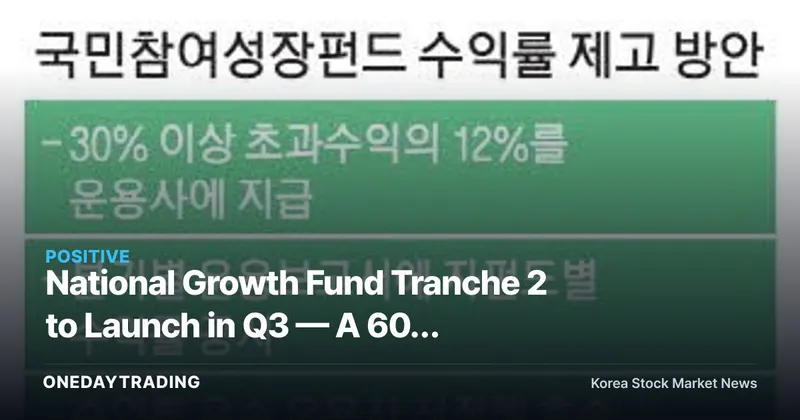
The Financial Services Commission (FSC) has decided to launch the second tranche of the public-participation National Growth Fund within the third quarter of this year. Its size matches the first tranche at 600 billion won, and the strong interest from retail investors — reflected in how quickly the first tranche sold out — is the backdrop for this follow-up launch.
What Happened
The FSC announced that it will roll out the second tranche of the public-participation National Growth Fund, in which citizens directly contribute capital, during the third quarter. Building on the success of the first fund, which was snapped up quickly after launch, it will raise additional capital at the same 600 billion won scale.
For this second tranche as well, an approach that gives priority allocation of a certain portion to ordinary citizens and individual savers is under consideration. The fund's basic framework — pooling policy capital together with private capital to invest in growth areas at the national level — is expected to be maintained.
Background and Context
The National Growth Fund is a policy-financing model that supplies capital to advanced strategic industries and future growth areas while sharing the resulting gains with the general public. With two sources of demand converging — an alternative to low-interest deposits and the appeal of participating in policy — the first fund was depleted early, demonstrating that retail investors' appetite for risk assets remains very much alive.
Impact on the Market and Stocks
- Advanced strategic industries: Capital is flowing into the growth areas designated by policy, such as semiconductors, secondary batteries, and biotech, which could work favorably for the medium- to long-term investment environment.
- Securities and asset management sector: Distributors and asset managers can expect fee income and inflows of fresh capital through the sale and management of the fund.
- Small and growth-stage companies: Rather than large caps, growth-stage companies that are direct investment targets of the fund may benefit on the fundraising side.
- Overall market supply-demand (order flow): As retail capital gathers into policy funds, it could indirectly help broaden the base of the domestic stock market.
Investor Checkpoints
- It is worth confirming how the fund's actual investment targets and weightings are structured, and whether they are the same as in the first tranche.
- Because this is an investment product rather than a principal-guaranteed one, the potential for losses must be weighed alongside expected returns.
- It is advisable to review specific terms — such as the volume reserved for priority allocation to ordinary savers, the subscription schedule, and redemption conditions — before launch.
- Separate from the flow of policy funds, the earnings and valuation of individual stocks (tickers) should be assessed independently.
Outlook
Optimistically, the second fund could also prove a success, increasing the supply of capital into advanced strategic industries and sending a positive signal to the market through the government's policy resolve. That said, fund performance hinges on the earnings and industry conditions of the companies invested in, so it is important to note that popularity and actual returns are two different things. Cyclical risks in growth industries, along with shifts in global interest rates and the economy, are also factors to consider.
This article is content automatically summarized and analyzed based on the original news report. View original (Maeil Business Newspaper, Securities)