
At a Glance
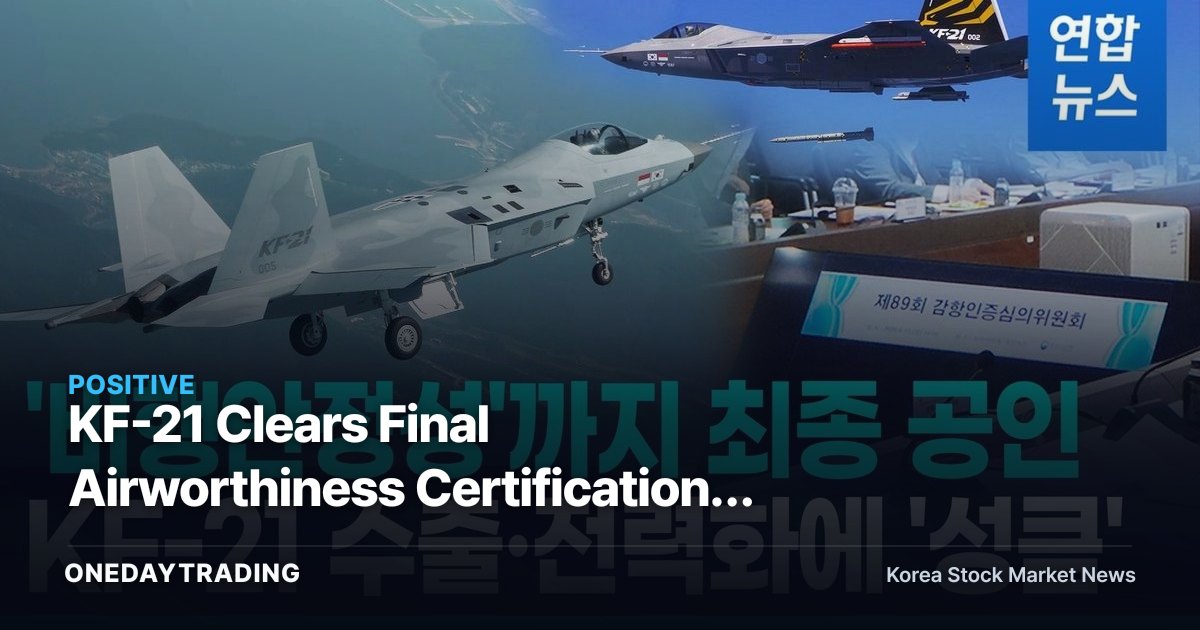
The KF-21 Boramae has cleared its final airworthiness certification, which validates flight safety. This means the program has passed the last technical gateway from the prototype flight-test stage toward mass production and operational deployment—bringing into sharper focus the revenue-recognition timing for the program's lead contractor, Korea Aerospace Industries (KAI), as well as the order visibility for its parts and engine suppliers.
For defense investors, the key point is not simply passing a test, but entering the phase where mass-production volumes and unit prices begin to flow through the income statement.
Why It Matters Now
Airworthiness certification is the procedure by which the state officially certifies that a military aircraft can be operated safely within a defined flight envelope. Only once this certification is confirmed do mass-production approval and unit-level deployment begin in earnest, and as program spending typically shifts from prototype development to the mass-production stage, the scale and durability of revenue change. In other words, this clearance can be read as a signal that the KF-21 program is shifting its center of gravity from an R&D-cost-heavy phase to a revenue- and profit-realization phase.
Drilling one level deeper into the cause-and-effect, the KF-21 is a systems program in which parts from numerous suppliers—radar, engine, avionics, precision-guided weapons and more—are integrated into a single airframe. As a result, the more firmly the mass-production schedule is set, the more it determines multi-year revenue not just for KAI but across the entire downstream supply chain, including avionics, radar and engine maintenance. Once front-end demand (the air force's procurement volume) is fixed, suppliers gain room to improve utilization rates and spread fixed costs.
At the same time, in future export negotiations the KF-21's real-world operational track record and certification history become key bargaining chips. Within the existing trend of expanding Korean weapons-system exports to countries such as Poland, the fact that the fighter is adopted and operated by Korea's own air force can serve as a pathway to building confidence among potential buyers.
Frequently Asked Questions
- Does clearing airworthiness certification mean mass production is confirmed? — It means the technical safety gateway has been passed and the preconditions for mass production and deployment have been met; actual volumes and budgets are confirmed in stages, subject to separate program timelines and government decisions.
- Who are the most direct beneficiaries? — Korea Aerospace Industries, which oversees the program and builds the airframe, followed by a structure in which the benefit spreads to avionics, radar, engine and precision-weapons suppliers beneath it.
- When will it show up in earnings? — Because recognition is staged according to mass-production contracts and delivery schedules, it is likely to appear not as a one-off but as multi-year revenue visibility.
- Is it already priced into the stock? — Given the defense sector's strong tendency to price in ahead of events, follow-on mass-production volumes, unit prices and export contracts matter more as additional catalysts than the certification clearance itself.
Related Stocks and Sector Impact
- Korea Aerospace Industries — As the lead of the KF-21 program, responsible for airframe design, manufacturing and systems integration, it most directly captures the revenue and profit effects of the shift to mass production.
- Hanwha Aerospace — A core defense firm involved in supplying aircraft engines and propulsion systems, it stands to benefit alongside as mass-production volumes expand.
- Hanwha Systems — Highly linked to the KF-21 system on the side of key sensors and electronics such as radar and avionics.
- LIG Nex1 — Connected to follow-on demand from fighter deployment in the armament and electronics field, including precision-guided weapons and electronic equipment.
- Defense sector overall — As a case that reinforces the trend of domestic weapons-system self-reliance and export expansion, it can work favorably on industry-sector investor sentiment.
Points to Watch When Investing
- Defense stocks tend to price in expectations ahead of earnings, so certification clearance alone may leave limited additional upside, and valuation burden should be examined.
- Mass-production volumes, unit prices and budget allocations depend on government program timelines and the defense budget, so policy and budget-related uncertainty remains.
- Export expectations hinge on the outcome of negotiations with potential buyers, so momentum could weaken if contracts are delayed or fall through.
- Given the nature of large-scale systems programs, if schedule delays or quality issues arise, there is a risk that the revenue-recognition timing across suppliers is pushed back as well.
Overall Outlook
In the optimistic scenario, the airworthiness certification clearance leads to mass-production approval and stable deliveries, expanding multi-year revenue visibility from KAI at the top down to avionics, engine and armament suppliers. As a domestic operational track record builds, persuasiveness in export negotiations also strengthens, which can support the structural-growth narrative for the defense sector.
On the risk side, however, budget and schedule variables, an already priced-in share price, and export-negotiation uncertainty all exist simultaneously. Accordingly, rather than the certification event itself, it is reasonable for investors to take a step-by-step approach, using follow-on mass-production contract disclosures, annual procurement volumes and unit prices, export-negotiation progress, and the defense-budget compilation schedule as key indicators to monitor.
Korea Aerospace Industries: A Real-Time Data View
Korea Aerospace Industries' latest closing price is 154,900 won (+4.95% versus the previous day), and the signal light combining foreign and institutional supply-demand (order flow) with news and momentum is 🟡 Neutral / Wait-and-See. With positive and negative signals mixed, this is a zone to watch.
- ▼ Dual Selling — foreign investors −2.1 billion won · institutional investors −6.3 billion won, selling in tandem
- ▲ News Flow — 5 positive catalysts vs. 1 negative catalyst — positive bias
Recent related news is favorable, with 5 positive catalysts and 1 negative catalyst.
※ Price and foreign/institutional supply-demand (order flow) data are provided by Korea Investment & Securities (KIS), as of the time of publication.
This article is content automatically summarized and analyzed based on the original news report. View original (Yonhap News, Industry)