
At a Glance
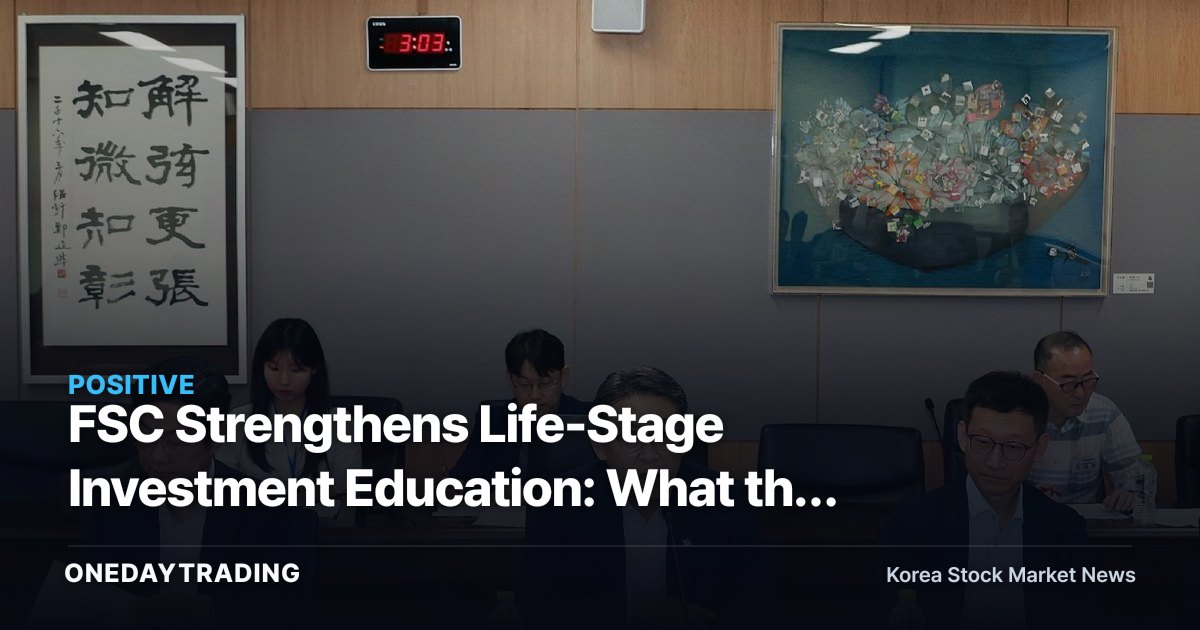
On the 16th, the Financial Services Commission (FSC) convened the Financial Education Council and decided to strengthen life-stage financial investment education covering everyone from students to military servicemembers, university students, office workers, and the elderly. Against a backdrop of surging retail investor participation in the market and an increasingly diverse product lineup spanning overseas stocks and ETFs, the core message is to invest only after fully understanding high-risk products.
From an investor's standpoint, it is more reasonable to read this announcement not as a catalyst that directly moves short-term share prices, but as a signal of policy belatedly acknowledging a structural broadening of the retail investor base. The brokerage sector — sensitive to trading value and new account inflows — is the first area to watch.
Why It Matters Now
The crux lies less in the policy itself than in its backdrop. The authorities elevating every stage of life into a target for education is evidence of just how rapidly non-expert retail participation is growing and how its risks have risen onto the policy agenda. Given the Korean market's characteristically high share of retail trading, a broadening participant base forms the structural foundation for brokerages' brokerage commissions and margin-lending interest income.
What is particularly meaningful is that the education content explicitly references overseas stocks, ETFs, and high-risk products. For brokerages and asset managers, overseas stock intermediation and ETF lineups are areas of relatively favorable margins and high growth potential. If education lowers the psychological hurdle around barriers to entry, the base of this market could thicken over the medium to long term.
That said, the fact that education's original intent is a cautious approach to high-risk products is a double-edged sword. The more accurately investors recognize risk, the more reckless churn trading declines — which could be neutral to, or even a drag on, short-term trading value. In other words, quantitative base expansion and qualitative prudence operate simultaneously.
Frequently Asked Questions
- Is this announcement a direct positive catalyst for brokerage stocks? It is not an immediate earnings variable. However, the backdrop itself — a broadening base of retail participation — signals a favorable environment for brokerages with high dependence on brokerage commissions.
- Why were overseas stocks and ETFs emphasized? It can be seen as a response to rising cases of retail investors buying U.S. stocks directly and investing in ETFs without understanding the underlying structures such as currency risk, price-NAV deviation, and leverage.
- What does strengthening education for the elderly imply? It reflects growing demand to shift retirement and pension assets into investments. This connects to demand for ETFs and overseas stocks based on pension and individual retirement pension (IRP) accounts.
- When will it be reflected in share prices? Rather than being priced in as a single event, it will be confirmed gradually through quarterly trading value, new accounts, and trends in overseas stock custody assets.
Impact on Related Stocks and Sectors
- Kiwoom Securities: With its high share of retail brokerage commissions, it could be a direct beneficiary of a broadening trading population. Given its strong sensitivity to trading value, its leverage is large during phases of quantitative base expansion.
- Mirae Asset Securities: With strong competitiveness in overseas stock intermediation and its ETF and pension lineup, it is aligned with the overseas and ETF base expansion the education targets.
- Samsung Securities and NH Investment & Securities: Through wealth management (WM) and pension channels, they connect to the trend of shifting the elderly's and office workers' assets into investments.
- Asset management and ETF sector: While the base for ETF fee income could broaden, it comes accompanied by fee-cutting competition, so the benefits may be concentrated among top-share players.
- Financial platforms and data providers: If demand for investment education and information provision expands, fintech and financial-information services could see indirect benefits on the traffic side.
Points to Watch When Investing
- Education policy is not a variable that directly lands on earnings. Ultimately, brokerage share prices are driven far more by fundamental variables — trading value, interest rates, and overall market direction.
- Heightened risk awareness can lead to lower turnover, so it is hard to conclude that a broadening base translates directly into higher commissions.
- Brokerage sector valuations tend to price in expectations of a trading-value boom in advance, so volatility increases when trading value turns down.
- An increased weighting in overseas stocks raises exposure to exchange rate and overseas market volatility, so related earnings could be shaken in the event of external shocks.
Overall Outlook
In the optimistic scenario, life-stage education structurally broadens the retail investment base, and brokerages with strengths in overseas stocks, ETFs, and pension channels cumulatively absorb the benefits of that trend. Conversely, if heightened risk awareness reduces short-term churn trading and trading value slows, the short-term momentum of brokerage stocks could be limited. The confirming indicators are clear. By watching together the monthly KOSPI and KOSDAQ trading value, trends in new accounts and customer deposits, overseas stock settlement value, and the brokerage-commission and financial-product income composition of brokerages' quarterly earnings, one can gauge whether this base expansion actually translates into real profits.
Kiwoom Securities Through Real-Time Data
Kiwoom Securities' latest closing price is 390,000 won (+6.12% from the previous day), and the signal light synthesizing foreign and institutional investor supply-demand (order flow) with news and momentum is 🟡 Neutral · Wait-and-See. With positive and negative signals mixed, it is a zone to watch.
- ▼ Supply-demand continuity — foreign investors net sellers for 4 consecutive days (−5.8 billion won)
- ▲ News flow — 4 positive vs 2 negative — positive catalysts in the lead
Recent related news is favorable, with 4 positive items and 2 negative items.
※ Price and foreign/institutional investor supply-demand (order flow) data are provided by Korea Investment & Securities (KIS), as of the time of publication.
This article is content automatically summarized and analyzed based on the original news. View original (Maeil Business Newspaper, Securities)