
Summary
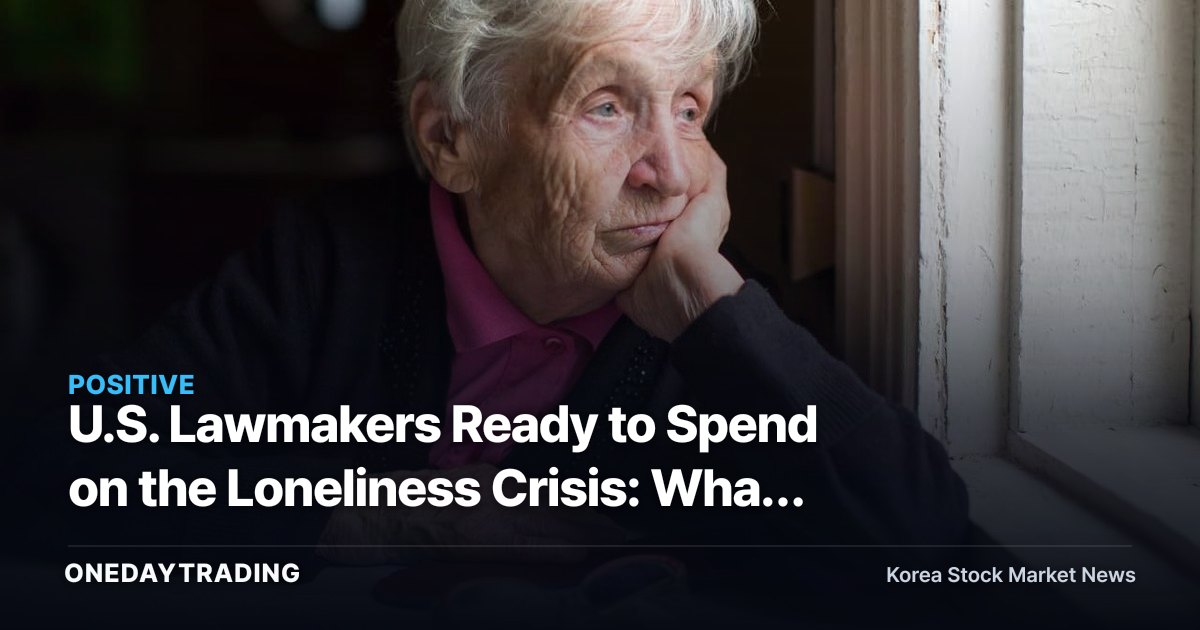
Loneliness is being defined as more than a mere social problem — as a public-health threat comparable to heavy smoking or obesity — and as the U.S. Congress weighs committing budget funds running into the millions of dollars, this trend could spill over into gradual policy-driven demand for mental health, telemedicine, and social connection platforms. The primary beneficiary candidates are companies positioned along the path where government health spending is headed, and companies whose business model centers on easing loneliness. That said, the lag before this shows up as direct revenue and the uncertainty around policy intensity are key variables.
What Happened
Policy circles in the U.S. have begun treating loneliness not as a matter of personal emotion but as a structural health risk that affects medical costs and labor productivity. This follows accumulated warnings from health authorities that sustained loneliness raises the risk of cardiovascular disease, depression and anxiety, and cognitive decline — and the assessment that the scale of this health damage is comparable to heavy smoking and obesity has become a basis for the policy debate.
Accordingly, moves to allocate budget funds to tackling loneliness at the legislative level are taking concrete shape. The key point is less the dollar figure itself than the fact that loneliness has risen onto the official agenda for which health budget is allocated. Once it secures a place as a budget line item, spending channels tend to broaden into local health programs, elderly care, mental health counseling services, and the like.
From an investment standpoint, what matters is where this spending flows. Given a U.S. healthcare structure that lacks in-person counseling infrastructure, cost-efficient remote mental health services and digital platforms are likely to become the priority conduits for budget allocation.
Structural Backdrop
The loneliness economy is a market expanding structurally as population aging, the rise of single-person households, and a digital lifestyle that reduces in-person contact converge. Mental health in particular has long been an area of chronically short supply relative to demand, owing to insurance reimbursement and access issues, so the addition of government funding directly enlarges upstream demand for private-sector service providers. Conversely, criticism that social media worsens loneliness is also mounting, so even within the same theme, regulatory risk and benefit diverge from stock (ticker) to stock (ticker).
Stock and Sector Ripple Effects
- Teladoc Health: With remote mental health counseling as a core business, it stands to directly capture upstream demand — growth in members and visit volumes — if public health budget is allocated to behavioral health services.
- Hims and Hers Health: As it expands mental health prescriptions for depression and anxiety and subscription-based care, policies that improve access could function as a channel for acquiring new customers.
- Match Group: As a connection platform that monetizes the forming of human relationships, it is a symbolic name of the loneliness theme, but with revenue centered on dating subscriptions, it is far removed from any direct benefit of policy budget.
- Meta Platforms: Its thematic relevance is high in the sense of social connection, but it could become a target of regulation amid controversy over worsening loneliness and mental health, making benefit and risk two-sided.
Bull vs. Bear Scenario
The bull scenario is one where the budget takes concrete form as an expansion of behavioral-health and telemedicine reimbursement, the members and usage frequency of related platforms grow, and easing loneliness becomes entrenched as a sustained spending item across society. In that case, digital healthcare rides the policy momentum.
The bear scenario is also clear. If the budget amounts to no more than a symbolic level or its execution is delayed, the actual revenue contribution could be negligible, and names like Teladoc and Hims already have some growth expectations priced into their valuations, so there is a risk of a pullback if earnings fall short of expectations. For social platforms, if the blame for worsening mental health spreads into regulation, the cost burden could instead grow heavier.
Investor Action Points
- Track the legislative progress to see whether the bill's actual budget size and allocated items lead to mental health and telemedicine reimbursement.
- In Teladoc's and Hims's next-quarter earnings, monitor the change in behavioral-health segment members and the trend in visit volumes as key metrics.
- For social platforms, also examine regulatory and litigation trends related to adolescent mental health, and assess benefit and risk separately.
- Don't jump to conclusions based on thematic relevance alone; weigh together the lag in converting policy demand into revenue and the valuation burden.
This article is content automatically summarized and analyzed based on the original news report. View original (MarketWatch)