
At a Glance
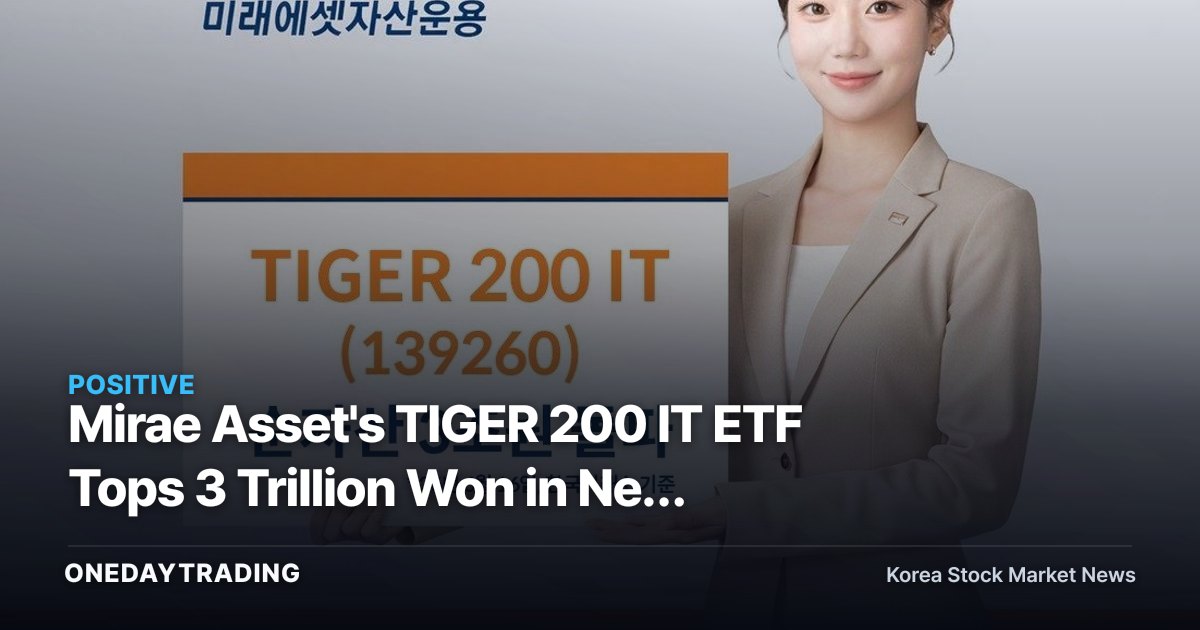
The net assets of Mirae Asset Global Investments' TIGER 200 IT ETF, which spreads investment across Korea's leading IT names, have surpassed 3 trillion won. This signals that capital is flowing into the IT sector as a whole rather than into single-stock bets, affecting the supply-demand (order flow) of heavily index-weighted names such as Samsung Electronics and SK Hynix.
Because concentrated passive money tends to move with sector momentum rather than individual earnings, the direction of the semiconductor cycle needs to be read in conjunction with the ETF's fund flow.
Why It Matters Now
The key point of this development is not the asset growth of a single ETF product itself, but where that money flows. TIGER 200 IT is a passive product that tracks the IT industry sector among the constituents of the KOSPI 200, with Samsung Electronics and SK Hynix sitting at the top of its weightings. Crossing 3 trillion won in net assets means a thicker base of passive buying for these large-cap IT names, since the structure mechanically adds buying in proportion to index weight.
What matters in particular is that money seeking to bet on the sector as a whole — rather than directly picking individual stocks (tickers) — has increased. In a phase where demand for high-bandwidth memory (HBM) for AI servers and the memory price cycle are lifting the earnings outlook for large-cap semiconductor names, demand from investors looking to ride the IT sector's rise while reducing stock-selection risk can be seen as concentrating into the ETF.
That said, passive money cuts both ways. If sector momentum stalls or memory prices correct, the inflows that arrived can reverse into redemptions, exerting selling pressure of equal intensity on the top-weighted names — something that must be watched as well.
Frequently Asked Questions
- What does this ETF invest in? It is a passive product that holds IT industry sector constituents within the KOSPI 200 by weight, with large-cap semiconductor and electronics names such as Samsung Electronics and SK Hynix forming its core.
- Why does crossing 3 trillion won in net assets matter? It signals that capital has flowed into the IT sector as a whole rather than into individual stocks, with mechanical buying proportional to index weight supporting the supply-demand (order flow) of large-cap names.
- Does this guarantee that share prices will rise? No. ETF asset growth only reflects the supply-demand (order flow) environment and does not guarantee an improvement in the fundamentals of individual stocks (tickers); a sector correction can create reverse pressure through redemptions.
- What should you check? Memory price trends, HBM order and capacity-expansion disclosures, and the quarterly earnings of Samsung Electronics and SK Hynix determine the ETF's fund flow and the sector's direction.
Impact on Related Stocks and Sectors
- Samsung Electronics As the most heavily index-weighted name, it directly benefits from passive buying. Its memory and foundry earnings, together with the ETF's fund flow, drive the share price.
- SK Hynix With its HBM competitiveness in the spotlight, it carries significant weight and influence within the IT index. AI memory demand is the key variable for sector momentum.
- Mirae Asset Securities As the parent of Mirae Asset Global Investments, which runs the ETF, growth in ETF assets can translate into an expanded management-fee base.
- Electronics and Components Sector Small- and mid-cap IT names included in the index also benefit indirectly from passive money in proportion to their weight.
- Semiconductor Sector Overall Inflows into sector ETFs reflect expectations for the industry while raising redemption risk should the cycle slow.
Points to Watch When Investing
- Growth in ETF net assets is only a supply-demand (order flow) signal and is not directly tied to earnings improvement at individual stocks.
- With high concentration in the top-weighted names, investors should recognize that the structure is effectively driven by the direction of Samsung Electronics and SK Hynix.
- If memory prices are in a stretched, high-level zone, valuation and the possibility of a cycle inflection should be checked together.
- Passive money can be redeemed as quickly as it flows in, so downside volatility can grow if sector momentum slows.
Overall Outlook
If expanding AI investment and a memory-demand recovery continue, inflows into IT sector ETFs have room to act favorably on the supply-demand (order flow) of large-cap semiconductor stocks. Conversely, a memory price correction, slowing end-demand, and exchange rate and interest-rate variables can create redemption pressure along the same path. Ultimately, an approach that checks fundamental indicators — memory prices, HBM orders, and quarterly earnings — rather than the ETF's headline size, and confirms the sector's direction, remains valid.
Samsung Electronics Through Real-Time Data
Samsung Electronics' latest closing price is 337,500 won (-1.60% versus the previous day), and the signal light combining foreign investor and institutional investor supply-demand (order flow) with news and momentum is 🟡 Neutral · Wait-and-See. With positive and negative signals mixed, this is a zone to watch.
- ▲ 52-Week Position — Upper 90% of 52-week range — near new highs
- ▲ News Flow — 26 positive catalysts vs. 9 negative catalysts — positive bias
Recent related news is favorable, with 26 positive catalysts and 9 negative catalysts.
※ Price and foreign investor/institutional investor supply-demand (order flow) data are provided by Korea Investment & Securities (KIS), as of the time of publication.
This article is content automatically summarized and analyzed based on the original news. View Original (Maeil Business Newspaper, Securities)