
At a Glance
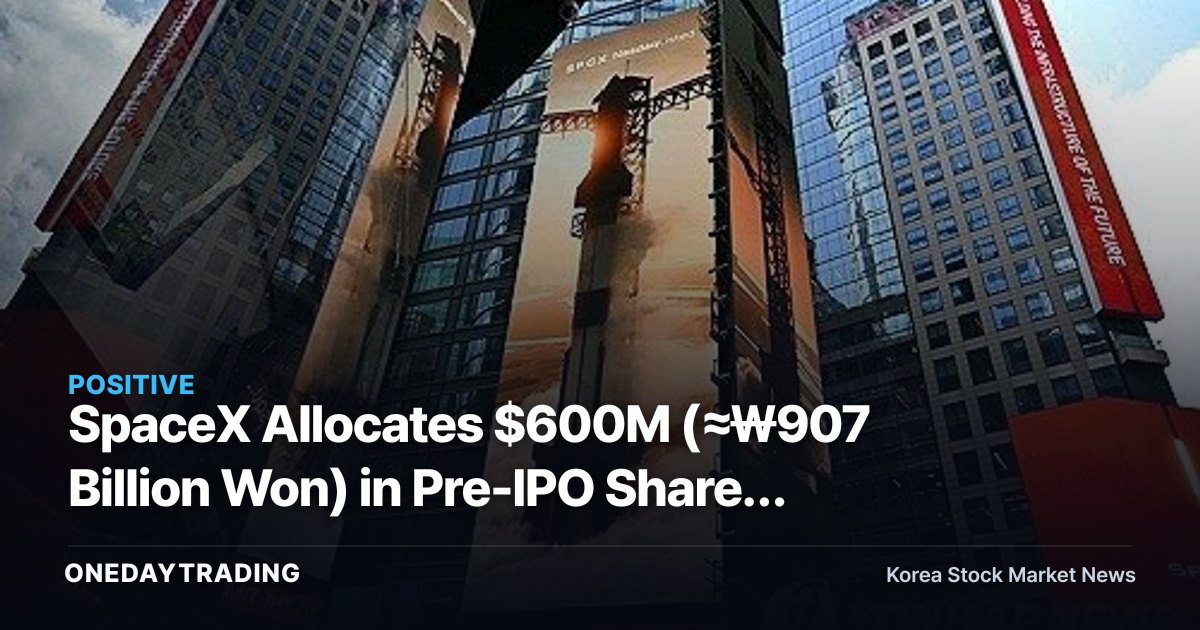
Retail investors across Europe, excluding the UK, were allocated $600 million (about 907 billion won) worth of SpaceX private shares. The fact that shares of a private space company have been opened up even to ordinary retail investors is a signal of how strongly capital is flowing into the space industry as a whole. Domestically, this is a development that could lend indirect warmth to investor sentiment across the launch-vehicle and satellite value chain, including Hanwha Aerospace.
Why It Matters Now
The key point is not so much the $600 million figure itself, but the structural shift: equity in space companies — previously the domain of institutional investors and venture capital at the private stage — has now trickled down into the form of an allocation to retail investors. This can be read as a sign that market confidence in the earnings visibility of satellite communications (Starlink) and launch services has grown considerably. It can be seen as reflecting the view that, as launch costs fall thanks to reusable rockets, low-earth-orbit satellite constellations and communications revenue have entered a stage of translating into actual cash flow.
That said, it is difficult for Korean investors to participate directly in this offering. SpaceX is private, and this allocation is also targeted at residents of Europe excluding the UK. From a domestic perspective, therefore, the practical investment route runs through listed aerospace stocks that supply launch-vehicle and satellite components or operate their own satellite businesses, as well as companies set to benefit from defense-linked space budgets. The point to watch is whether the global space investment boom can dovetail with domestic policy and order momentum.
Frequently Asked Questions
- Can Korean retail investors buy SpaceX shares? Because the company is private, ordinary purchases are not possible, and since this allocation is also limited to European residents excluding the UK, there is effectively no channel for direct domestic participation.
- Is $600 million a large amount? It is only a fraction of SpaceX's overall corporate valuation, but the fact that the retail allocation reached the 900-billion-won range shows the intensity of capital inflows into the space industry.
- Is this a direct positive catalyst for the domestic market? Rather than a direct beneficiary effect, it is closer to a mood-setting development that stimulates sentiment toward the space theme. Whether it translates into earnings or new orders is a separate variable.
- What is the link to Starlink? Since expectations for satellite communications revenue underpin the company's valuation, the supply chain for satellite components and ground equipment could draw indirect attention.
Related Stocks and Sector Impact
- Hanwha Aerospace: As Korea's flagship aerospace stock — holding launch-vehicle engines and the Nuri rocket (KSLV-II) business — it serves as the theme's sector bellwether when global space investment expands.
- Hanwha Systems: With its satellite communications and low-earth-orbit satellite businesses, it is a candidate beneficiary of growing interest in Starlink-style satellite communications.
- Satrec Initiative and AP Satellite: Working with small satellites and satellite bodies and components, they are tied to the trend of expanding satellite constellations.
- Intellian Technologies: As a supplier of satellite communications antennas and ground equipment, it could see rising downstream demand as low-earth-orbit communications infrastructure expands.
- The defense sector broadly: With space budgets and security demand overlapping, the launch and satellite value chain shares a path to policy benefits.
Points to Watch When Investing
- Even if the news stimulates sentiment toward the theme, the link to the earnings of domestic stocks is weak. It is necessary to check the actual scale that the space business accounts for in a company's revenue mix.
- Aerospace stocks are often in zones of heavy valuation pressure, with expectations already priced in. Investors should keep in mind the risk of expanded volatility following a short-term sharp gain (surge).
- Domestic satellite and launch businesses are swayed by government budgets and order schedules, so the timing of revenue recognition can fluctuate unevenly from quarter to quarter.
- The correlation between sentiment toward overseas private shares and the prices of domestic listed stocks is not consistent, so theme-driven co-movement can cool quickly.
Overall Outlook
On the optimistic view, the inflow of retail capital into a private space company signals that the space industry is entering its monetization stage, leaving room for a re-rating of the launch-vehicle and satellite communications value chain to spread to domestic names such as Hanwha Aerospace. Conversely, because this matter involves an overseas private transaction, its link to domestic earnings is loose, and stocks that have risen on theme expectations alone could see a pullback if their rationale is not confirmed at the next order announcement or earnings release. The indicators to monitor are domestic companies' space-segment order announcements, the government's space budget and launch schedule, and progress toward the commercialization of satellite communications.
Hanwha Aerospace Through Real-Time Data
Hanwha Aerospace's most recent closing price was 1,148,000 won (+5.90% from the previous day), and the signal light combining foreign and institutional supply-demand (order flow) with news and momentum is 🟢 Buy-Favored. With news and momentum being positive, it may be worth keeping an eye on.
- ▲ News Flow — 15 positive catalysts vs. 4 negative catalysts — positive bias
Recent related news is favorable, with 15 positive catalysts and 4 negative catalysts.
※ Price and foreign/institutional supply-demand (order flow) data are provided by Korea Investment & Securities (KIS), as of the time of publication.
This article is content automatically summarized and analyzed based on the original news report. View original (Yonhap News, Securities)