
Key Takeaways
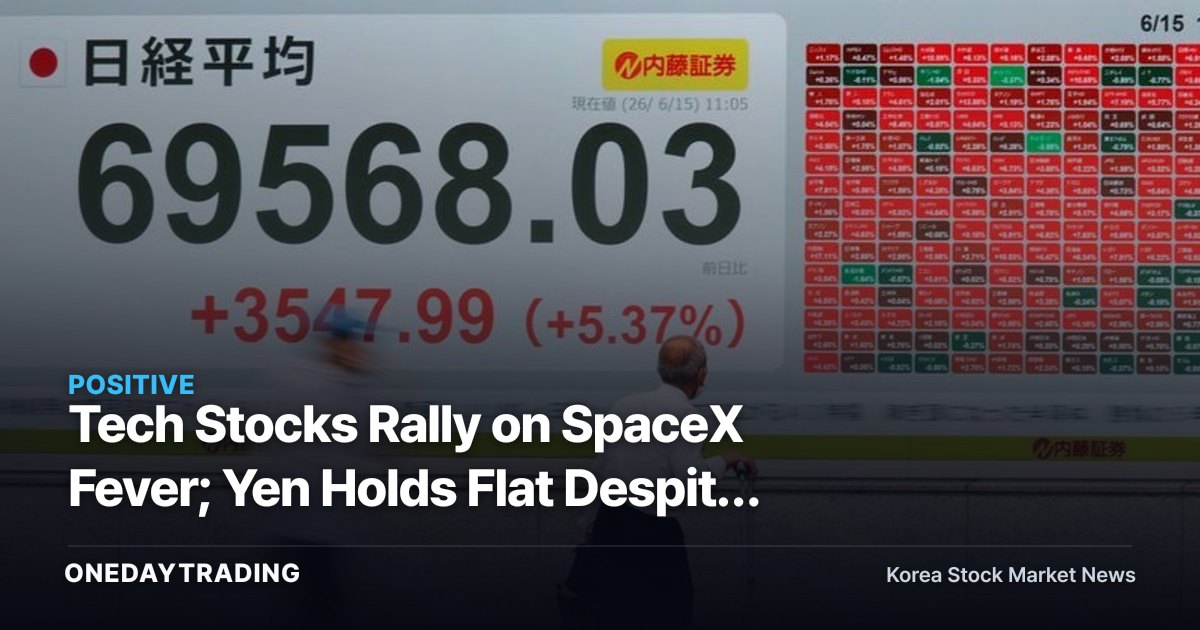
The core of this move runs along two tracks. First, investment fever surrounding the privately held SpaceX spilled over into listed tech and aerospace stocks, stoking risk appetite. Second, the fact that the yen barely moved even after the Bank of Japan (BOJ) raised rates signals that the market sees only limited room for further tightening. For Korean investors, it is time to simultaneously assess the momentum of the space and defense themes and the exporter environment shaped by the yen's movements.
What Happened
As valuations and expectations for SpaceX ballooned rapidly, investor sentiment across space, satellite, and launch-vehicle-related tech stocks improved, and this warmth spread into broad-based tech buying that lifted the market. The character of this rally is not an earnings improvement at a specific company but rather thematic money rotating back into risk assets.
On the same day, the Bank of Japan raised its benchmark interest rate. A rate hike is typically a currency-strengthening factor, yet the yen stayed flat. This suggests that the hike itself was already priced into the market, or that the prevailing interpretation was that the BOJ will be cautious about the pace of further hikes.
Background and Context
Aerospace, long an area dependent on government budgets and security demand, is being rapidly reshaped into a privately led industry. SpaceX's reduction in launch costs and commercialization of satellite communications symbolize this transition, and even as a private company, its valuation serves as a reference point that re-rates the expected returns across the entire listed value chain.
The yen is directly tied to the price competitiveness of Korean exporters. If yen weakness persists, Korean firms that compete with Japanese companies in autos, machinery, and other areas face greater margin pressure, so the BOJ's policy path affects exporters' bottom lines beyond being merely a currency-market issue.
Impact on the Market and Stocks
- Hanwha Aerospace and Hanwha Systems: As Korea's flagship names in the launch-vehicle and satellite value chain, they are direct beneficiary candidates of improving sentiment, as inflows of space-theme money overlap with defense-export momentum.
- AP Satellite and Intellian Technologies: As satellite-communications and antenna-component companies, they are structurally positioned for rising downstream demand as private-sector space commercialization expands.
- Korea Aerospace Industries (KAI): Tied to government space-development projects and aviation and defense orders, it has room for re-rating during a phase of thematic strength.
- Hyundai Motor and Kia: As exchange-rate-sensitive stocks, they are negatively affected when the yen weakens, as price competition with Japanese automakers intensifies, while the burden eases when the yen holds flat or rebounds.
- Tech stocks broadly: A recovery in risk appetite works favorably for the supply-demand (order flow) of high-valuation sectors such as growth stocks and semiconductors.
Investor Checkpoints
- Thematic rallies carry high volatility. For space and defense stocks, it is necessary to confirm whether the trend can be sustained through fundamental events such as actual order disclosures and launch and contract schedules.
- Watch the levels of the yen-dollar and won-yen exchange rates, and check whether the Bank of Japan signals further hikes at its next policy meeting.
- Use the schedule of domestic space-development budget and policy announcements, along with the progress of defense-export contracts, as momentum indicators.
- Because tech stocks are sensitive to the direction of interest rates, monitor shifts in the monetary-policy stance of both the United States and Japan at the same time.
Outlook
If the structural growth of the private space industry dovetails with a recovery in risk appetite, the aerospace and defense value chain has room for re-rating over the medium term. That said, the fact that much of this rally rests on thematic money riding on expectations for a private company is a clear risk. If those expectations cool or the interest-rate environment tilts back toward tightening, high-valuation stocks would be the first exposed to profit-taking pressure, and should the yen turn weak again, the competitive burden on exporters would also grow. Whether the substance of earnings and orders backs up the theme is likely to be the turning point for the trend.
Hanwha Aerospace by Real-Time Data
Hanwha Aerospace's most recent closing price is 1,183,000 won (+9.13% versus the previous day), and the signal light combining foreign investor and institutional investor supply-demand (order flow) with news and momentum is 🟡 Neutral · Wait-and-See. With positive and negative signals mixed, this is a zone to watch.
- ▲ News Flow — 18 positive catalysts vs. 3 negative catalysts — positive catalysts in the lead
Recent related news is favorable, with 18 positive catalysts and 3 negative catalysts.
※ Price and foreign/institutional investor supply-demand (order flow) data are provided by Korea Investment & Securities (KIS) and are as of the time of publication.
This article is content automatically summarized and analyzed from an original news source. View Original (Yahoo Finance)