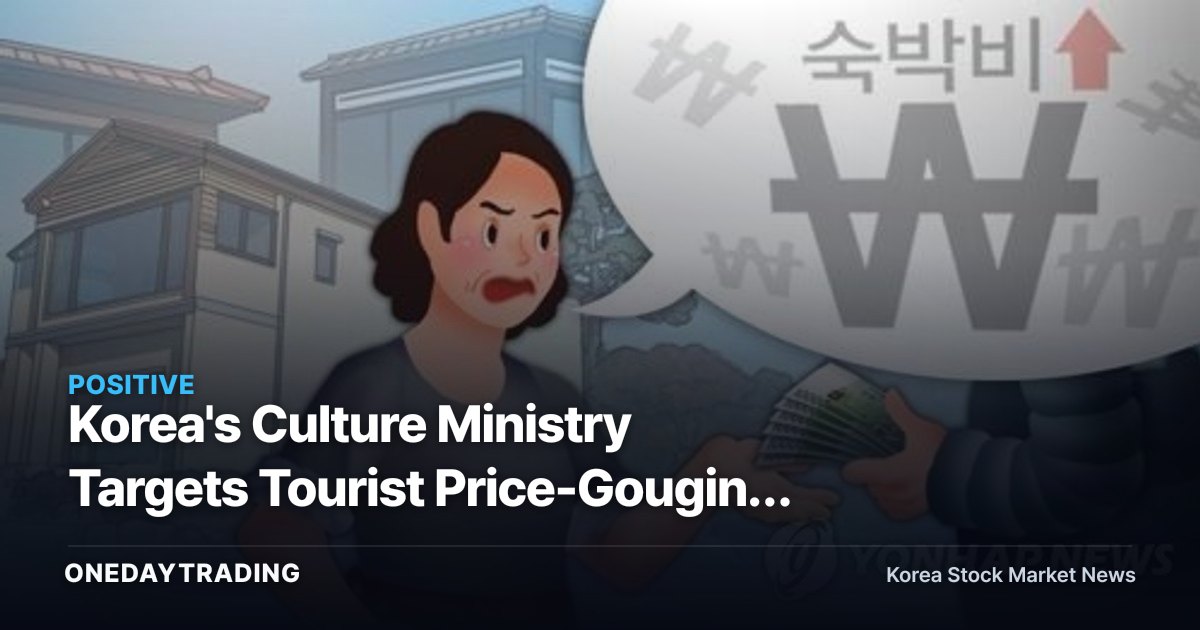

Regulating price-gouging at tourist destinations is not merely consumer-protection administration. The crux is preventing consumers from abandoning domestic travel destinations where price trust has collapsed, thereby protecting the foundation of domestic tourism demand. If, since COVID, the segment of consumers who turned overseas to destinations such as Japan and Southeast Asia instead of traveling domestically was leaving even faster on the grounds of price distrust, this measure could work to underpin structural demand in the travel, lodging, and leisure sectors.
Three-Line Briefing
- The Culture Ministry is pushing to introduce a "price-gouging-safe pricing" scheme to stamp out overcharging at tourist sites.
- Measures to penalize unilateral reservation cancellations without legitimate cause are also being prepared.
- Restoring trust in domestic tourism prices is a medium-to-long-term variable for the travel and leisure sectors, in that it defends domestic travel demand.
What Changes
The center of gravity of this policy is price transparency and transaction stability. The safe-pricing scheme works by presenting reasonable price benchmarks in advance and making the businesses that comply visible — a device that puts the brakes on the practice of peak-season lodging and food prices spiking in a disorderly fashion. As price predictability rises for consumers, the psychological barrier that had been excluding domestic travel from their options is lowered.
Penalizing unilateral reservation cancellations is directly tied to trust in lodging and travel platform transactions. If the behavior of arbitrarily cancelling existing reservations to take in higher-paying guests during peak season recurs, consumers will ultimately become reluctant to book in advance at all, which lowers room occupancy rates and the visibility of advance revenue. Reinforcing transaction stability through regulation is, in the short term, a regulatory burden for some small operators, but for reservation platforms and large lodging and travel operators it becomes a favorable environment that broadens the trading volume base.
That said, the policy's effectiveness hinges on the strength of enforcement. If it remains at the level of guidelines, the real impact on market price formation will be limited; tangible change will emerge only when effective measures such as fines and business sanctions accompany it.
By the Numbers and Context
This announcement itself is a stage that presents the framework of the system rather than specific figures. From an investment perspective, therefore, the meaningful numbers are not the policy wording but the indicators that follow. Domestic travel spending, room occupancy rates, the number of travelers sent on agency packages, and the trend in average spending per customer at hotels and leisure facilities will serve as the yardstick for gauging the policy's effectiveness. If restored price trust translates into actual demand, it will show up as reduced volatility in peak-season revenue and a higher share of advance bookings.
Beneficiary and Disadvantaged Stocks
- Hana Tour and Mode Tour: As leading travel stocks that handle both domestic package and free independent travel bookings, they become a direct channel for a recovery in traveler volume when domestic travel demand is defended. However, given their revenue mix, their reliance on overseas travel is high, so the strength of the benefit is limited.
- Hotel Shilla and Lotte Tour Development: As lodging and integrated-resort operators whose room occupancy rates and advance-booking stability are directly tied to earnings, they stand to gain indirectly from the institutionalization of transaction trust.
- Paradise and Kangwon Land: As casino-and-resort complexes, they are linked to demand for domestic tourism and leisure infrastructure, but they sit at a distance from the policy's core target (lodging and food prices), so their relevance is relatively low.
- Small lodging and dining operators: A potential disadvantaged area that may face margin pressure in the short term as their room to raise prices during peak season narrows.
Risk Check
- If the system ends up at the level of recommendations or campaigns, its real effect on price formation may be negligible.
- The bigger variable for domestic travel stocks' earnings is the exchange rate and competition from overseas travel; policy alone will struggle to lift demand.
- If participation in the safe-pricing scheme is left voluntary, there is a risk that its effectiveness and scope will narrow.
- Many travel and leisure stocks have a large overseas, duty-free, or casino weighting, so the benefit of domestic tourism policy may not be directly reflected in their share prices.
Bottom Line in One Sentence
Restoring price trust is a favorable direction that underpins domestic tourism demand, but it could be overshadowed by bigger variables such as enforcement strength and competition from overseas travel and the exchange rate, so it is reasonable to approach travel and leisure stocks as a gradual positive catalyst.
Hana Tour Through Real-Time Data
Hana Tour's latest closing price is 37,300 won (-1.58% versus the previous day), and the signal light synthesizing foreign and institutional supply-demand (order flow) with news and momentum is 🟡 Neutral · Wait-and-See. Positive and negative signals are mixed, making this a zone to watch.
※ Price and foreign/institutional supply-demand (order flow) data are provided by Korea Investment & Securities (KIS), as of the time of publication.
This article is content automatically summarized and analyzed based on the original news report. View original (Yonhap News, Industry)