
Key Takeaways
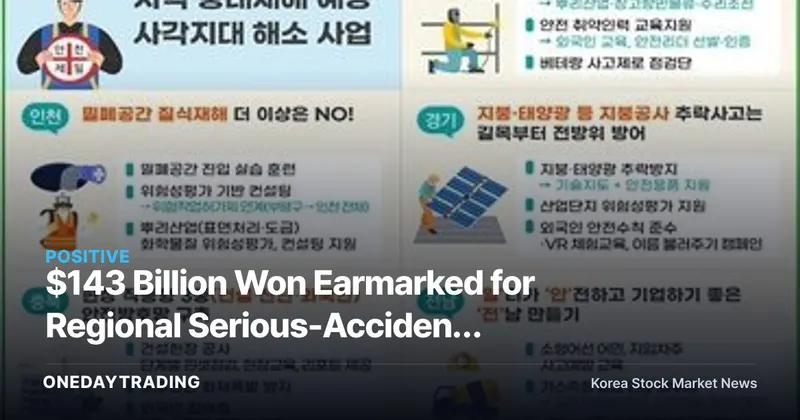
The Ministry of Employment and Labor will invest 14.3 billion won to prevent serious industrial accidents across 11 local governments. The program funds costs such as the installation of safety railings and safety consulting, signaling that the government's industrial-safety policy stance is spreading to the regional level. Direct beneficiaries among listed companies are limited, but the move reflects a structural increase in demand for industrial-safety equipment and services.
What Happened
The Ministry of Employment and Labor announced it will provide a total of 14.3 billion won for serious-accident prevention projects targeting 11 local governments, including Busan, Gwangju, and Jeju. Eligible items include the installation of safety railings to prevent falls and safety consulting costs for diagnosing risk factors.
The program is seen as an effort to extend industrial-safety policy—previously implemented directly by the central government—to the regional level, reducing safety blind spots at small local workplaces and publicly commissioned sites. The backdrop also includes the growing need for prevention infrastructure investment at the local-government level, as the Serious Accidents Punishment Act has strengthened management's accountability for safety and health.
Background and Context
The Serious Accidents Punishment Act provides for the punishment of business owners and chief management officers when serious accidents such as fatalities occur, prompting both companies and public institutions to increase preventive investment. Falls, in particular, are cited as the most frequent cause of death at construction and manufacturing sites, so demand for safety railings and fall-prevention equipment continues to expand.
Direct government financial support acts as priming water to lift safety investment that had been left to market discretion. That said, it should also be noted that the 14.3 billion won is dispersed across 11 local governments, making it too small a program to boost any single listed company's earnings in the short term.
Impact on the Market and Stocks
- Industrial safety equipment sector: As government and local-government orders for safety railings, fall-prevention equipment, and the like increase, the order environment improves for related manufacturing and installation firms.
- Safety consulting and diagnostic services: Support for risk assessment and consulting costs raises demand for safety diagnostics, expanding the occupational safety and health services market.
- Construction and plant sector: Tighter safety regulation is a short-term cost burden, but it is positive for medium- to long-term site operating stability by reducing accident risk.
- Smart safety solutions: The adoption of digital safety technologies, such as Internet of Things–based hazard detection and video monitoring, could draw attention in line with the policy trend.
Investor Checkpoints
- Investors should note that this program is a policy-driven, small and dispersed budget, making it hard to treat as earnings momentum for any specific stock (ticker).
- The key is to confirm whether the structural trend of a strengthened Serious Accidents Punishment Act is the bigger picture underpinning industrial-safety demand.
- It is necessary to check the actual order backlog of safety-equipment and consulting firms, as well as the share of their revenue derived from government and local-government contracts.
- The impact of tighter regulation on the cost structure of construction and manufacturing companies should also be examined from both sides.
Outlook
Optimistically, government and local-government financial investment in serious-accident prevention could serve as a stable growth driver for the industrial-safety market. Combined with digital safety solutions, there is also room for the related industry to expand in scale. However, the 14.3 billion won is a policy budget executed in a dispersed manner, so it is hard to view as a catalyst that directly lifts individual stock prices. Rather than short-term thematic expectations, it is reasonable for investors to focus on the larger trend of a structural increase in industrial-safety demand driven by tighter regulation.
This content was automatically summarized and analyzed based on the original news article. View original (Yonhap News)