
This drop in oil prices should be read not as a simple price move but as a phase in which the Middle East geopolitical risk premium is unwinding. For Korean investors, the key splits into two threads. Refiner stocks, which import crude and live off refining margins, face the burden of inventory valuation losses and margin pressure, while conversely airline and shipping stocks—where fuel costs make up a large share of their cost base—see a path open to benefit from lower expenses. The essence of this issue is that the same news works in exactly opposite directions across sectors.
3-Line Briefing
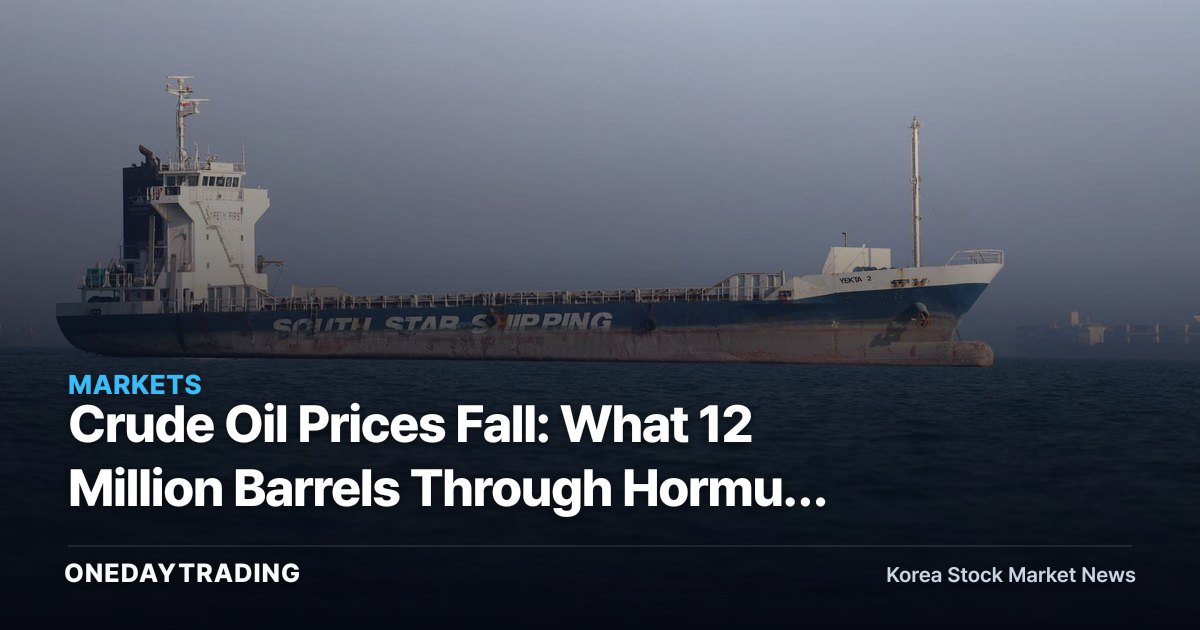
- U.S. Vice President JD Vance noted that more than 12 million barrels a day are passing normally through the Strait of Hormuz, easing concerns over supply disruptions.
- Added to expectations of progress in U.S.–Iran negotiations, the Middle East–driven geopolitical risk premium has come out of oil prices.
- Falling oil prices split into margin and inventory burdens for refiners and E&P, and cost-saving benefits for airlines, shipping, and logistics.
What's Changing
When geopolitical risk escalates, a fear premium gets priced into oil ahead of any actual supply disruption. The Strait of Hormuz is a chokepoint through which a substantial share of the world's seaborne crude volume passes, and a blockade scenario was in itself a catalyst that pushed prices higher. Yet confirmation that more than 12 million barrels a day are passing through without disruption becomes a trigger that reverses that premium.
Add to this the negotiating mood between the U.S. and Iran, and even the possibility of Iranian crude returning to the market comes into play. If sanctions relief materializes, global supply rises and short-term supply-demand (order flow) loosens. In other words, what matters is that this decline is an adjustment driven by reduced supply uncertainty rather than a downturn in demand. A drop driven by slowing demand and one driven by supply relief follow different paths thereafter.
By the Numbers and Context
The key figure is the more than 12 million barrels a day passing through Hormuz. This is direct evidence that the supply shock assumed by blockade fears has not materialized. That said, this figure only means that the peacetime flow is being maintained; it simultaneously carries a two-sided implication that the premium could return if negotiations break down or military tensions reignite. It means that, structurally, there remains room for oil prices to rebound quickly.
Beneficiary and Affected Stocks
- Korean Air, Asiana, low-cost carriers: Fuel costs make up a large share of operating expenses, so a drop in oil prices has a direct margin-improvement effect. However, if the exchange rate moves in tandem, the effect can be offset.
- Shipping and logistics (HMM, etc.): Lower fuel costs such as bunker oil bring a cost-side benefit. But the freight-rate cycle is the bigger variable.
- S-Oil, SK Innovation, GS, HD Hyundai Oilbank (refiners): The potential for valuation losses on crude and product inventories held, plus the burden of refining-margin swings. In a phase of a sharp drop (plunge) in oil prices, the lagging effect can weigh negatively on short-term earnings.
- Chemicals (Lotte Chemical, LG Chem base materials): A decline in feedstock costs such as naphtha is favorable to the cost base, but the benefit is limited unless demand and spreads accompany it.
Risk Check
- If negotiations break down or Middle East military tensions reignite, the risk premium could flow back in quickly and oil prices could retrace.
- If this decline is interpreted not as supply relief but as a signal of slowing global demand, the demand-side burden on airlines and logistics could overwhelm the cost savings.
- The possibility that the supply-demand (order flow) balance tightens again depending on changes in OPEC+ production-cut policy.
- If the won-dollar exchange rate rises in tandem, the benefit of lower import costs is diluted.
One-Line Conclusion
An oil-price drop driven by the easing of supply uncertainty is a textbook setup that splits into a cost-side positive catalyst for airlines and logistics and a margin burden for refiners; gauging the direction requires checking, together, whether negotiations progress along with Hormuz throughput and exchange-rate levels.
This article is content automatically summarized and analyzed based on the original news. View Original (CNBC)