
Key Takeaways
As leverage and inverse products built on individual large-cap stocks proliferate, the intraday volatility of Korea's stock market is widening structurally. Because this volatility is driven by derivatives and fund flow rather than by any change in a specific stock's fundamentals, it should be read as a signal to review your weighting toward diversified, long-term holdings over short-term trading.
What It Means for Investors
The spread of leverage products means that the share prices of core stocks such as Samsung Electronics and SK hynix can move in amplified swings regardless of their fundamentals. When the volatility of stocks you hold rises, stop-losses and chase-buying become more frequent and erode long-term returns, so the product structure itself needs to be recognized as a risk factor.
What Happened
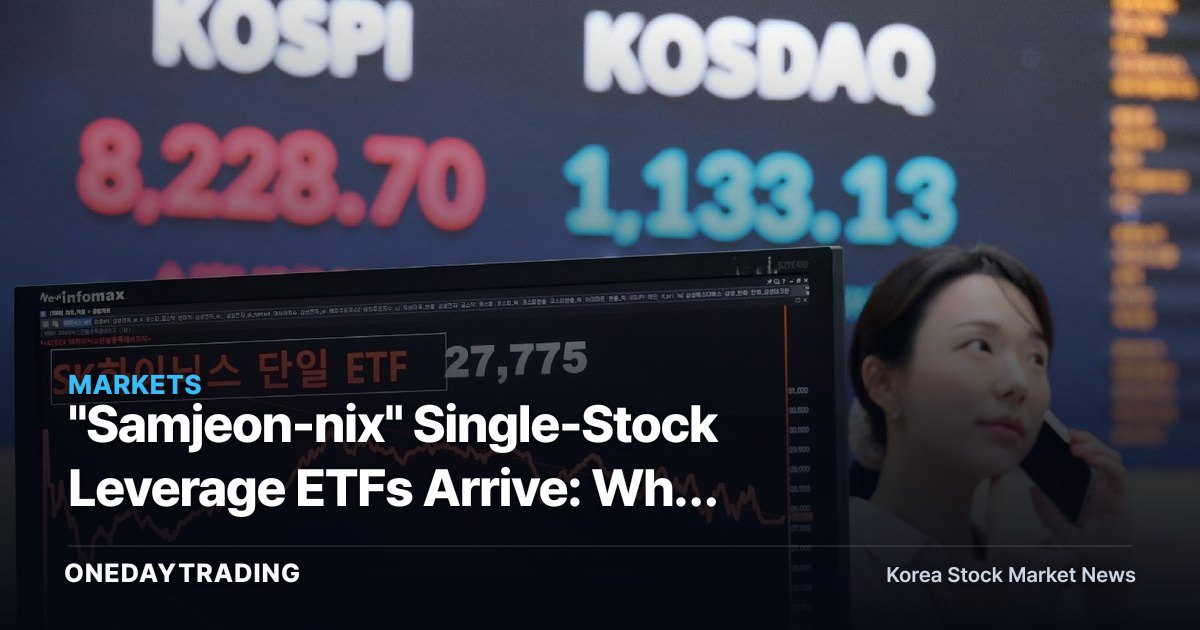
Analysts say Korea's market volatility has noticeably increased since the launch of leverage products linked to Samsung Electronics and SK hynix — the pair colloquially dubbed "Samjeon-nix." Because these products track individual stocks rather than an index at a 2x ratio, price swings are amplified further whenever trading crowds into those names.
Leverage products are designed to track a multiple of daily returns, so holding them long-term through high-volatility periods causes compounding decay — cumulative losses that build up even when the underlying asset returns to its starting point. This is why the column emphasizes retail-investor protection and passive, long-term investing.
Background and Context
A textbook cautionary case is Japan's Nikkei index level of 38,915. After peaking there at the end of 1989, the Nikkei failed to recover its prior high for more than 30 years following the bursting of the bubble. The fact that even an index can stay underwater for so long shows that a volatility-amplifying leverage bet, if mistimed, can lead to losses that are close to irrecoverable.
Impact on the Market and Stocks
- Samsung Electronics: When funds concentrate into the underlying asset of leverage products, intraday swings widen independently of earnings and the industry cycle, raising both short-term trading demand and the perceived risk for long-term investors.
- SK hynix: The more actively a stock trades on memory momentum such as HBM, the more leverage money pours in, exposing it to amplified volatility in which both rallies and declines become steeper.
- Asset managers and brokerages: Expanding single-stock leverage ETF/ETN lineups is favorable for management-fee and trading-commission revenue, but it also comes with the possibility of mis-selling and tighter investor-protection regulation.
- Index ETF market: Rising volatility highlights the relative stability of diversified passive products such as the KOSPI 200, which could stimulate demand for diversification among long-term capital.
Investor Checkpoints
- Check whether the stocks you hold or are watching serve as the underlying asset of any leverage or inverse product, and review whether their intraday swings have widened versus normal.
- If you hold leverage products, keep the holding period short to account for the compounding decay caused by daily rebalancing, and stay wary of cumulative losses in a sideways market.
- Monitor regulators' moves toward tighter rules and disclosure on single-stock leverage products, as well as how frequently the exchange triggers its volatility-mitigation mechanisms.
- Set a cap in advance on the leverage weighting within your overall portfolio, and use these products only to the extent that they do not undermine your diversification and long-term investing principles.
Outlook
Leverage products can be a tool for rapidly growing gains in a bull market, and the trading activity they generate contributes in part to market liquidity. The core risk, however, is that if you mistime your entry during a high-volatility phase, compounding decay and a large drawdown work together to make losses steeper. Since the possibility of a long recovery — as in the Nikkei case — cannot be ruled out, the reasonable approach is to first weigh the product's structure against your own risk tolerance.
Samsung Electronics in Real-Time Data
Samsung Electronics' latest closing price is 351,000 won (+1.30% versus the previous day), and its signal light — combining foreign and institutional supply-demand (order flow) with news and momentum — is 🟢 Buy bias. News and momentum are positive, making it worth a look.
- ▲ Trend alignment — short- and mid-term aligned to the upside (today +1.3% · 1 week +16.0% · 1 month +29.8%)
- ▲ 52-week position — 94% in the upper 52-week range — new-high territory
- ▲ News flow — 26 positive catalysts vs. 8 negative catalysts — positive bias
Recent related news is favorable, with 26 positive catalysts and 8 negative catalysts.
※ Price and foreign/institutional supply-demand (order flow) data are provided by Korea Investment & Securities (KIS), as of the time of publication.
This article is content automatically summarized and analyzed based on the original news. View the original (Maeil Business Newspaper, Securities)