What Changes
The headline is a ranking, but the real story is product mix. Toyota built its U.S. volume around hybrids — gasoline-electric drivetrains that need no charging infrastructure, carry a smaller battery, and sit at price points mainstream buyers already accept. That made the lineup resilient exactly when EV demand growth cooled, letting Toyota convert hesitant EV shoppers into hybrid sales rather than losing them.
GM took the opposite path, committing heavily to a battery-electric roadmap. When consumer adoption ran below plan, that capital sat in slower-moving inventory and underused EV capacity, while the margin engine remained trucks and SUVs. The forecast narrowing is the market pricing in who guessed right about how fast Americans would actually switch.
For investors, the lesson is that powertrain flexibility now reads as a defensive asset. A hedged lineup spanning gas, hybrid and EV absorbs demand swings better than a concentrated all-electric pivot.
By the Numbers
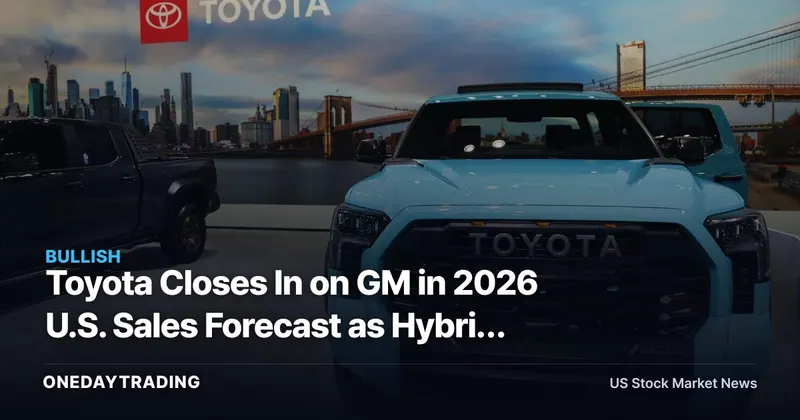
The concrete data point is directional: the updated U.S. sales forecast has Toyota closing the gap on GM, prompting the on-the-record caution that GM may be looking over their shoulder. The driver cited is lower-than-expected EV adoption against Toyota's hybrid emphasis. Investors should anchor the thesis to hard monthly and quarterly U.S. delivery figures and hybrid versus EV mix disclosures rather than the forecast alone.
Winners & Losers
- Toyota (TM) — primary beneficiary; hybrid-weighted mix matches current demand and supports volume without heavy charging-dependent risk.
- General Motors (GM) — pressured; concentrated EV investment meets softer adoption, raising scrutiny on EV unit economics and capital allocation.
- Ford (F) — read-through risk and opportunity; its own hybrid-plus-EV balance becomes a competitive reference point.
- EV-pure names and battery/charging suppliers — softer near-term volume if the hybrid bridge persists longer than the all-electric timeline assumed.
Risk Check
- A forecast is not a delivered result; actual registration and sales data can revise the gap in either direction.
- Policy shifts on emissions rules or EV incentives could re-accelerate battery-electric demand and reward GM's earlier investment.
- GM still earns its core profit from high-margin trucks and SUVs, which a sales-ranking narrative understates.
- Hybrid leadership does not guarantee long-run EV positioning if the transition resumes at speed.
Bottom Line
Toyota's narrowing of GM's lead validates a hybrid bridge strategy for today's hesitant EV buyer, but the advantage is demand-timing, not destiny — if EV adoption reaccelerates on policy or price, GM's heavier electric investment could swing back into favor.
Market data check: TM
TM last traded near $167.7 (+0.28%). Our composite signal — blending price momentum and news flow — reads 🟡 neutral. Price momentum scores 52/100.
Data as of publication. Price via market feeds; for reference only, not investment advice.
📊 Analysis
Signal Bullish
Why Toyota's hybrid-led mix is gaining U.S. sales share on GM as EV adoption disappoints, a demand-aligned tailwind for TM.
This article was independently written by OneDayTrading from public reporting. Read the original (CNBC)