What Changes
A software release should not generate a stock's best session in over a year unless the market had been quietly pricing in a missed milestone. That is the mechanism here. Tesla's self-driving update arrived after a prolonged period of investor frustration, and the relief rally is proportional to how much doubt had accumulated — not necessarily to how transformative the update itself is. The capital for developing the system has already been deployed; what the market is now debating is whether the return on that investment is real and near-term enough to justify the embedded premium.
The month-to-date decline heading into the update day sharpens this read. Tesla's equity had been drifting in a sentiment void, with delivery dynamics and margin pressure keeping institutional buyers cautious, the valuation premium hinging almost entirely on autonomy optionality. That optionality just received its first tangible refresh. Whether it holds depends less on the software version itself and more on the regulatory timeline for commercial deployment — a variable entirely outside Tesla's direct control.
The competitive backdrop adds urgency. Every quarter that Tesla delays a material self-driving milestone, Alphabet's Waymo accumulates real-world autonomous miles in live commercial markets. The update resets that competitive perception clock — at least in the market's eyes — but the distance between a software release and a monetizable autonomous product remains substantial and largely non-technical in nature.
By the Numbers
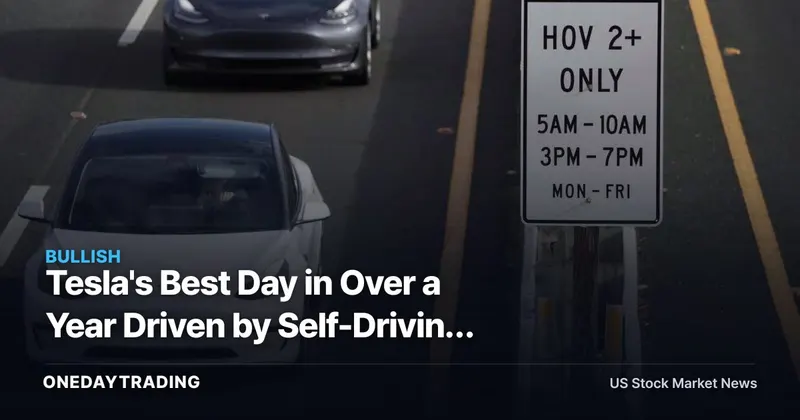
Tesla's stock recorded its best single-day performance in over a year — a threshold that reveals how compressed sentiment had become ahead of the update. Yet the stock remains negative for the month, meaning the session's gain reversed part of a broader drawdown rather than establishing new high ground. That distinction matters: a stock recovering from a sentiment hole on a catalyst must demonstrate sustained buying to validate a genuine re-rating rather than a technical bounce. The month-long slide is not erased; it is paused.
Winners & Losers
- TSLA — Direct beneficiary. The update reactivates the technology platform thesis that separates Tesla's multiple from traditional automakers. Follow-through depends on whether software progress translates into measurable FSD subscription growth or commercial autonomous fleet announcements.
- MBLY (Mobileye) — Indirect pressure. As Tesla advances its proprietary vision-only autonomous stack, it reduces the rationale for third-party ADAS suppliers. Mobileye's customer diversification is its structural defense, but Tesla's momentum is a persistent long-term overhang on that story.
- GOOGL (Waymo) — Competitive read. A credible Tesla self-driving advance narrows Waymo's perceived lead in the robotaxi race. Waymo's edge is its operational commercial deployments; Tesla's counterpunch is the sheer size of its on-road fleet already gathering real-world data.
- GM — Weak relative position. General Motors' Cruise robotaxi program has faced significant operational setbacks, making it the most exposed legacy automaker when a competitor demonstrates autonomous credibility. The perception gap widens on sessions like this one.
- UBER — Dual read. As a potential robotaxi network partner, Uber benefits from broader autonomous progress long-term; near-term, any acceleration toward Tesla-operated robotaxi services would directly compete with Uber's core ride-hail business.
Risk Check
- Regulatory latency: a software update is not a deployment permit. NHTSA oversight and state-level frameworks can delay commercial rollout indefinitely regardless of how capable the system becomes technically.
- Safety incident exposure: any high-profile accident involving the updated system triggers regulatory scrutiny that can reverse a sentiment rally faster than it built — this is the embedded binary risk in every autonomous-driving catalyst move.
- Monthly trend unresolved: shares remain negative for the period, so buyers who stepped in carry unrealized losses from earlier in the month, an overhang that can cap upside if no additional catalyst materializes quickly.
- Valuation already prices optionality: Tesla's multiple embeds a meaningful probability of autonomous success. If this update proves incremental rather than step-change, the premium can compress even if the core EV business improves.
Bottom Line
Tesla's best single session in over a year is a genuine sentiment catalyst — but the month-long drawdown it surfaced from is a reminder that autonomy promises require deployment proof to sustain a premium. The capital cycle for self-driving has been running for years; what changes now is whether this update materially compresses the timeline from software capability to commercial revenue. The concrete checkpoints to track are any follow-on regulatory filings, supervised-autonomy expansion announcements, or FSD subscription-rate disclosures that would convert today's technical release into a monetizable product event. Without those, the rally is a sentiment unlock — and sentiment unlocks that lack fundamental follow-through tend to surrender more than half their gains before the next quarter closes.
Market data check: TSLA
TSLA last traded near $411.84 (+8.46%). Our composite signal — blending price momentum and news flow — reads 🟡 neutral. Price momentum scores 95/100 (firm).
Data as of publication. Price via market feeds; for reference only, not investment advice.
📊 Analysis
Signal Bullish
Why A long-awaited self-driving software update triggered Tesla's best single-day stock gain in over a year, re-igniting the autonomy premium that lifts Tesla's multiple above pure-play automakers.
Tickers$TSLA$GOOGL$GM$UBER$MBLY
This article was independently written by OneDayTrading from public reporting. Read the original (MarketWatch)