Summary
Tesla's expansion at Gigafactory Berlin and Volkswagen's announcement of 100,000 job cuts are not opposite ends of a cyclical swing — they are the same structural story told from two sides of the cost curve. Legacy European auto manufacturing, built for combustion-engine volumes and union-protected headcount, is retreating precisely where a vertically integrated EV pure-play is pressing forward, and the capacity gap that opens between them is durable, not temporary.
The Full Story
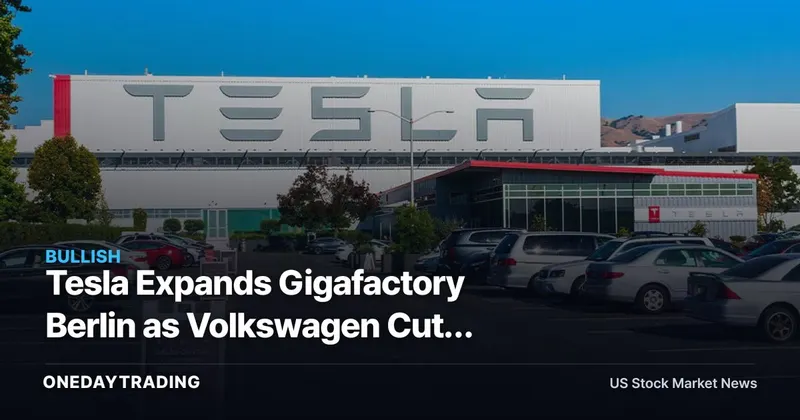
Gigafactory Berlin is Tesla's most strategically valuable asset in Europe for one concrete reason: it manufactures inside the EU tariff wall. Model Y units assembled in Grünheide avoid the import duties that now apply to Chinese-built EVs, giving Tesla a landed-cost advantage over its own Shanghai-produced vehicles and over Chinese OEM entrants simultaneously. Expanding output at that plant — rather than absorbing European demand from Fremont — also compresses per-unit logistics costs and shortens customer delivery lead times, two variables that drive incremental purchase decisions in a market where EV adoption is price-sensitive and subsidy regimes are shifting.
Volkswagen's 100,000-job reduction is the arithmetic result of a cost structure built for a world that is ending. VW's German plants carry labor costs that are structurally elevated relative to Asian competitors, and the EV powertrain transition accelerates the imbalance: electric drivetrains require fewer assembly hours than combustion equivalents, meaning the same workforce produces the same revenue with a larger fixed-cost overhang. Cutting at this scale — the deepest restructuring in VW's post-war history — signals that management has concluded organic efficiency measures cannot close the gap without hard capacity withdrawal. That is a fundamentally different posture than a one-cycle adjustment.
The European EV market remains the world's second-largest by registration volume. Subsidy withdrawals in Germany and France have already softened aggregate demand growth, which means the competition for remaining demand is intensifying on price, range, and software — dimensions where Tesla has structural advantages and VW is still mid-retool. Tesla expanding into that environment while its largest European competitor contracts is a market-share thesis with a physical-capacity mechanism behind it.
Structural Background
Legacy OEMs entered the EV cycle with fixed-cost bases calibrated for internal-combustion economics and co-determination labor laws that give works councils formal veto power over restructuring speed. Germany's Mitbestimmung framework means VW's 100,000-job target is a negotiating opening, not a guaranteed outcome — actual headcount reduction will move slower and cost more than the headline implies, extending the margin drag. Tesla operates in Grünheide under German labor law as well, but without the legacy workforce base or union representation depth that constrains VW's flexibility.
Stock and Sector Ripple
- TSLA — Direct beneficiary: European domestic production expands tariff-sheltered capacity and reduces policy exposure; a higher share of European deliveries manufactured locally improves unit economics on a per-vehicle basis.
- VWAGY — Restructuring at this scale carries execution risk under German labor law; cost savings will be slower to materialize than the headline job number suggests, and the competitive gap with Tesla in software-defined vehicles is not closed by headcount cuts alone.
- F, GM — Analogous cost-structure pressures apply as EV mix rises and ASPs compress; VW's trajectory is a leading indicator for how combustion-era fixed costs interact with EV transition economics across all legacy OEMs.
- RIVN — Smaller EV pure-plays may attract attention as legacy incumbents visibly contract, though RIVN cash runway and production ramp remain the primary stock-specific variables independent of this narrative.
- Lithium and battery supply chain — Incremental Gigafactory Berlin output volumes drive additional cell demand; suppliers tied to Tesla European offtake agreements benefit from ramp confirmation.
Bull vs Bear Scenarios
Bull: Tesla hits targeted weekly build rates at Grünheide ahead of schedule, VW's restructuring accelerates its own EV pivot and validates the market-structure thesis, and EU-China tariff escalation widens the value of Tesla's domestic European manufacturing footprint. European market share gains are structural, not cyclical.
Bear: German regulatory friction and works-council negotiations slow Tesla's own expansion permitting; aggregate European EV demand stagnates as subsidy withdrawal effects persist across France, Germany, and the UK; and Chinese OEMs successfully navigate tariffs through local joint-venture structures, eroding the competitive moat Tesla is trying to build. Adding capacity into a demand air pocket is a cost, not an asset.
Investor Action Points
- Track Tesla's Q3 European delivery figures and any Gigafactory Berlin run-rate commentary on the earnings call — the expansion thesis has a specific production metric that should show up in the numbers within two quarters.
- Monitor VW works-council negotiations for actual headcount reduction pace versus the 100,000 headline; slower execution extends the cost-drag timeline and has direct read-through to VWAGY margin estimates.
- Watch monthly EU EV registration data from ACEA — if industry volumes remain soft, Tesla share gains become the variable that matters more than absolute output growth.
- Track EU-China trade policy: any escalation in EV-specific tariffs increases the strategic value of Berlin-assembled units; any negotiated rollback narrows that moat and reopens the Shanghai supply option for European customers.
Market data check: TSLA
TSLA last traded near $379.71 (+1.22%). Our composite signal — blending price momentum and news flow — reads 🟡 neutral. Price momentum scores 60/100 (firm).
Data as of publication. Price via market feeds; for reference only, not investment advice.
📊 Analysis
Signal Bullish
Why Tesla gains tariff-sheltered European capacity and market-share positioning precisely as its largest European competitor undergoes the deepest cost-driven restructuring in its post-war history, a structural divergence that favors TSLA unit economics and share gains.
Tickers$TSLA$VWAGY$F$GM$RIVN
This article was independently written by OneDayTrading from public reporting. Read the original (Yahoo Finance)