What Changes
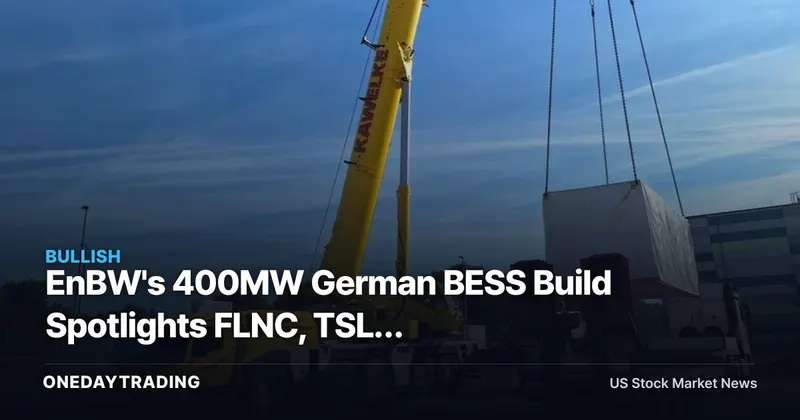
A construction start is a hard commitment of capital, not a press-release intention. EnBW moving dirt on 400MW means hardware procurement is locked: lithium-iron-phosphate cells, power-conversion systems, transformers and balance-of-plant. That is where U.S.-listed names participate, because the value of a BESS project sits in the integrator stack, not in the utility that owns the asset.
Germany's grid is the structural driver. As coal and nuclear retire and intermittent wind and solar dominate new generation, the system needs hours of fast-responding storage to firm output and arbitrage price swings. A single 400MW plant does not solve that, but it signals where capital allocation is heading for the utilities building the Energiewende grid.
For investors, the cleaner expression is the supplier tier. Fluence Energy is a pure-play grid-storage integrator with a European footprint; Tesla's Megapack competes for the same utility contracts; GE Vernova supplies grid and storage equipment. Each converts projects like this into backlog before it shows up in revenue.
By the Numbers
The disclosed figure is 400MW of power capacity. The economically decisive number EnBW has not specified here is duration in megawatt-hours, which determines cell volume and contract value far more than the headline megawatts. A 400MW system at two hours is a very different order than at four. Treat the 400MW as a demand marker, not a sized contract win for any single supplier.
Winners & Losers
- FLNC (Fluence Energy) — pure-play grid integrator; European utility BESS builds map most directly to its addressable backlog and book-to-bill.
- TSLA (Tesla) — Megapack energy-storage deployments are a high-margin growth line; every utility tender expands its pipeline.
- GEV (GE Vernova) — grid and storage equipment supplier leveraged to European transmission and firming demand.
- EnBW (not U.S.-listed) — bears the capex and execution risk; upside accrues only if storage arbitrage and capacity revenue clear its cost of capital.
- Coal and gas peakers — incremental loser as storage erodes the economics of fossil firming on the German grid.
Risk Check
- No award named: this is a utility project, not a confirmed supplier contract, so attribution to any U.S. name is inference.
- Single project: 400MW is not a sector inflection; one build does not reset European storage demand.
- Margin pressure: BESS integration is competitive and cell-price sensitive; volume can grow while integrator margins compress.
- Duration unknown: without MWh, contract value and cell demand cannot be sized.
Bottom Line
EnBW's groundbreaking is a concrete demand signal for grid-scale storage in Europe's largest power market, and the practical beneficiaries are the U.S.-listed integrators and battery suppliers that feed it. The upside is a thickening European pipeline for FLNC, TSLA and GEV; the live risk is that headline megawatts without a named contract, disclosed duration or pricing tell you direction but not magnitude. Track next-quarter book-to-bill and any supplier announcement to confirm who actually captures the order.
Market data check: FLNC
FLNC last traded near $19.27 (-0.57%). Our composite signal — blending price momentum and news flow — reads 🟡 neutral. Price momentum scores 45/100.
Data as of publication. Price via market feeds; for reference only, not investment advice.
📊 Analysis
Signal Bullish
Why A 400MW German BESS construction start signals incremental grid-scale storage demand that flows to U.S.-listed integrators and battery suppliers, even though no supplier contract is named.
This article was independently written by OneDayTrading from public reporting. Read the original (Yahoo Finance)