Summary
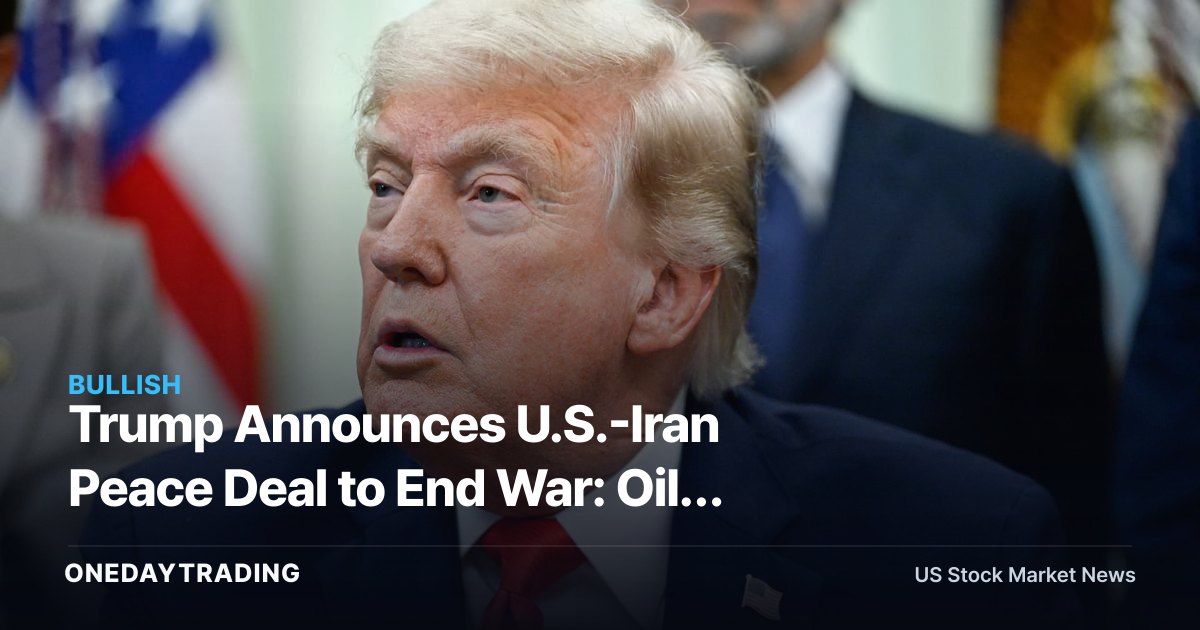
President Trump, alongside Pakistan, announced that the United States and Iran have agreed to a peace deal aimed at ending the war. The announcement follows weeks of conflicting signals from both Washington and Tehran about the direction of the conflict. For markets, a credible Middle East de-escalation typically pulls geopolitical risk premium out of oil and lifts risk appetite.
The Full Story
According to statements from Trump and Pakistan, the two sides have reached an agreement to halt hostilities. The path here was anything but linear — for weeks both Washington and Tehran sent mixed messages on whether the situation was escalating or cooling, leaving investors to price an uncertain range of outcomes.
The involvement of Pakistan as a party confirming the deal is notable, signaling regional diplomacy rather than a purely bilateral arrangement. While the precise terms were not detailed, the framing as an end to the war is the key market variable. If the ceasefire holds, the immediate effect is the unwinding of the war-risk premium that had been embedded across energy and safe-haven assets.
Structural Background
Middle East conflicts involving Iran carry outsized weight for global energy markets because of the region's role in crude supply and the strategic importance of shipping routes such as the Strait of Hormuz. Periods of confrontation tend to push crude oil prices and volatility higher, while resolutions reverse that flow. Equity markets generally welcome reduced geopolitical uncertainty, as it lowers input costs for energy-intensive industries and supports consumer sentiment.
Stock & Sector Ripple
- XOM, CVX — Oil majors could face downward pressure on crude prices if the war-risk premium deflates, weighing on energy earnings expectations.
- DAL, UAL — Airlines benefit from lower jet-fuel costs and improved travel demand when geopolitical tension eases.
- LMT, RTX — Defense names may see sentiment soften if conflict-driven demand narratives cool, though long-term budgets are sticky.
- SPY, QQQ — Broad U.S. equities tend to rally on de-escalation as risk appetite returns and the safe-haven bid fades.
Bull vs Bear Scenarios
Bull: A durable ceasefire removes a major overhang, cooling oil prices, easing inflation pressure and clearing a path for risk assets to advance. Lower energy costs flow through to corporate margins and consumer spending.
Bear: Given weeks of mixed messaging, the deal could prove fragile. A breakdown would snap the risk premium back into oil and equities, and headline-driven volatility may persist until terms are verified and implemented on the ground.
Investor Action Points
- Watch crude oil and energy equities for confirmation that the war-risk premium is actually unwinding.
- Treat the announcement as headline-stage news; verify durability before repositioning aggressively.
- Consider that airlines and energy-sensitive sectors are the cleanest expressions of a de-escalation trade.
- Keep hedges in place against the risk that fragile terms collapse and volatility returns.
📊 Analysis
Signal Bullish
Why A Middle East peace deal removes geopolitical risk premium, typically lowering oil prices and lifting broad equity risk appetite.
Tickers$XOM$CVX$DAL$LMT$SPY
This article was independently written by OneDayTrading from public reporting. Read the original (CNBC)