At a Glance
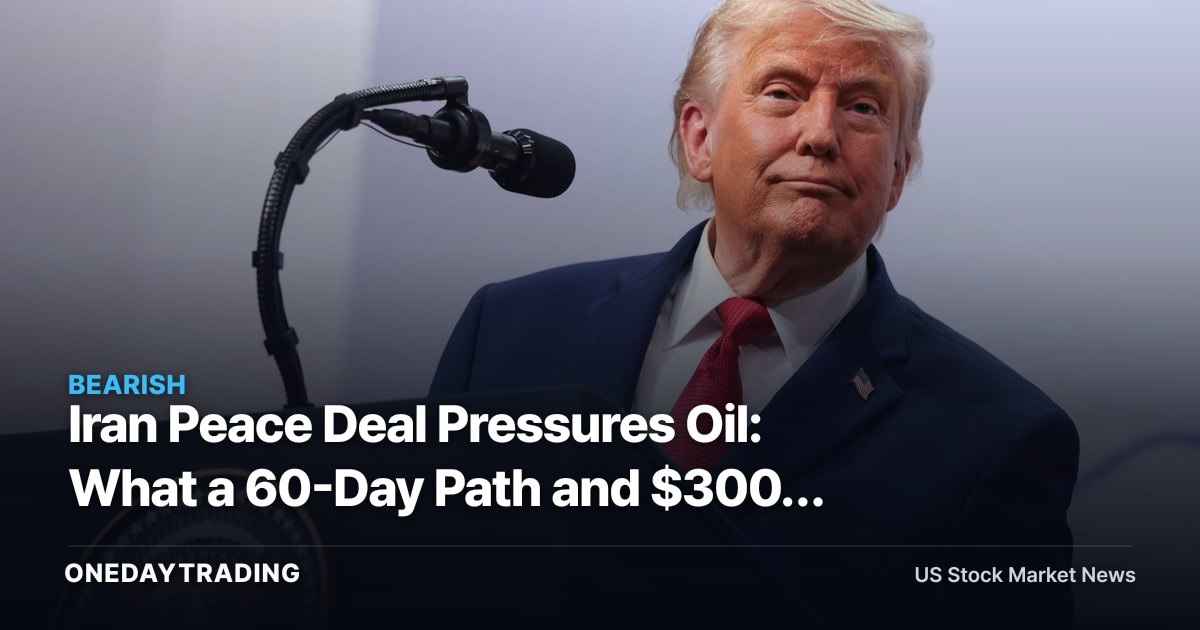
A tentative U.S.-Iran framework that commits both sides to 60 days of further talks toward a final agreement, paired with a proposed $300 billion plan for Iran's reconstruction, reshapes the geopolitical risk premium that has supported crude. The clearest market channel runs through oil supply: any path to sanctions relief raises the prospect of more Iranian barrels reaching global markets.
Why It Matters Now
For two years, Middle East tension has acted as a floor under oil prices by threatening supply through the Strait of Hormuz and Iranian export routes. A negotiated de-escalation works in the opposite direction. If the 60-day window produces a durable deal, sanctions easing could gradually return Iranian crude to legal channels, adding barrels at a time when demand growth is uneven. That is a structural negative for spot crude and, by extension, for the upstream-heavy earnings of integrated producers.
The effect is not uniform. Lower input costs help refiners and transport-intensive businesses, so the same headline that pressures producers can support margins downstream. A $300 billion reconstruction program, if funded and executed, would also create multi-year demand for engineering, construction, and industrial equipment — though sequencing, financing, and political durability make that a slow-burn theme rather than an immediate catalyst.
Investors should treat this as a probability shift, not a settled outcome. A framework that depends on 60 days of negotiation can stall on verification, sanctions sequencing, or domestic opposition on either side. Crude often reprices the risk premium first and re-adds it quickly if talks fray.
FAQ
- Why does an Iran deal pressure oil prices? Sanctions relief could legalize and expand Iranian crude exports, adding supply to a market where demand growth is modest, which weighs on prices.
- Who benefits from cheaper crude? Refiners, airlines, and shippers see input costs fall, partially offsetting weaker upstream producer economics.
- Is the $300 billion reconstruction tradable now? Not immediately — funding and execution would unfold over years, making it a longer-horizon industrial theme.
- What could reverse the move? A breakdown in the 60-day talks would restore the geopolitical risk premium and lift crude.
Related Stocks & Sectors
- ExxonMobil (XOM), Chevron (CVX): Upstream-weighted earnings are most exposed to softer crude prices from added supply.
- Refiners (Valero, Marathon Petroleum): Lower feedstock costs can support crack spreads if product demand holds.
- Airlines (Delta, United): Fuel is a major cost line; cheaper jet fuel improves operating leverage.
- Defense (Lockheed Martin, RTX): Sustained de-escalation can compress the conflict-driven sentiment premium, though program backlogs are slow to change.
- Engineering and construction: A reconstruction program is a potential multi-year demand source if financing materializes.
What to Watch
- The 60-day negotiation milestones and any concrete sanctions-relief language.
- Crude price levels and how quickly markets price in or out the risk premium.
- Signals on Iranian export volumes and whether barrels move to legal channels.
- Funding structure and political backing for the $300 billion plan before treating it as real demand.
Overall Outlook
The bull case for oil consumers and the bear case for producers both hinge on the same variable: whether talks convert into enforceable sanctions relief. If they do, added Iranian supply pressures crude and integrated majors while aiding refiners and airlines. The counter-scenario is real — frameworks that rely on a 60-day runway frequently slip, and a stall would re-anchor the geopolitical premium and reverse the trade. Position sizing should respect that headline-driven volatility cuts both ways.
📊 Analysis
Signal Bearish
Why A U.S.-Iran framework toward sanctions relief raises the prospect of additional Iranian crude supply, pressuring oil prices and upstream-heavy producer margins.
Tickers$XOM$CVX$VLO$DAL$LMT
This article was independently written by OneDayTrading from public reporting. Read the original (CNBC)