What Changes in the U.S.-Canada Trade War
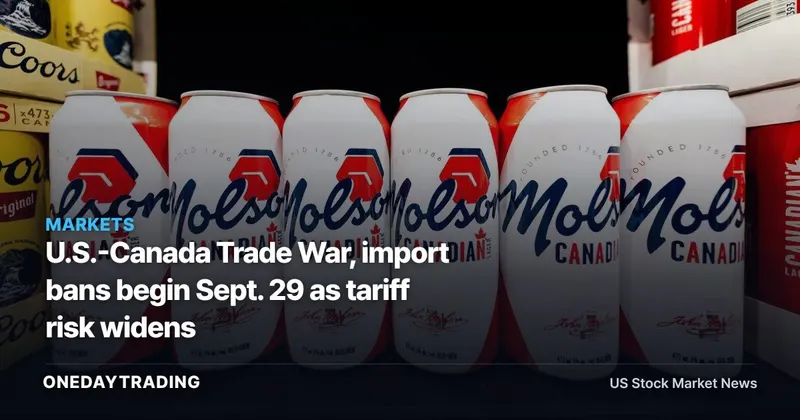
The sharpest market read-through is that trade policy is moving from border taxes toward selective bans. The White House said imports of Canadian whey products, molasses, nonalcoholic beer, alcoholic drinks, larger-capacity motorcycles and mopeds will be prohibited from Sept. 29, 2026. CNBC Markets reported that these restrictions largely replace 50% tariffs on the affected goods.
That distinction matters for businesses. A tariff raises the landed cost of an imported product; an import ban removes the ordinary transaction route altogether unless rules later change. The fact sheet does not state how long the bans will last, so companies cannot yet translate the announcement into a fixed earnings impact. They must instead plan around an unresolved policy duration and the possibility of additional measures.
Other Canadian products face a different channel. The U.S. announced modified and extended tariffs beginning Sept. 15, with all-terrain vehicles and animal hides added while rock salt and cement were removed. Jamieson Greer described the action as a “natural consequence of Canada's continued discriminatory treatment of crucial American exports,” while Canadian Prime Minister Mark Carney said Canada's tariffs were necessary to protect businesses, workers and communities.
Those competing explanations are themselves part of the risk. Justin Angotti of Reed Smith said companies on both sides would need to wait to see whether the tariffs hold, whether more measures are enacted or whether the countries de-escalate. He said businesses would face tariff, compliance and uncertainty-related costs during that wait.
By the Numbers: A Two-Way Cost Shock
Canada's same-day response covered more than 700 goods and was valued at 27.6 billion Canadian dollars, or $20 billion, according to CNBC Markets. The targeted sectors span industrial inputs and consumer categories, so the transmission mechanism is broader than a single product line: importers may face higher costs, suppliers may lose access, and distributors may need to revise sourcing or inventory decisions.
The measures sit inside a $715.5 billion trade-in-goods relationship between the U.S. and Canada. The existing tariffs apply to a relatively small portion of that total, but the scale of the bilateral relationship means that uncertainty can reach businesses that are not directly listed in an order if they depend on cross-border logistics or demand.
The chronology is also important. U.S. tariffs took effect Aug. 22 after trade talks broke down. Canadian measures were announced for the same day as the latest U.S. action. A further potential shock is dated Jan. 1, 2027, when the U.S. has threatened a 50% tariff on cars, trucks and auto parts. The fact sheet does not provide the value of that threatened tariff or confirm that it will ultimately begin.
Alcohol provides the clearest observed evidence of how retaliation can affect trade flows. U.S. spirits exports to Canada fell more than 70% year on year from the start of the retaliatory ban in March 2025 through December 2025, according to the Distilled Spirits Council of the United States. Chris Swonger, the group's president and CEO, said American distillers had “shouldered the brunt of this trade dispute.” That decline is a reported historical result for the stated period, not a forecast for future sales.
Winners & Losers
- Canadian producers of banned goods: Whey, molasses, nonalcoholic beer, alcoholic drinks and larger-capacity motorcycles and mopeds lose access to the U.S. market under the restrictions scheduled for Sept. 29. The fact sheet does not identify replacement markets or quantify company-level revenue exposure.
- U.S. spirits exporters: The sector has already experienced a more than 70% year-on-year decline in exports to Canada during March–December 2025, according to the Distilled Spirits Council of the United States. The latest measures keep the policy channel active and leave the timing of any recovery uncertain.
- Cross-border small and medium-sized businesses: Angotti's assessment points to tariff, compliance and uncertainty costs on both sides. These firms may have less flexibility to absorb new border procedures, although the fact sheet does not provide margin or employment estimates.
- Businesses tied to autos and industrial supply chains: Cars, trucks and auto parts face a threatened 50% U.S. tariff from Jan. 1, 2027. That is a future policy risk rather than a confirmed financial result, and the fact sheet does not establish which listed companies would be most exposed.
- Potential alternative trade relationships: Ottawa is eyeing closer trade and security ties with the European Union as its Washington relationship deteriorates, according to the supplied reporting. No agreement, value or timing is confirmed, so investors should treat this as a possible direction rather than an established offset.
Risk Check
- Duration risk: The fact sheet does not state how long the import bans or tariff measures will remain in force. A short-lived restriction and a permanent barrier would have very different effects on inventory, contracts and capital allocation.
- Escalation risk: The Sept. 15 tariff modifications, the Sept. 29 bans and the threatened Jan. 1, 2027 auto tariff create several policy dates at which the dispute could broaden. The fact sheet does not confirm whether additional sectors will be targeted.
- Demand and substitution risk: The 70% decline in U.S. spirits exports to Canada shows that consumer-facing trade can contract sharply during retaliation. It does not show whether Canadian buyers permanently switch suppliers or return if restrictions ease.
- Negotiation risk: Carney said Canadian tariffs would “come with a cost,” while Greer defended the U.S. action. The article does not state whether the two governments will reach a negotiated trade agreement, leaving the policy path unresolved.
Bottom Line
The U.S.-Canada dispute has entered a more disruptive phase: selected Canadian goods are set for import bans on Sept. 29, Canadian tariffs cover more than 700 U.S. goods worth 27.6 billion Canadian dollars, and a 50% auto tariff is threatened for Jan. 1, 2027. That combination raises the probability of higher border, compliance and sourcing costs, while the $715.5 billion goods relationship leaves plenty of room for broader spillovers. The upside case is de-escalation or a negotiated settlement that reopens affected channels; the live downside is that the Sept. 15 and Sept. 29 measures become stepping stones toward wider restrictions. Investors should track implementation at those dates and any policy change affecting autos, alcohol, dairy and industrial goods.
FAQ
When do the U.S. bans on Canadian goods take effect?
The import restrictions are scheduled to take effect on Sept. 29, 2026, according to CNBC Markets. They cover Canadian whey products, molasses, nonalcoholic beer, alcoholic drinks, larger-capacity motorcycles and mopeds, among other products identified by the White House.
How large are Canada's retaliatory tariffs on U.S. imports?
Canada's tariffs target more than 700 goods and are valued at 27.6 billion Canadian dollars, or $20 billion, according to the fact sheet. The affected categories include steel, dairy, farm equipment, pulp and paper, electronics and other goods.
Is a 50% tariff on Canadian autos already in force?
No. The fact sheet describes a threatened 50% U.S. tariff on cars, trucks and auto parts beginning Jan. 1, 2027. It does not provide the tariff's exact value or confirm that the measure will ultimately take effect.
📊 Analysis
Signal Neutral
Why The measures create clear cost and disruption risks, but the fact sheet does not establish a lasting outcome or negotiated resolution.
This article was independently written by OneDayTrading from public reporting. Read the original (CNBC Markets)