Key Takeaways
Brent crude futures rose 0.9% to $102.10 per barrel for November delivery on Thursday morning, while West Texas Intermediate crude futures gained 1% to $97.01, as investors weighed a wider U.S.-Iran confrontation. The immediate market question is not whether a warning was issued, but whether activity at Pickaxe Mountain and attacks near the Strait of Hormuz create a physical disruption to oil flows.
CNBC reported that Donald Trump warned Iran at the midterm Republican convention over increased activity at Pickaxe Mountain, while Iran said it fired ballistic missiles at a U.S. military base in Jordan and attacked 10 ships near Hormuz on Wednesday. The evidence points to elevated geopolitical risk, but the fact sheet does not establish that oil supply has been disrupted or that Iran moved uranium centrifuges into the site.
What Happened at Pickaxe Mountain and Hormuz
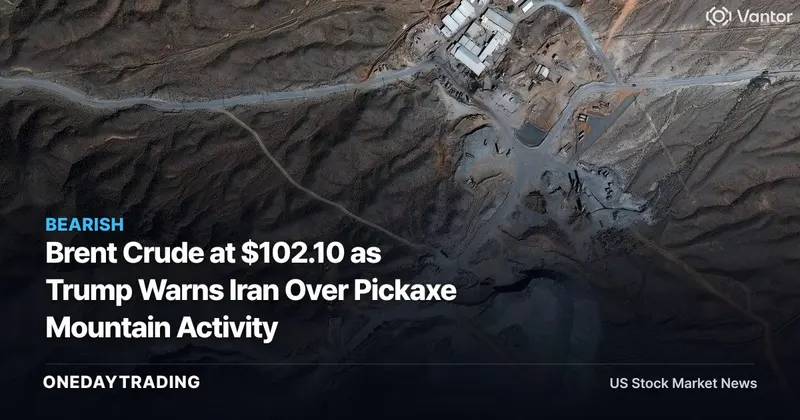
Trump said, “We notice there's a little activity at Pickaxe. I would advise Iran not to get cute because we will have to hit them very hard.” Pickaxe Mountain, also known as Kuh-e Kolang Gaz La, is near Iran’s Natanz uranium-enrichment facility, with the current site location reported as 2 kilometers, or 1.2 miles, from an older uranium facility at Natanz.
CSIS said its satellite-imagery analysis found more road activity at Pickaxe Mountain in 2026 than at any point in the site’s history and described “a clear surge” in construction activity. According to CSIS, the work had shifted from active excavation toward probable internal construction and continued exterior reinforcement. CSIS called the activity “suspicious,” but said it could not substantiate or refute claims that Iran had moved uranium centrifuges into Pickaxe Mountain.
The confrontation extends beyond the nuclear-site warning. Iran said it attacked 10 ships near the Strait of Hormuz, a waterway that typically handles 20% of the world’s oil traffic. Earlier in the week, U.S. Central Command forces said five Iranian oil tankers were destroyed after Iran’s Revolutionary Guard targeted a U.S. Navy warship with ballistic missiles twice in two days.
Why the Oil Market Reacted
Oil prices transmit geopolitical risk through the possibility of lost barrels, delayed shipping and higher insurance or transport friction. Those mechanisms are conditional here: the fact sheet confirms attacks and higher futures prices, but it does not confirm a sustained interruption to flows through Hormuz.
The physical significance of Hormuz explains why a relatively small futures move can carry a larger risk signal. With the strait typically handling 20% of global oil traffic, any verified disruption would matter to refiners, traders and consumers even before inventories or alternative routes were reassessed. For now, the Thursday morning prices show a market assigning value to risk without evidence that a full supply shock has occurred.
Energy-market participants are also tracking fighting between Saudi Arabia and the Iran-backed Houthis in Yemen. That additional theater increases the number of routes and facilities investors must monitor, but the supplied facts do not identify a specific production loss, refinery outage or shipping closure.
Background: The Nuclear-Site Risk
U.S. forces struck three Iranian nuclear sites—Natanz, Fordow and Isfahan—in June 2025. Iran has repeatedly denied seeking nuclear weapons. The new CSIS assessment therefore matters as an indicator of construction activity, not as confirmation of the site’s purpose or of centrifuge transfers.
Trump said he did not think the U.S.-Iran war would end until after November’s midterm elections and separately said the conflict would end immediately after the election because Iran could not hold out longer. Whether that political forecast proves accurate is unknown. Investors should treat the statements as signals about policy posture rather than as a timetable for de-escalation.
Market & Stock Impact
- Crude futures: Brent crude futures were reported 0.9% higher at $102.10 per barrel for November delivery on Thursday morning, and WTI crude futures were up 1% at $97.01. The move reflects heightened risk pricing, while the fact sheet does not establish a confirmed supply outage.
- Energy producers: Higher crude benchmarks can improve realized prices for producers if the move persists, but no company-specific earnings, production or guidance data is provided. The key transmission mechanism is the commodity price, not a confirmed change in any issuer’s operations.
- Refiners and fuel consumers: A sustained rise in crude costs could pressure fuel buyers and refiners’ margins if product prices do not adjust. That scenario is conditional because the source does not report a verified disruption to oil flows.
- Shipping exposure: Reports of attacks on 10 ships and the destruction of five Iranian oil tankers raise uncertainty for maritime logistics. The available facts do not identify listed shipping companies or quantify freight-rate effects, so company-level conclusions would be premature.
Investor Checkpoints
- Track whether Brent crude futures hold above the Thursday morning level of $102.10 per barrel for November delivery or reverse as fears of disruption fade.
- Monitor verified reports of oil-flow interruptions through the Strait of Hormuz, which typically carries 20% of world oil traffic; the fact sheet does not confirm such an interruption.
- Follow further CSIS imagery or statements for evidence that Pickaxe Mountain activity continues shifting toward internal construction and exterior reinforcement.
- Watch official U.S., Iranian and regional statements after any additional attacks involving tankers, naval assets, Saudi Arabia or the Iran-backed Houthis in Yemen.
Outlook
The bullish case for oil prices rests on escalation translating into physical constraints. Attacks near a waterway handling 20% of world oil traffic, combined with a warning over suspected nuclear-site activity, give traders a reason to demand a larger risk premium. ING strategists Warren Patterson and Ewa Manthey said Chinese buying behavior will be crucial to whether the latest oil move gains follow-through or fades.
The counter-scenario is that oil continues to move despite the headlines. The source notes that oil flows have surprised to the upside in recent weeks, and it does not confirm that further escalation has disrupted exports. In that case, higher futures could lose momentum if Chinese buying does not validate the rally or if diplomatic and military signals reduce the probability of a sustained confrontation.
For investors, the distinction is between a geopolitical headline and a physical-market event. Pickaxe Mountain activity remains unconfirmed as a centrifuge relocation, the war’s end date is unknown, and the Iranian embassy’s response to CNBC was not immediately available. The next meaningful repricing would come from evidence that attacks are changing actual oil movements, not from rhetoric alone.
FAQ
What is Pickaxe Mountain?
Pickaxe Mountain, also known as Kuh-e Kolang Gaz La, is a site near Iran’s Natanz uranium-enrichment facility. CNBC reported that it is 2 kilometers, or 1.2 miles, from an older uranium facility at Natanz.
What did CSIS report about Pickaxe Mountain in 2026?
CSIS reported more road activity at Pickaxe Mountain in 2026 than at any point in the site’s history and described a clear surge in construction activity. It said activity had shifted toward probable internal construction and continued exterior reinforcement, but it could not confirm or refute claims about uranium centrifuges.
Why did oil prices rise on Thursday morning?
Brent crude futures rose 0.9% to $102.10 per barrel for November delivery, and WTI crude futures rose 1% to $97.01. The move followed reported attacks near the Strait of Hormuz and broader U.S.-Iran escalation, although the facts provided do not confirm a disruption to oil flows.
📊 Analysis
Signal Bearish
Why Escalation around a suspected nuclear site and tanker attacks raises the risk of tighter oil flows and higher energy-market volatility.
This article was independently written by OneDayTrading from public reporting. Read the original (CNBC)