Key Takeaways
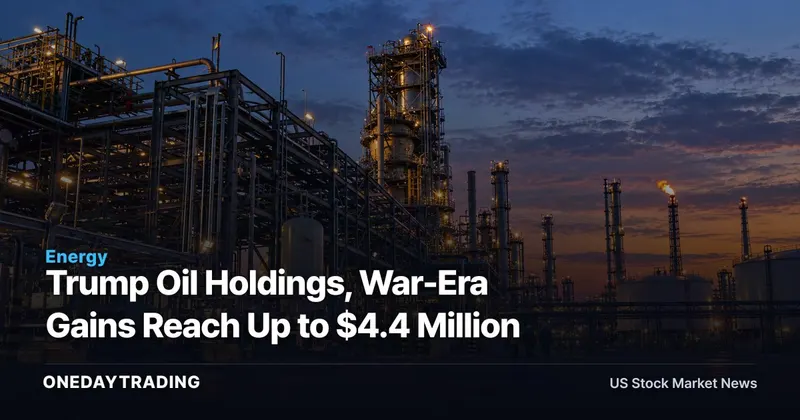
Donald Trump’s oil investments and the Iran war now intersect in a market story spanning Exxon Mobil, Chevron and seven other energy companies. On Sept. 9, 2026, CNBC reported that Trump’s nine largest oil and gas holdings generated an estimated gain of $1.5 million to $4.4 million from the Feb. 27 market close through the Aug. 31 market close while his accounts continued trading energy stocks.
For investors, CNBC’s figures point to a bullish operating backdrop for the group but not a permanent one: the nine companies produced $47.6 billion of combined second-quarter profit, versus $15.9 billion one year earlier. CNBC’s evidence does not establish realized trading profits, advance knowledge, policy influence or presidential direction of any transaction.
What Happened to Trump’s Oil Holdings During the Iran War
CNBC defined the portfolio as Trump’s nine largest disclosed oil and gas holdings, identified by aggregating and ranking his year-end 2025 positions by disclosed value. The group consisted of Chevron, ConocoPhillips, Exxon Mobil, Kinder Morgan, Marathon Petroleum, Occidental Petroleum, Phillips 66, Valero Energy and the Williams Companies.
CNBC estimated the $1.5 million-to-$4.4 million gain by applying share-price changes between the Feb. 27 and Aug. 31 market closes to the minimum and maximum values in Trump’s disclosures. That method measures an estimated change in holding value, not cash profit.
The accounts reported purchases and at least 23 sales involving the nine companies through June 29, the latest disclosed transaction date, according to CNBC. Because the filings omit exact share counts, execution prices, the identity of the particular shares sold and Trump’s precise current holdings, the realized results cannot be calculated from the disclosed information.
Exxon Trades Put the Disclosure Limits in Focus
Exxon provides the clearest view of both the portfolio’s upside and the analysis’s boundaries. CNBC reported that Trump entered the war with between $3.2 million and $12.5 million invested in Exxon; the share-price move from Feb. 27 through Aug. 31 added an estimated $176,000 to $690,000 to that initial stake before subsequent trades were considered.
On March 2, the first trading day after the initial U.S.-Israeli attack on Iran, the accounts purchased between $100,001 and $250,000 of Exxon shares, according to CNBC. On March 23, when Trump postponed threatened strikes on Iranian energy infrastructure and Brent crude fell nearly 11%, the accounts reported 16 oil and gas stock purchases with a combined value of approximately $163,000 to $570,000.
An account reported selling between $500,001 and $1 million of Exxon shares on April 7, before Trump later announced a two-week ceasefire, CNBC reported. Exxon opened more than 6% lower the following morning. CNBC estimated that the shares would have gained roughly $35,000 to $70,000 since Feb. 27 if they had been held before the war, but the unknown purchase dates mean that range is not the transaction’s actual profit.
Background: Independent Management and an Unresolved Ethics Debate
White House spokesman Davis Ingle told CNBC that neither Trump nor a family member could direct, influence or provide input into portfolio investments or transaction timing. He said independent managers made every investment decision and rejected the existence of conflicts.
Scott Greytak of Transparency International U.S. offered CNBC the counterargument, saying a discretionary account is not equivalent to a blind trust. The disagreement matters to investors because the disclosed asset ownership remains visible even when outside managers control daily execution.
Crucially, CNBC found no evidence that Trump or his managers used advance knowledge of presidential decisions, that Trump’s financial interests shaped policy or that he directed a specific trade. CNBC also reported that the Trump Organization did not respond to multiple requests for comment.
Market and Stock Impact
- Exxon Mobil and Chevron: CNBC reported combined second-quarter profit of $26.6 billion for the two companies, compared with $9.6 billion one year earlier. On CNBC’s evidence, higher oil prices and refining margins supported earnings, while a reversal in those conditions would weaken that support.
- Marathon Petroleum, Phillips 66 and Valero Energy: The three refiners generated $12.7 billion of combined second-quarter profit, according to CNBC. Exxon CEO Darren Woods linked high refining margins with high product prices, while Phillips 66 CEO Mark Lashier said on Aug. 5 that refining conditions could remain strong even if peace began immediately.
- ConocoPhillips and Occidental Petroleum: CNBC included both producers among Trump’s nine largest year-end 2025 oil and gas positions. Pavel Molchanov of Raymond James & Associates attributed oil’s moves to the war-related supply disruption, making the direction of oil the relevant conditional link in CNBC’s account.
- Kinder Morgan and the Williams Companies: CNBC identified both companies as holdings in the same nine-company portfolio. The fact sheet provides no company-specific profit, trade or operating figure for either, so a more precise stock-level conclusion would exceed the disclosed evidence.
The Consumer and Political Counterweight
The same pricing conditions that supported energy-company results also raised household costs. CNBC reported that U.S. crude traded around $91 on Friday, or 36% above prewar levels, while the national average gasoline price was $4.09 over Labor Day weekend.
Americans incurred an estimated $71.5 billion of additional gasoline costs after the war began, equal to about $604 per household, CNBC reported. In an early-August Reuters/Ipsos poll cited by CNBC, 48% of Americans ranked the cost of living as their leading voting issue and 70% disapproved of Trump’s handling of it; the survey covered 4,505 adults aged 18 or older and carried a margin of error of plus or minus 1.5 percentage points.
On CNBC’s evidence, that tension is central to the energy trade: stronger commodity and refining economics can lift company profits while simultaneously intensifying affordability pressure. It also means the portfolio’s favorable market backdrop carries political exposure alongside commodity risk.
Investor Checkpoints
- Oil-price direction: Track whether U.S. crude holds near the approximately $91 Friday price reported by CNBC and remains above its prewar level. Molchanov told CNBC that an end to the war should pull oil prices and likely energy stocks lower.
- Refining conditions: At the next Exxon and Phillips 66 earnings updates, examine whether the strong refining environment described by Woods on July 31 and Lashier on Aug. 5 persists. CNBC’s figures connect that environment with the profit strength at Exxon, Chevron, Marathon Petroleum, Phillips 66 and Valero Energy.
- Future disclosures: Review the next transaction filing for activity after June 29, the latest trade date disclosed to CNBC. Exact ownership and realized returns will remain indeterminate unless later disclosures supply information absent from the current filings.
- Policy developments: Monitor decisions that change the war’s effect on oil supply. According to CNBC’s reporting and Molchanov’s assessment, de-escalation is the clearest countercondition to the oil-price support behind energy stocks.
Outlook
The bullish case rests on reported results rather than rhetoric. CNBC calculated $47.6 billion of combined second-quarter profit for the nine energy companies, three times their $15.9 billion combined profit one year earlier, while U.S. crude stood 36% above prewar levels on Friday.
The risk is equally direct. Molchanov told CNBC that oil prices, and probably energy stocks, should decline when the war ends. Because CNBC’s gain estimates use disclosed value ranges rather than exact positions, investors should treat the $1.5 million-to-$4.4 million figure as a bounded portfolio estimate—not evidence of realized profit or a forecast of further gains.
FAQ
How much could the disclosed sales have gained before they were executed?
CNBC estimated that shares involved in at least 23 reported sales through June 29 would have been worth $36,000 to $95,000 more when sold than on Feb. 27 if they had been held since before the war. The filings do not identify which shares were sold, so the estimate is conditional rather than a realized-profit calculation.
Was there another estimate of the portfolio’s increase?
CNBC reported that Democratic staff on the Joint Economic Committee estimated Trump’s broader oil and gas portfolio had increased in value by as much as $15.5 million this year. That estimate covers the broader portfolio and should not be treated as interchangeable with CNBC’s $1.5 million-to-$4.4 million estimate for the nine largest holdings from Feb. 27 through Aug. 31.
What other investigation involving the Trump family was identified?
According to CNBC, Jamie Raskin opened an investigation into 1789 Capital on Aug. 27. Donald Trump Jr. is a partner at 1789 Capital, but the supplied facts do not establish a connection between that investigation and the energy-stock transactions.
📊 Analysis
Signal Bullish
Why CNBC reported higher oil prices, stronger refining margins and sharply increased second-quarter profits across the nine portfolio companies, while a war-ending reversal remains the principal risk.
Tickers$XOM$CVX$COP$KMI$MPC$OXY
This article was independently written by OneDayTrading from public reporting. Read the original (CNBC)