Key Takeaways
Brent crude above $99 per barrel tells investors more than Washington’s expansion of Iran sanctions: the market is paying for uncertainty over whether oil can move safely through the Strait of Hormuz and whether attacks will cause longer interruptions at regional energy facilities. That supports crude prices while increasing fuel-cost risk across transportation, but the durability of the move depends on physical flows rather than the number of entities added to a sanctions list.
The new restrictions still matter because they widen Iran’s financial and commercial isolation. Yet Treasury disclosed no figures showing how much additional economic pressure the 27 airline designations will create, leaving enforcement against Iran’s oil trade as the more consequential unresolved variable.
What Happened
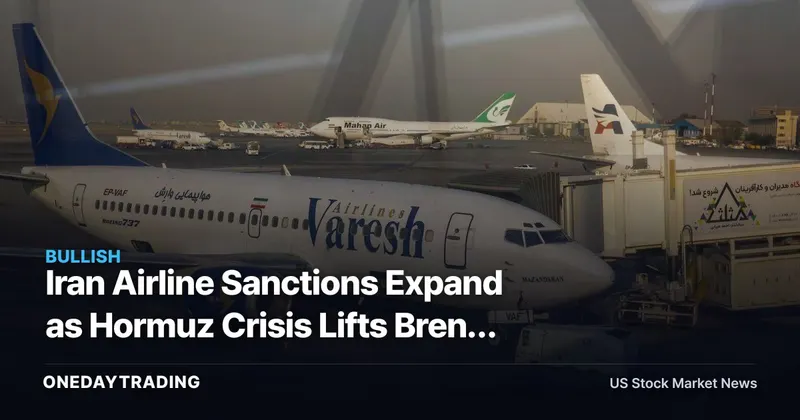
On Tuesday, the U.S. Treasury Department sanctioned 27 Iranian airlines and several other entities under “Operation Economic Outcast.” The action covers every Iranian airline that had not already been sanctioned and builds on an earlier authorization aimed at Iran’s aviation sector and a prior designation of Mahan Air.
Operation Economic Outcast is a U.S. pressure campaign intended to isolate Iran by restricting its access to international commerce and the global financial system. Treasury Secretary Scott Bessent said counterparties dealing with the remaining Iranian carriers risk exclusion from that system. A Treasury official also said the United States is effectively ending aviation-related licenses that had permitted U.S. firms or other entities to engage with Iran.
The announcement coincided with an escalation outside the aviation sector. Iran-backed Houthi militants attacked multiple energy facilities in Saudi Arabia on Tuesday, forcing a temporary halt to some operations. Brent crude futures rose past $99 per barrel, while U.S. West Texas Intermediate futures gained nearly 2% at their session high.
Background & Context
The more-than-six-month war has concentrated market risk around the Strait of Hormuz, a vital route for global oil trade. Iran has retained leverage by limiting ship traffic through the waterway, although President Donald Trump maintains that the United States controls it. His administration has challenged reports from ship-tracking firms that crossings remain far below prewar levels.
For commodity markets, that factual dispute is critical. Verified vessel movements indicate whether barrels are reaching buyers; political assertions do not establish the volume of oil passing through the channel. A persistent shortfall in crossings would keep transport availability tight, while a sustained recovery could remove part of the premium now embedded in crude.
The administration unveiled its broader sanctions plan on Aug. 24 and described it as Iran’s “economic D-Day.” Subsequent actions targeted the United Arab Emirates branch of an Egyptian bank in late August and Turkey’s 35th-largest bank on Friday, according to TheBanks.eu. These measures show the campaign extending into financial intermediaries, but the source characterizes its implementation so far as heavier on broad warnings than demonstrable economic results.
Why Aviation Sanctions Have a Different Market Channel
The airline designations and the oil-price move operate through separate channels. Aviation restrictions threaten access to payments, authorized transactions and international counterparties. The crude market, by contrast, responds to the availability and movement of energy supplies amid attacks and constrained shipping.
That distinction prevents a false causal leap. The source does not show that sanctioning Iranian airlines reduced oil supply or caused Brent to cross $99. It does show that the sanctions arrived as hostilities spread, Saudi energy operations faced a temporary interruption and Hormuz traffic remained contested.
Treasury also offered limited public evidence about the pressure campaign’s effectiveness. Asked by CNBC to identify economic proof, an official cited anecdotal and nonpublic information but supplied no specific figures. Iran is described as facing soaring inflation and plunging oil exports, yet the report does not quantify how much either condition resulted from the latest measures.
Market & Stock Impact
- Crude oil: Brent’s move above $99 per barrel and WTI’s nearly 2% intraday rise indicate a higher price for regional supply risk. Further upside would require evidence that disrupted shipping or halted operations are lasting, rather than merely a continuation of geopolitical headlines.
- Energy producers: Higher crude prices can raise realized revenue when production volumes, operating costs and hedging do not offset the benefit. The source provides no company-level data, so it does not support naming a particular U.S.-listed producer as the primary beneficiary.
- Airlines and transportation: Sustained crude strength can feed into fuel expense, pressuring operators that cannot recover higher costs through pricing or hedges. No U.S.-listed carrier is identified as directly exposed to the Iranian sanctions, and the report includes no route, fuel-contract or earnings data for a company-specific conclusion.
- Iranian aviation: Sanctioning all previously undesignated Iranian airlines expands the legal and financial barriers confronting the sector. The termination of aviation-related licenses further narrows authorized dealings, but no figures are supplied for affected revenue, fleet activity or service availability.
- Financial intermediaries: Bessent’s warning raises compliance risk for institutions and businesses dealing with sanctioned carriers. Earlier actions involving banks in the UAE and Turkey show where enforcement has begun to travel, although the source identifies no measurable loss or exposure for a U.S.-listed financial company.
China Is the Larger Enforcement Test
China is identified in the report as Iran’s leading trade partner and oil buyer, but Washington has not yet applied tangible pressure that caused Beijing to cut off Tehran. That gap matters because aviation restrictions may increase economic friction without directly closing Iran’s principal oil-sales channel.
The sanctions also contain a policy tension. Lower export volumes could reduce Tehran’s receipts, but a higher market price for barrels that continue reaching customers may cushion part of that pressure. The balance cannot be calculated from the supplied evidence because the report gives neither current export volumes nor Iran’s realized selling prices.
Trump and Chinese leader Xi Jinping are scheduled to meet in Washington later this month. Any explicit decision involving Chinese purchases of Iranian crude would carry more direct implications for Iran’s oil income and global supply than another warning to airline counterparties.
Investor Checkpoints
- Hormuz vessel traffic: Use the next credible ship-tracking update to compare crossings with prewar levels. Persistently depressed traffic would confirm a continuing transport constraint; recovery would weaken that part of the oil thesis.
- Saudi operating status: Check whether the facilities attacked Tuesday fully resume activity and whether officials disclose the scale or duration of the interruption. A temporary halt alone does not establish lost production capacity.
- Treasury implementation: At the next enforcement update, look for blocked transactions, license terminations and identified counterparties that stopped serving Iranian airlines. Those data would make the sanctions’ commercial effect more measurable.
- Trump-Xi meeting: Focus on any concrete commitment, enforcement measure or stated change concerning Chinese purchases of Iranian oil. Broad diplomatic language would leave the principal trade channel unresolved.
Outlook
The constructive case for crude rests on persistence. If vessel crossings stay below prewar levels or the temporary Saudi shutdowns become extended operational constraints, buyers may continue assigning a premium to reliably deliverable oil.
The counter-case does not require the war to end. Restored Saudi operations and improved Hormuz traffic could ease immediate supply concerns even as the aviation sanctions remain in place. With Brent already above $99, investors should separate risk that the market has visibly priced from enforcement effects that Treasury has not yet quantified.
The next decisive signals are therefore observable flows: ships crossing Hormuz, Saudi facilities returning to normal operation and any shift in China’s purchases of Iranian crude. Those measures will determine whether the current oil move represents durable tightness or a premium that can retreat as operating conditions stabilize.
FAQ
Why did Brent crude rise above $99 per barrel?
Brent crossed $99 as the regional conflict threatened energy infrastructure and continued to constrain a vital oil-shipping route. Houthi attacks forced a temporary halt to some Saudi energy operations, while traffic through the Strait of Hormuz remained disputed and limited.
What do the new U.S. sanctions against Iranian airlines cover?
Treasury sanctioned 27 Iranian airlines and several other entities on Tuesday, reaching every Iranian carrier that had not already been designated. The United States is also effectively ending aviation-related licenses that had authorized certain dealings with Iran.
Could the sanctions materially weaken Iran’s oil leverage?
The airline measures may deepen financial isolation, but the source supplies no quantified evidence of their incremental effect on Iran’s economy or oil income. Enforcement involving China, Iran’s leading oil buyer and trade partner, would have a more direct connection to petroleum revenue and export flows.
📊 Analysis
Signal Bullish
Why Restricted Hormuz traffic and attacks on Saudi energy facilities increase the supply-risk premium in crude, although the sanctions’ incremental economic effect remains unquantified.
This article was independently written by OneDayTrading from public reporting. Read the original (CNBC)