What Changes
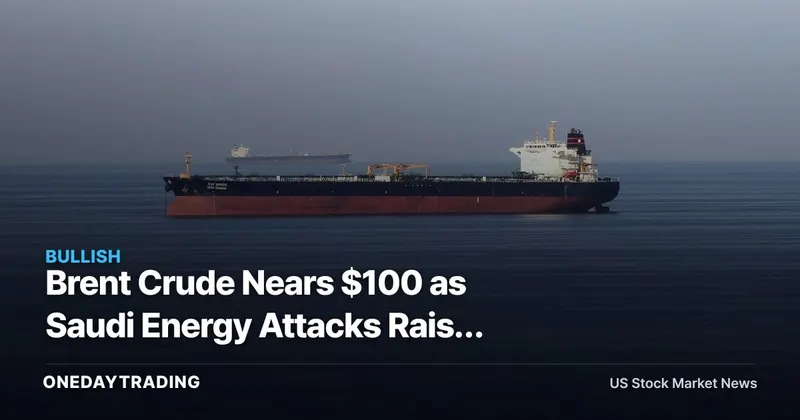
Brent crude oil is the principal international benchmark for pricing physical barrels across global markets. Its move toward $100 signals that traders are assigning a higher probability to persistent supply and transport disruption after Iran-allied Houthi militants attacked energy facilities in Saudi Arabia.
The distinction matters. Saudi Arabia described fires and temporary shutdowns but did not identify the facilities struck, their capacity or the volume of production affected. That leaves the confirmed physical loss undefined. The market move therefore reflects both an operational interruption and an insurance-like premium against further attacks on Saudi assets, commercial vessels, the Strait of Hormuz and the Red Sea.
That premium was already building before Tuesday. Oil prices have gained more than 8% in September as the United States and Iran exchanged military strikes for the first time since July. Tuesday’s attack extends the conflict’s transmission channel from tankers and naval vessels to facilities inside the world’s largest oil-exporting country, increasing the number of ways regional escalation could restrict available supply.
By the Numbers
Brent gained 1% to $97.99 a barrel by 11:28 a.m. ET, after touching $99.46 during the session. WTI rose 1.55% to $92.90 a barrel. The narrower daily advance relative to the more than 8% September increase suggests the market had already priced meaningful geopolitical stress, even before the Saudi attacks added a new layer of uncertainty.
Goldman Sachs raised its December 2026 forecasts by $5, taking Brent to $85 and WTI to $80 per barrel. It lifted its 2027 forecasts to $80 and $75, respectively. Those estimates sit below Tuesday’s spot-futures levels, implying that the bank’s central case still assumes some normalization rather than a permanent extension of the current premium.
The tail scenario is more severe. Goldman said Brent could exceed $120 in 2027 if Gulf crude production remains 4 million barrels per day below prewar output, although the bank explicitly said that is not its base case. The gap between the central forecast and the stress case identifies the variable investors need to track: sustained lost output, not simply the frequency of military statements.
Winners & Losers
- Oil producers: Higher benchmark prices can improve realized revenue on barrels sold, provided producers maintain output and do not absorb offsetting security or transportation costs. The benefit weakens if disrupted infrastructure prevents volumes from reaching buyers.
- Refiners and fuel buyers: A higher crude input price can pressure economics when refined-product prices do not rise at the same pace. The relevant mechanism is the spread between product values and crude costs, not the direction of oil alone.
- Transportation and other fuel-intensive industries: WTI at $92.90 and Brent near $98 increase the risk of higher fuel expense. The income-statement effect depends on contract timing, hedging and the ability to pass costs through, none of which the source quantifies.
- Saudi energy operations: The kingdom faces the direct burden of extinguishing fires, assessing damage and restoring temporarily halted sites. The Saudi government did not disclose the type of facilities involved, so the effect on crude production, processing or distribution cannot yet be calculated.
- Global consumers: A prolonged oil shock could raise energy costs beyond the immediate conflict zone. That transmission requires elevated benchmark prices to persist long enough to flow through supply contracts and fuel markets.
Risk Check
- Unknown physical damage: More than 70 civilians were injured, according to the Saudi Foreign Ministry, but officials supplied no capacity figures for the affected energy sites. A rapid restart with little lost output could remove part of Tuesday’s premium.
- Escalation at sea: Goldman identified more intense attacks in the Strait of Hormuz and the Red Sea as the most likely route to its lower-output, higher-price scenario. Disruption to shipping can constrain supply even when production equipment remains intact.
- Military retaliation: The Saudi government asserted its right to defend its sovereignty and national assets. Further retaliation could expand the conflict, while successful containment could lower the probability of repeated infrastructure attacks.
- Expectation risk: President Donald Trump said oil prices would fall sharply when the United States wins the war with Iran. That statement offers no measurable timetable or supply path, so futures prices must still respond to observable shipments, output and facility operations.
Bottom Line
Oil’s advance is bullish for the commodity, but the tape has already absorbed more than an 8% September gain and brought Brent within 54 cents of $100 at Tuesday’s peak. What is not yet priced with confidence is the duration of Saudi shutdowns or the probability that Gulf output remains materially below prewar levels. The next decisive evidence will come from Saudi damage and restart disclosures, observed regional production, and the intensity of shipping attacks in Hormuz and the Red Sea; confirmation of persistent losses would support the premium, while restored operations and secure tanker flows could unwind it quickly.
FAQ
Why did Brent crude oil rise toward $100?
Brent reached $99.46 after Houthi attacks caused fires and temporary shutdowns at several Saudi energy facilities. Investors also faced a broader escalation involving U.S.-Iran strikes and repeated attacks on commercial shipping, which increased the probability of supply or transport disruption.
Could Brent crude exceed $120 in 2027?
Goldman Sachs said Brent could rise above $120 if Gulf production remains 4 million barrels per day below prewar levels. The bank stressed that this is not its base case and instead forecast Brent at $80 for 2027.
What should oil investors monitor after the Saudi attacks?
The first checkpoint is Saudi Arabia’s assessment of which facilities were hit, how much capacity stopped and when operations restart. Investors should then track Gulf production and attacks affecting the Strait of Hormuz and the Red Sea, because sustained lost barrels or restricted shipping would determine whether the current risk premium endures.
📊 Analysis
Signal Bullish
Why Attacks on Saudi energy sites and continued shipping disruption increase the geopolitical risk premium embedded in crude prices.
This article was independently written by OneDayTrading from public reporting. Read the original (CNBC)