Key Takeaways
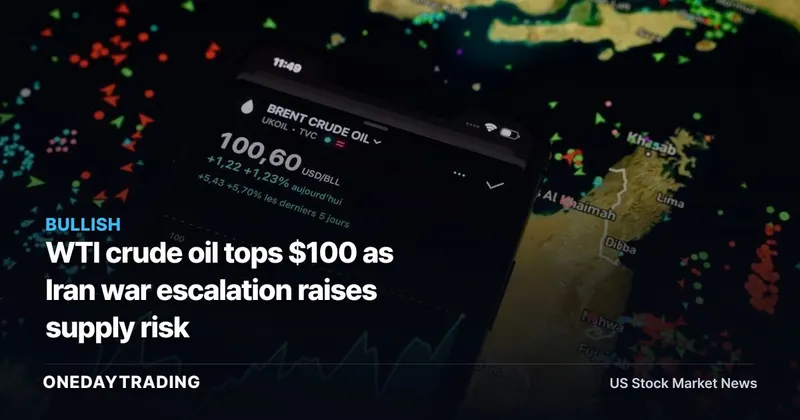
WTI crude oil futures reached a $100.88 per barrel session high on Thursday as fighting between Washington and Tehran intensified. CNBC reported that U.S. crude was up 3.4% at $99.32 per barrel around 10:03 a.m. ET, while Brent crude traded 3.4% higher at $104.69 per barrel. For investors, the immediate signal is a sharper energy-cost shock risk, with the oil market pricing a conflict that may last longer than official political claims suggest.
Oil prices had already advanced nearly 16% in September, according to CNBC. Daan Struyven of Goldman Sachs said the escalation raises the risk of prices moving above $120 per barrel, but CNBC's report does not establish that such a level will be reached.
What Happened to WTI and Brent Crude
West Texas Intermediate futures briefly moved above $100 per barrel, a level CNBC said was last seen in May. The contract's session high was $100.88 per barrel, and the latest cited price was $99.32 per barrel around 10:03 a.m. ET, up 3.4%. Brent crude, the international benchmark, was also up 3.4% at $104.69 per barrel during the cited trading period.
The move came as fighting sharply escalated between Washington and Tehran after a period of relative calm in August. CNBC reported that Iran had tried several times to attack American warships, while the U.S. military destroyed at least eight Iranian tankers since Saturday. The report does not provide a more precise tanker count.
Risk has also spread beyond the immediate U.S.-Iran confrontation. Iran's Houthi allies in Yemen struck energy facilities and other targets in Saudi Arabia this week, injuring more than 70 civilians, according to CNBC. That geography matters for traders because attacks involving shipping or energy infrastructure can tighten the physical market even before a measured supply loss is confirmed.
Why Duration Is Driving the Oil Risk Premium
The central market question is no longer only whether fighting intensifies on a given day; it is whether transit volumes and infrastructure remain exposed for an extended period. Andrei Constantin, commercial director and trading adviser at TFP Software FZCO, said a further decline in transit volumes, broader escalation or threats to energy infrastructure could tighten the physical market further. Those are conditions, not confirmed outcomes.
CNBC also reported that top White House advisers discussed with President Donald Trump the possibility that the Iran war could continue past Inauguration Day in January 2029, citing U.S. officials quoted by The Wall Street Journal. The report contradicted Trump's claim that the war would end immediately after the midterm elections. The identities of those officials were not provided.
David Morrison, senior market analyst at Trade Nation, said WTI had completely unwound its selloff between early June and July, while Brent was well above levels seen in early June. That comparison shows how quickly the market's pricing has shifted, but it does not by itself prove that the move will persist.
Market and Stock Impact
- Oil-linked equities: CNBC's reported rise in WTI and Brent improves the revenue backdrop for producers when realized prices track benchmark strength. The fact sheet does not identify individual listed producers, so no company-specific earnings conclusion is supported.
- Refining and fuel users: Higher crude raises the input-cost pressure faced by fuel-intensive businesses. CNBC reported that pump prices hit a Labor Day record Monday and that diesel was expected to cross $6 per gallon in the coming days; the report does not identify which companies would absorb or pass through those costs.
- Transportation exposure: Diesel moving toward $6 per gallon increases the importance of fuel-cost monitoring for transport operators, but the supplied reporting names no listed transportation company and provides no margin data.
- Energy infrastructure and shipping: The combination of tanker destruction, attacks near Saudi energy facilities and warnings about transit volumes makes physical-market security a key variable. CNBC's evidence supports heightened risk awareness, not a quantified supply shortfall.
Investor Checkpoints
- Track whether WTI holds above or falls back below the $100-per-barrel threshold after the Thursday spike. The supplied facts confirm the level was reached, not that it will hold.
- Compare the Brent benchmark with the cited $104.69 per barrel level and monitor whether the market continues to price a widening international risk premium.
- Watch for evidence of lower transit volumes, additional attacks on energy infrastructure or further tanker destruction. These are the physical-market conditions identified by Andrei Constantin as capable of tightening supply.
- Monitor fuel-price transmission after the Labor Day record and the expected move of diesel above $6 per gallon in the coming days. The timing is supplied by CNBC, but no exact calendar date is given.
Outlook for Oil Markets
The bullish case for crude rests on duration and physical disruption. A conflict that continues toward January 2029, combined with attacks on shipping or energy facilities, could sustain the premium already visible in WTI's move above $100 per barrel and Brent's rise to $104.69 per barrel. Struyven's $120-per-barrel risk is a scenario described by Goldman Sachs, not a confirmed target.
The countercase is that political claims of a faster end to the war could eventually reduce the premium, even though CNBC reported that those claims were contradicted by discussions of a potentially prolonged conflict. The market also has to distinguish headline escalation from an actual decline in transit volumes. Until that distinction becomes clearer, oil-sensitive assets face a wide range of outcomes rather than a one-way signal.
The next useful information will come from the conflict's effect on shipping, tankers and energy facilities, alongside observable movement in WTI, Brent and diesel. Those checkpoints matter more than any single forecast because the article does not establish whether crude will exceed $120 per barrel.
FAQ
Why did WTI crude oil rise above $100 per barrel?
CNBC linked the move to sharply escalating fighting between Washington and Tehran and concerns that the conflict could disrupt shipping and energy infrastructure. WTI futures reached a $100.88 per barrel session high on Thursday.
How high did Brent crude trade?
Brent crude traded 3.4% higher at $104.69 per barrel during the period cited by CNBC. The article does not state that this price represents a permanent new floor.
Could oil prices reach $120 per barrel?
Daan Struyven of Goldman Sachs said escalation raises the risk of oil prices surging above $120 per barrel as attacks on shipping intensify. CNBC's reporting does not confirm that prices will reach or exceed $120.
📊 Analysis
Signal Bullish
Why Higher crude prices can support the oil sector, although prolonged conflict and demand uncertainty keep the direction conditional.
This article was independently written by OneDayTrading from public reporting. Read the original (CNBC)