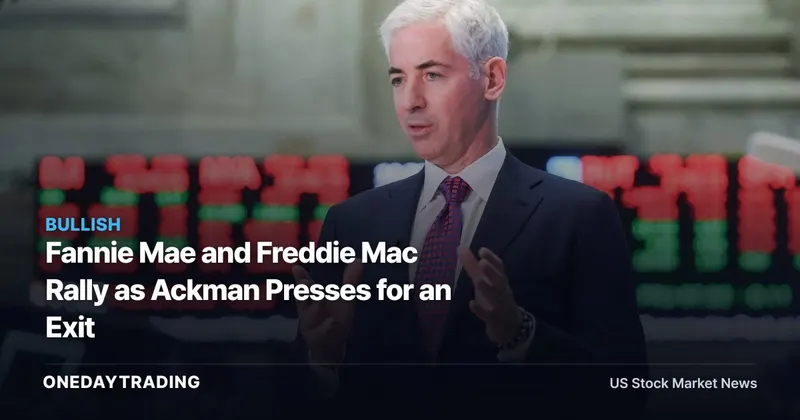
Fannie Mae and Freddie Mac Rally Reprices the Policy Possibility
Fannie Mae and Freddie Mac each advanced more than 60% from Oct. 14 through Monday’s close, according to CNBC, as Bill Ackman pressed for their release from federal conservatorship. Both shares added roughly 3% on Tuesday. The move is bullish for the stocks, though it reflects a possible change in ownership and control rather than a completed restructuring.
The central distinction for investors is between what the rally recognizes and what remains unpriced because it is unknowable. The market has responded to renewed pressure for an exit and Donald Trump’s support for ending conservatorship. It still lacks the timing, legal terms, recapitalization structure and treatment of the Treasury Department’s ownership position that would define the value available to common shareholders.
Bill Ackman’s Case Meets an Unfinished Capital Structure
Bill Ackman, founder of Pershing Square Capital Management, owns interests in both companies through the firm and has pushed for their return from federal control. He has argued that Freddie and Fannie could rise 10-fold from current share prices. That is Ackman’s stated upside case, not an established valuation outcome or a forecast that the available evidence can verify.
His explanation for the lack of action is explicitly political. “The reason why it’s not being touched right now is, you know, midterms,” Bill Ackman told CNBC. That framing may help explain why investors are focused on a policy window, but it supplies neither an exit date nor binding terms.
The largest visible complication is the government’s position. The Treasury Department holds a roughly $388 billion ownership stake in Fannie Mae and Freddie Mac through preferred securities and warrants, CNBC reported. Any exit framework must therefore address not only the companies’ status, but also how that stake interacts with the interests of existing shareholders.
Why Conservatorship Matters to the Mortgage Channel
Fannie Mae is the Federal National Mortgage Association, while Freddie Mac is the Federal Home Loan Mortgage Corporation. The companies buy mortgages from banks and other lenders and package those loans into mortgage-backed securities. Conservatorship is the federal-control structure under which both entities have operated since September 2008.
The investment issue extends beyond whether the government releases the companies. Their role connects lenders, mortgage assets and mortgage-backed securities, so the operating rules attached to an exit could matter as much as the formal change in status. For shareholders, the relevant transmission channel runs from policy terms to ownership structure, then from ownership structure to the value retained by common equity.
Scott Bessent has said affordability will guide the decision. His stated constraint is precise: “Whatever we do is going to be guided by making sure that the spread on [agency] mortgages … over the Treasury does not increase,” Scott Bessent said. A spread is the difference between the pricing of agency mortgage-backed securities and Treasury securities; the future effect of an exit on that spread or on mortgage costs is unknown.
From September 2008 Conservatorship to Over-the-Counter Trading
Fannie Mae and Freddie Mac entered conservatorship in September 2008. Their shares were delisted from the New York Stock Exchange in 2010 and have traded over the counter since then. That history leaves today’s equity case tied unusually closely to government control, the Treasury Department’s securities and warrants, and the unresolved route back from conservatorship.
Donald Trump has supported ending the arrangement, giving the exit thesis political support. Support alone does not establish execution. The evidence does not determine whether Congress will approve restructuring legislation, how the entities would be recapitalized, or which terms would govern any release.
A disciplined reading of the rally therefore separates recognition from resolution. The more than 60% gains show that investors have assigned greater importance to the exit possibility. They do not reveal how much value common shareholders would retain under a final structure or whether the ultimate framework would match Ackman’s preferred outcome.
Fannie Mae and Freddie Mac: Bull and Bear Conditions
Bull case: A defined path out of conservatorship could replace an open-ended policy question with explicit rules on control, ownership and capitalization. Ackman argues that public ownership would provide greater certainty over how the entities are run. His sharpest formulation was: “We set the rules. In conservatorship, the president can do anything.” If an eventual framework protects common-equity value while satisfying the Treasury Department’s position, the current rally could retain a policy-driven foundation.
Bear case: The rally has moved ahead of the terms required to evaluate that foundation. An exit could involve recapitalization, while the treatment of preferred securities and warrants could shape what remains for common holders. Congressional involvement is uncertain, and the future effect on mortgage-backed-security spreads or mortgage costs cannot be established from the available facts.
The balance is not simply release versus no release. The decisive scenario is the form of release. A structure that ends federal conservatorship without clarifying capitalization, ownership and mortgage-market safeguards would leave the core valuation questions intact.
Stock and Mortgage-Market Read-Through
- Fannie Mae: The stock directly benefits from rising investor attention to a possible conservatorship exit, as shown by its more than 60% gain from Oct. 14 through Monday’s close. Its eventual common-equity value remains conditional on the exit and ownership terms.
- Freddie Mac: The same policy catalyst applies because Freddie Mac shares also rose more than 60% over the stated period and roughly 3% on Tuesday. The company faces the same unresolved questions around recapitalization and the government’s stake.
- Mortgage-backed securities: Fannie Mae and Freddie Mac package purchased mortgages into these securities. Scott Bessent’s emphasis on preventing an increase in agency mortgage spreads makes this market a central policy constraint, not merely a secondary consequence.
- Banks and other mortgage lenders: The two entities purchase mortgages from these institutions. The fact sheet establishes that operating link, though it does not establish a future earnings effect for any particular lender.
Decision Points for Fannie Mae and Freddie Mac Investors
- Demand formal exit terms. Political support and investor advocacy are catalysts, but neither specifies the timing, conditions or allocation of value under a conservatorship release.
- Track the Treasury Department’s stake. The roughly $388 billion position through preferred securities and warrants is a central ownership issue whose treatment could determine the consequences for common shareholders.
- Watch for a recapitalization framework. The available evidence does not establish how either entity would be recapitalized. Any future framework should be assessed for its effect on existing common equity rather than treated as automatically favorable.
- Use agency mortgage spreads as a policy test. Scott Bessent has linked the decision to affordability and to avoiding wider spreads over Treasury securities. The next substantive signal is whether an announced structure explains how that constraint would be addressed.
📊 Analysis
Signal Bullish
Why The share rally and renewed support for ending conservatorship are positive catalysts, though exit terms, recapitalization and mortgage-market effects remain unresolved.
This article was independently written by OneDayTrading from public reporting. Read the original (CNBC)