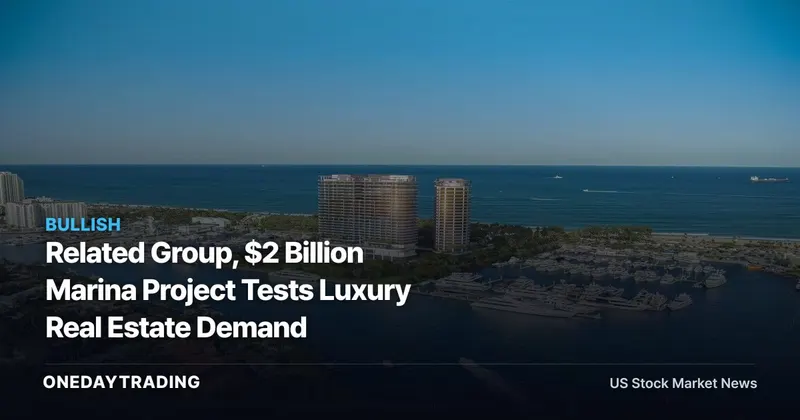
Related Group Turns Yacht Access Into a Real Estate Thesis
Related Group’s $2 billion Fort Lauderdale marina development puts a physical constraint—scarce yacht slips—at the center of a luxury real estate investment thesis. CNBC reported on 2026-11-03 that developers and investors are expanding marina projects and acquisitions as the global fleet grows, making the story relevant to real estate, leisure infrastructure and luxury consumer demand.
A marina development combines waterfront property with dedicated boat access; in this case, that access is being packaged alongside a St. Regis Hotel, residences and a beach club. For investors, the distinction matters: the thesis depends not only on demand for expensive homes, but also on whether access to deepwater berths makes the surrounding real estate more attractive to yacht owners and international buyers.
A Growing Fleet Meets a Limited Supply of Slips
SuperYacht Times counts over 6,000 superyachts longer than 30 meters, or 98 feet, worldwide, with another 200 superyachts delivered every year, according to CNBC. Those figures establish the demand-side base for marina investment without quantifying the actual shortage: the reporting does not state how many slips are lacking.
The physical size of the vessels sharpens the constraint. Ken Griffin is building a Miami megayacht marina with eight megayacht slips, including one intended for his 308-foot yacht. Related Group’s planned Fort Lauderdale marina would accommodate yachts as long as 350 feet, showing that these projects are designed around vessels whose berth requirements are substantially different from ordinary boat storage.
Tourism officials estimate that 2,000 superyachts pass through Fort Lauderdale each year. That traffic does not prove residential sales or marina profitability, but it gives the proposed development an identifiable pool of vessels and owners to serve.
Blackstone and Safe Harbor Marinas Put Capital Behind the Theme
Blackstone paid $5.6 billion for Safe Harbor Marinas last year, providing the clearest transaction evidence that institutional capital is assigning substantial value to marina ownership. Safe Harbor Marinas then paid $1.5 billion in August for 65 marinas and storage sites acquired from MarineMax.
The sequence matters more than either transaction in isolation. Blackstone acquired a marina platform, and that platform subsequently expanded its collection of operating sites. This creates a different exposure from a ground-up luxury project: acquisitions provide existing marina and storage assets, while a development must still move from plans to construction and opening.
Scale alone does not establish returns. The available facts provide purchase prices and asset counts, but no revenue, occupancy, operating margin, acquisition financing or valuation multiple. Investors can therefore identify capital commitment, not the economics ultimately earned on that capital.
Inside Related Group’s Fort Lauderdale Plan
Related Group plans to break ground next year and open the Fort Lauderdale project in 2030. The 40-acre development is planned to contain a 122-room St. Regis hotel, a 78-residence condo tower, 106 resort residences and a deepwater marina with capacity for 250 boats.
The proposed mix broadens the project beyond berth rental. A St. Regis Hotel, condominiums, resort residences and a beach club could address several forms of luxury demand within one waterfront property. That integration is the project’s central commercial proposition, although the supplied evidence does not separate expected value among hotel rooms, homes, marina slips and other amenities.
Nick Pérez of Related Group described South Florida as short of yachting destinations, marinas and slips, arguing that combining scarce waterfront real estate with a marina creates an attractive formula. His statement explains the developer’s strategy; it is not a substitute for completed sales totals, which the reporting does not provide.
International Demand Adds Reach, Not Certainty
Several buyers from Mexico and Brazil have already purchased in the building, and Nick Pérez said international buyers could represent up to 30% of the St. Regis development’s buyers. The evidence supports geographic breadth in buyer interest, while the phrase “up to” leaves the eventual share uncertain.
Pérez also cited interest from Newport, the Laguna area and San Diego in connection with California taxation. This is a developer’s account of buyer inquiries, not a quantified migration total or a completed-sales measure. Investors should keep expressions of interest separate from binding purchases and realized revenue.
His positioning of Fort Lauderdale as a luxury destination referenced Rolex, Patek and Cartier. Those names help define the clientele Related Group is targeting, but their presence does not establish demand for the development or a financial relationship with the project.
Market Read-Through for Real Estate and Marina Assets
- Luxury real estate: Yacht access may differentiate waterfront residences where suitable slips are scarce. The planned combination of homes, hospitality and a deepwater marina gives Related Group several demand channels, subject to construction and buyer conversion.
- Marina ownership: Blackstone’s $5.6 billion purchase of Safe Harbor Marinas and Safe Harbor Marinas’ $1.5 billion August acquisition from MarineMax show active capital deployment into marina and storage assets. Financial performance cannot be assessed from transaction values alone.
- Luxury hospitality: The planned 122-room St. Regis hotel places a hospitality component beside the residential and marina uses. Its contribution remains prospective because the wider development is slated to open in 2030.
- Luxury consumption: Interest from yacht owners and international buyers may support the project’s positioning, though no completed sales total or buyer-spending data is available.
Investor Checkpoints Before the 2030 Opening
- Groundbreaking: Check whether Related Group begins construction next year. CNBC did not provide an exact groundbreaking date.
- Project delivery: Track whether the planned hotel, residences, beach club and 250-boat marina remain included as the development advances toward its 2030 opening. No exact opening date within 2030 was supplied.
- Buyer conversion: Look for completed sales totals and evidence supporting Nick Pérez’s estimate that international buyers could account for up to 30% of the project’s buyers.
- Marina economics: For acquisition-led exposure, seek operating data that can connect the $5.6 billion and $1.5 billion transaction values to asset performance.
The Bull Case and the Execution Risk
The constructive case rests on evidence that the superyacht fleet already exceeds 6,000 vessels over 30 meters, expands by 200 deliveries every year and sends an estimated 2,000 superyachts through Fort Lauderdale each year. Institutional acquisitions and Related Group’s planned development indicate that capital providers see a commercial opportunity around marina access.
The countercase is an evidence gap, not proof that demand is weak. The reported shortage has no stated slip count, the Fort Lauderdale project has no disclosed completed-sales total, and the acquisition figures come without operating results. A bullish sector reading therefore reflects demand signals and capital commitment rather than verified project returns.
The decisive next evidence will be physical and financial: construction beginning next year, the planned components surviving through delivery, buyer interest converting into reported purchases and marina owners disclosing operating performance. Until those checkpoints arrive, scarce slips support the thesis, while execution determines whether that scarcity becomes durable real estate value.
📊 Analysis
Signal Bullish
Why Marina acquisitions, a growing superyacht fleet and planned luxury development indicate positive demand for scarce yacht-access real estate, though sales and execution evidence remains incomplete.
This article was independently written by OneDayTrading from public reporting. Read the original (CNBC)