Xi Jinping’s Shenzhen Meeting: The Investor Read
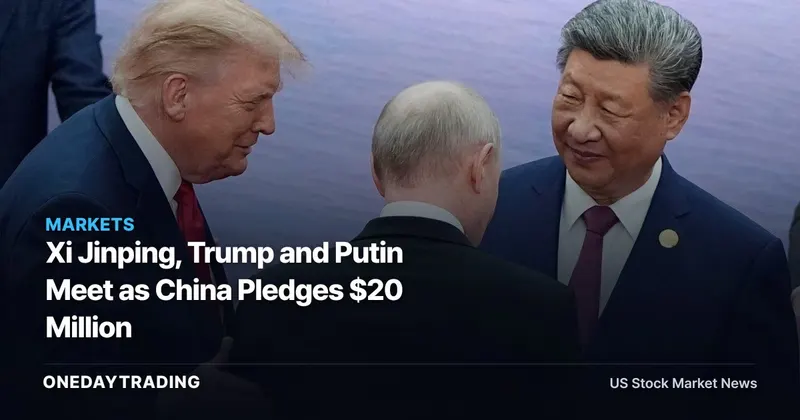
Xi Jinping, Donald Trump and Vladimir Putin met in Shenzhen on Thursday, creating a diplomatic forum with potential macro relevance but no confirmed stock, sector or asset-price consequence. CNBC reported that the meeting took place during the Asia-Pacific Economic Leaders’ Meeting and marked the first time the three leaders had met together in person.
The investable distinction is between access and outcome. The leaders discussed Ukraine, the Middle East and the Korean Peninsula, according to a Chinese readout, while the supplied evidence identifies no negotiated agreements on those issues. Investors therefore have a confirmed channel for dialogue, not a confirmed change in policy or economic conditions.
What Donald Trump, Xi Jinping and Vladimir Putin Actually Did
A trilateral meeting is a discussion involving three parties; in this case, the participants were the presidents of the United States, China and Russia. CNBC identified Thursday as the timing of the meeting, although the exact calendar date represented by Thursday was not provided.
The encounter was notable because it was the first time Donald Trump, Xi Jinping and Vladimir Putin had met together in person. Donald Trump described the countries as “uniquely positioned,” while the Chinese readout identified Ukraine, the Middle East and the Korean Peninsula as subjects of discussion. The evidence does not establish what proposals were presented or whether the leaders accepted any common position.
That boundary matters for markets. A meeting can create diplomatic space, while an agreement would supply terms that investors could evaluate. Without such terms, assigning a directional effect to U.S.-listed equities, commodities, currencies or rates would go beyond the available facts.
China’s $20 Million Asia-Pacific Announcement
Xi Jinping announced on Thursday that China would provide $20 million in support for the Asia Pacific region, CNBC reported. The amount, entity, region and timing are confirmed; the evidence does not specify how the $20 million will be allocated.
Allocation is the missing link between the announcement and any commercial analysis. No recipient, project, company or industry is identified, so the support cannot responsibly be mapped to revenue, orders, capital expenditure or earnings. The announcement is a concrete commitment in amount, though its transmission into economic activity remains undefined.
For investors, the next useful information would be an official breakdown that identifies the recipients and permitted uses of the support. Until that appears, the pledge belongs in a diplomatic and macro framework rather than a company earnings model.
Xi Jinping’s Expanding Summit Calendar
The Shenzhen gathering fits a broader pattern documented by CNBC. Xi Jinping hosted more than 40 heads of state so far this year, including at least eight heads of state this week around the meetings in Shenzhen. Each figure retains a distinct period: one covers the year so far, while the other applies only to this week.
CNBC also reported that Xi Jinping received over 60 state visits in 2025. The Shenzhen appearance made this the second year in a row that he had brought Vladimir Putin together with another major world leader on mainland Chinese shores.
The earlier gathering occurred in September 2025, when Xi Jinping, Vladimir Putin and Narendra Modi appeared together alongside the Shanghai Cooperation Organization meeting. Separately, China provided the forum for restoring diplomatic ties between Saudi Arabia and Iran in 2023. These events establish repeated use of meetings hosted in China; they do not by themselves prove a particular economic or market outcome.
Dialogue Is the Confirmed Result, Not an Agreement
Jodie Wen said, “China hopes to play a more constructive role in this conflict-[ridden], unstable world.” She also said, “China will hope to provide more platforms.” Those comments frame China’s intended diplomatic role, while the measurable evidence is the number of leaders hosted, the meetings held and the support amount announced.
The strongest constructive scenario is conditional. If later readouts add negotiated terms concerning Ukraine, the Middle East or the Korean Peninsula, investors would gain specific policy information to assess. If the discussions produce no documented commitments, the event remains evidence of high-level access rather than a new economic baseline.
That distinction keeps the analysis balanced. The first in-person trilateral meeting may create room for further negotiations, yet the supplied record contains no negotiated outcome. The $20 million announcement is similarly concrete at the headline level and incomplete at the allocation level.
Why No U.S. Stock or Sector Call Is Supported
- No company linkage: The evidence names no public company, contract, revenue exposure or listed beneficiary connected to the meeting.
- No sector allocation: China’s $20 million in support is confirmed, but no industry or use of funds is specified.
- No market reaction: The supplied facts contain no stock, index, bond, currency or commodity move.
- No policy terms: The readout identifies discussion topics without providing negotiated agreements that could be translated into an earnings or valuation effect.
For those reasons, a bullish or bearish equity conclusion would require assumptions outside the evidence. Neutral is not a judgment that the meeting lacks importance; it reflects the absence of a verified channel from the diplomatic event to company cash flows or market pricing.
Next Checkpoints After the Shenzhen Trilateral
- Negotiated language: Check future official readouts for specific agreements concerning Ukraine, the Middle East or the Korean Peninsula.
- Support allocation: Look for documentation identifying how China’s $20 million for the Asia Pacific region will be distributed.
- Further meetings: Track whether the three leaders meet together again and whether subsequent discussions produce terms beyond the confirmed agenda.
- Economic linkage: Require named recipients, projects or industries before connecting the announcement to a U.S.-listed stock or sector.
The live question is not whether Shenzhen produced a significant image. It is whether the diplomatic access demonstrated there develops into written commitments with identifiable economic channels. That is the threshold the next disclosure must cross before this event supports a directional market thesis.
📊 Analysis
Signal Neutral
Why The meeting expands diplomatic engagement, but the evidence provides no negotiated agreements, allocation details or direct market impact.
This article was independently written by OneDayTrading from public reporting. Read the original (CNBC)