Summary
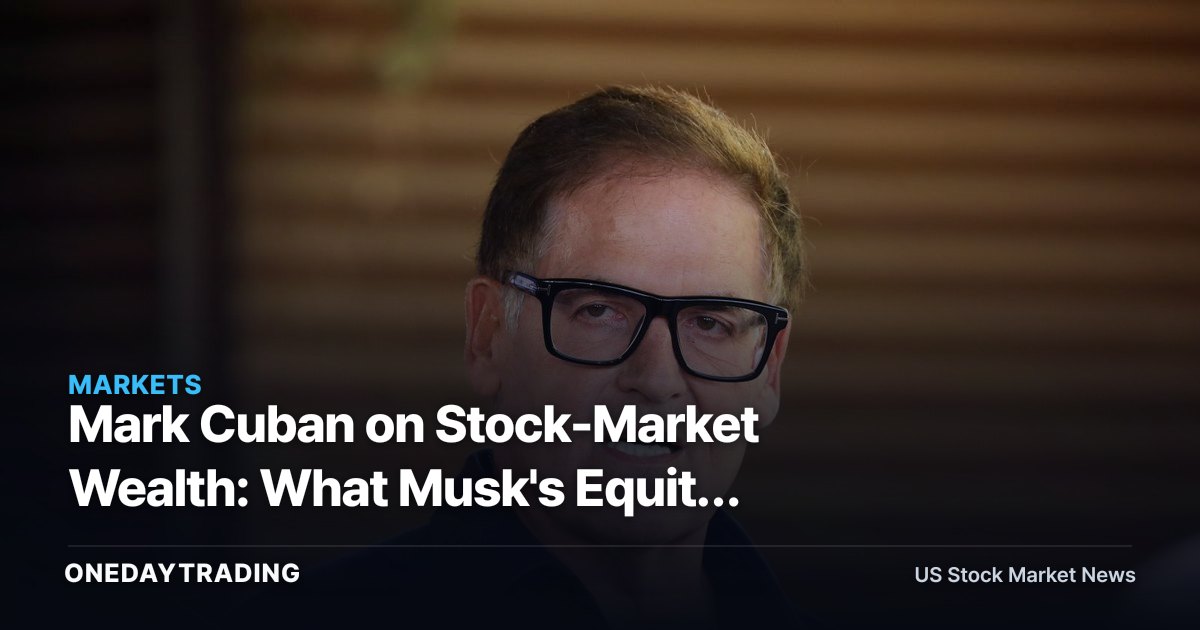
Mark Cuban argued that the public equity market is what turns founders such as Elon Musk into the ultra-wealthy, and that forcibly eliminating billionaires would set off the worst depression ever seen. The comment is less a policy debate than a reminder of how tightly modern fortunes are tied to share prices — a structural fact with direct read-through for stocks like Tesla.
The Full Story
The core point is mechanical, not ideological: the wealth attributed to figures like Musk is overwhelmingly paper wealth held in company stock, not cash in a vault. When a founder retains a large equity stake, every move in the share price marks their net worth up or down, often by billions in a single session. That is why headline fortunes swing with market sentiment rather than with salary or spending.
Cuban's second claim — that removing billionaires would cause a severe economic contraction — points to the same plumbing. Founder equity sits inside the broader capital structure that funds payrolls, capex and pensions. Forcibly unwinding those concentrated stakes would mean mass forced selling, collapsing valuations and a hit to the retirement and index portfolios that ordinary investors hold. The argument, whether one agrees with it, underscores that retail and billionaire wealth ride the same equity curve.
Structural Background
For two decades, value creation has shifted toward scalable, equity-heavy technology and platform businesses where a single founder can hold a commanding stake. The result is fortunes that are real but illiquid and volatile, concentrated in a handful of names. This is precisely why a stock like Tesla can act as a proxy for one person's wealth, and why broad index funds quietly carry exposure to the same concentration.
Stock & Sector Ripple
- Tesla (TSLA): The clearest embodiment of equity-linked founder wealth; the stock's volatility directly reflects how paper fortunes are made and unmade, making it sensitive to sentiment shifts around its founder.
- Mega-cap tech broadly: Companies with founder-led, equity-concentrated ownership share the same dynamic, where insider stakes amplify both upside and downside.
- Index and retirement vehicles: Cap-weighted funds inherit concentration risk, so the same names driving billionaire net worth also dominate everyday portfolios.
- Brokerage and capital-markets names: Platforms that intermediate equity ownership benefit when public markets remain the primary engine of wealth creation.
Bull vs Bear Scenarios
The constructive read is that deep, liquid equity markets keep funding innovation and let retail investors participate in the same compounding that enriches founders. The cautionary read is that extreme concentration cuts both ways: a single high-beta name carrying a founder's reputation can drag indexes and sentiment when it falls, and headline-driven volatility around any one personality is a genuine portfolio risk, not a sideshow.
Investor Action Points
- Check how much of your index exposure sits in a few founder-led mega-caps before assuming you are diversified.
- Treat single-name volatility tied to a high-profile founder as a position-sizing question, not a buy-the-dip reflex.
- Watch upcoming earnings and guidance from concentrated leaders like Tesla as the real driver beneath the personality headlines.
- Distinguish paper wealth narratives from cash flow and fundamentals when judging whether a valuation is durable.
Market data check: TSLA
TSLA last traded near $400.49 (+1.04%). Our composite signal — blending price momentum and news flow — reads 🟡 neutral. Price momentum scores 58/100.
Data as of publication. Price via market feeds; for reference only, not investment advice.
📊 Analysis
Signal Neutral
Why The remarks are macro commentary on how equity markets generate wealth, with no specific catalyst, guidance, or numbers that push the related stocks directionally.
This article was independently written by OneDayTrading from public reporting. Read the original (Yahoo Finance)