Novo’s long-term answer meets a near-term valuation problem
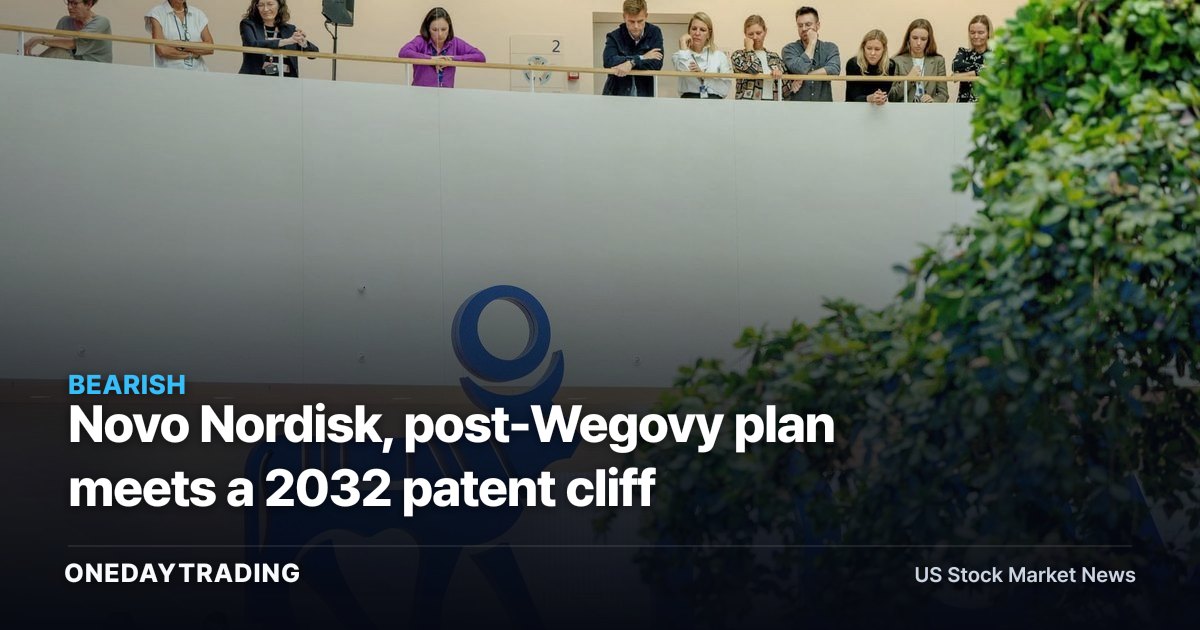
Novo shares fell as much as 7% on Sept. 21, 2026, after the drugmaker presented a post-Wegovy strategy that reaches well beyond its current obesity franchise but offered limited detail on how quickly the plan can replace lost exclusivity. The stock traded 5.4% lower at 12:30 p.m. local time, showing that investors are discounting execution risk before the promised pipeline arrives.
CNBC reported that Novo aims to launch more than five drugs with “multi-blockbuster” potential by 2030 and generate more than 150 billion Danish kroner ($23 billion) in risk-adjusted pipeline sales by 2035, including current assets. Those are substantial targets, but they are not near-term earnings guidance. The company also said revenue growth from 2026 through 2030 should be in line with industry peers, without giving a precise rate.
That gap explains the market’s response. Novo is asking investors to underwrite a larger, more diversified pharmaceutical company while its most important current mechanism faces a defined patent timetable and its chief rival already holds a majority share of the injectable GLP-1 market, according to the report.
Semaglutide remains the central evidence problem
Semaglutide is the active ingredient in Wegovy and Ozempic, Novo’s weight-loss and diabetes medicines. The company said semaglutide exclusivity will begin to be lost early next decade, with the U.S. patent expiring in 2032. The United States accounted for more than half of Novo’s overall sales last year, making that date a material boundary for revenue durability rather than a distant legal footnote.
Chief Executive Mike Doustdar called the patent issue “the elephant in the room.” He also acknowledged that Novo created an attractive market that now draws competition from almost every large or small pharmaceutical company. His stated objective is to emerge from the loss of exclusivity as a larger and more diversified company.
The mechanism is straightforward: if semaglutide faces price pressure after exclusivity weakens, Novo must replace a portion of that economics with volume, new formulations or unrelated medicines. The fact sheet does not provide the expected contribution from any individual pipeline asset, so investors cannot yet test the 2035 sales target against a disclosed product-by-product bridge.
Diversification changes the company’s risk mix
Novo said obesity and diabetes will remain its foundation, but it now plans to expand toward blood and endocrine disorders, liver disease and cardiovascular disease. It also intends to become more active in business development. That broadens the addressable disease mix, yet it also introduces the development, regulatory and commercial risks associated with entering additional therapy areas.
The strategic shift reverses the sharper focus Doustdar had outlined after becoming CEO last year. Jacob Pedersen, an investment strategist at Middelfart Sparekasse, told CNBC that investors had recently heard a focus message and were now hearing a broadening message. For a healthcare company, that inconsistency matters because capital allocation and clinical priorities determine which programs receive funding before they produce revenue.
Novo’s rebrand from Novo Nordisk to Novo and its corporate-culture update, announced the prior week, were described by Doustdar as part of the same package aimed at meeting fierce competition. A new name can signal organizational intent, but it does not establish clinical efficacy, approval probability or commercial uptake. Those evidence points remain absent from the supplied targets.
The market is comparing delivery, not ambition
Novo’s share performance shows why the announcement was judged against a high prior expectation. Before Monday’s opening bell, Novo shares had declined 27% over the previous 12 months, while Eli Lilly shares had gained 52%. Lilly’s Mounjaro and Zepbound have given it a majority share of the injectable GLP-1 market despite launching years after Novo’s medicines.
Novo said its Wegovy pill launched in the United States at the beginning of 2026 and had begun rolling out in other markets, but the pill still represented a small portion of total sales. That creates a possible product-expansion avenue, yet the fact sheet gives no sales figure or market-share measure to show whether the pill can materially change the revenue mix before 2032.
The immediate financial baseline is also demanding. Novo said adjusted sales and operating profit in 2026 are expected to be down 6% to flat at constant exchange rates. Per Hansen, a savings economist at Nordnet, said investors had hoped for a short-term “miracle” and that none existed. His comment captures the distinction between a pipeline plan and a forecast capable of changing the next earnings cycle.
Winners and losers in the competitive read-through
- Novo (NVO): The company gains a framework for replacing semaglutide exposure through more than five planned launches by 2030, but its shares face pressure because the targets do not specify the drugs, their launch timing or their individual sales contribution.
- Eli Lilly (LLY): Lilly enters the comparison with a majority share of the injectable GLP-1 market through Mounjaro and Zepbound and a 52% share gain over the prior 12 months before Monday’s opening bell. That position gives the rival commercial momentum while Novo works to diversify.
- Obesity and diabetes pharmaceuticals: Novo’s core remains the foundation, but the sector faces a more crowded field and potential price pressure as competitors pursue the market Novo helped create.
- Blood, endocrine, liver and cardiovascular drug development: These areas could become future growth channels for Novo, although no supplied data establish the size, timing or clinical status of specific programs.
Risk check: what the targets do not answer
- Pipeline identity: Novo has not disclosed the exact number and identities of the drugs behind the “more than five” launch ambition.
- Growth pace: “In line with industry peers” does not provide a precise 2026-to-2030 revenue-growth rate, leaving the market without a numerical trajectory to model.
- Patent transition: The U.S. semaglutide patent expires in 2032, but the fact sheet does not quantify the sales or margin effect of declining exclusivity.
- Execution breadth: Diversification and more active business development may reduce concentration risk, but they also require successful development and commercialization across additional disease areas.
What investors can verify next
The next useful checkpoints are operational rather than rhetorical. Investors can compare 2026 adjusted sales and operating profit against the company’s “down 6% to flat” outlook, then track whether the Wegovy pill grows beyond its currently small share of total sales. They can also look for named programs, development milestones and transaction details that convert the 2030 launch ambition into identifiable assets.
By 2030, the test is whether more than five launches have actually reached the market with the stated multi-blockbuster potential and whether revenue growth has matched industry peers. By 2032, the decisive question becomes how effectively the portfolio absorbs the U.S. semaglutide patent expiry. The 2035 pipeline-sales target is meaningful only if those intermediate milestones demonstrate that risk-adjusted estimates are becoming commercial products.
Bottom line
Novo’s strategy addresses the correct structural problem: dependence on semaglutide-based obesity and diabetes medicines in a market that Eli Lilly has entered forcefully. More than five planned launches, expansion into blood, endocrine, liver and cardiovascular diseases, and more than 150 billion Danish kroner of risk-adjusted pipeline sales could support a broader company over time. The near-term evidence is weaker: 2026 adjusted sales and operating profit are expected to be down 6% to flat, the Wegovy pill remains a small part of sales, and the announcement did not provide the product-level detail investors wanted. Until those assets and milestones become measurable, the patent timetable and competitive pressure remain the dominant facts in NVO’s valuation.
Market data check: Novo Nordisk A/S
Novo Nordisk A/S last traded near $43.24 (+0.12%). Our composite signal — blending price momentum and news flow — reads 🟡 neutral. Price momentum scores 51/100.
Data as of publication. Price via market feeds; for reference only, not investment advice.
📊 Analysis
Signal Bearish
Why Novo's long-range diversification targets did not offset immediate concerns about semaglutide exclusivity, slower expected growth and intensifying Eli Lilly competition.
This article was independently written by OneDayTrading from public reporting. Read the original (CNBC)