The Shopper Question Behind the Shoe Launch
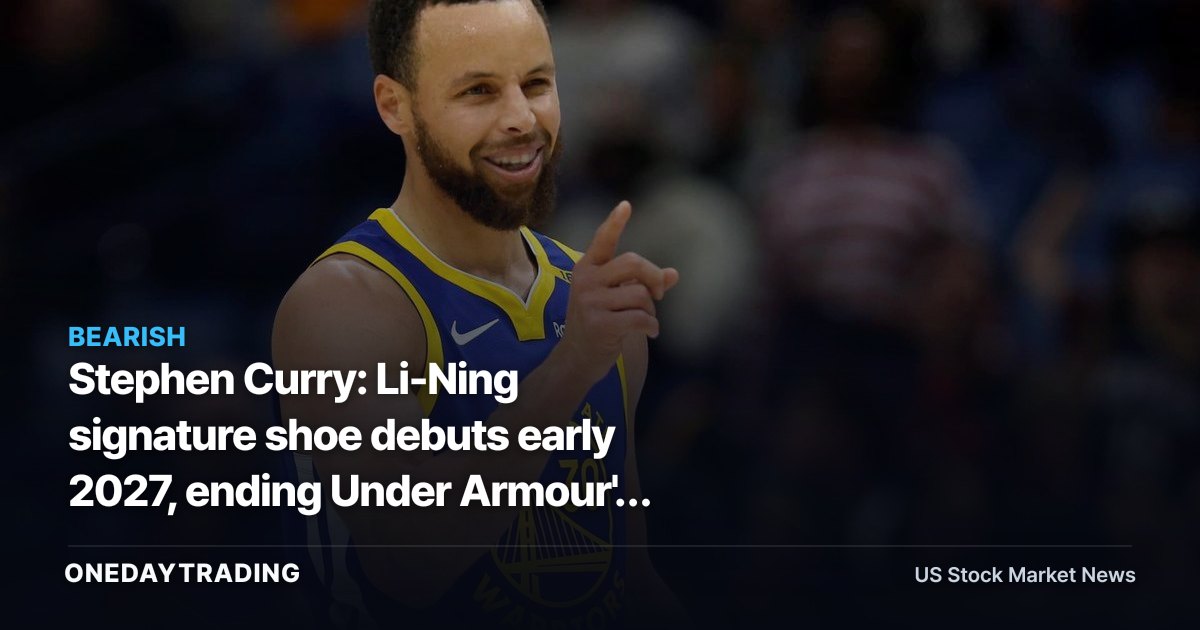
Stephen Curry said Thursday that his new signature shoe, designed in partnership with Li-Ning, will debut early next year, according to CNBC. The bigger commercial fact sits behind that timeline: Curry's 13-year partnership with Under Armour has closed, and the athlete who built Under Armour's basketball identity now wears a rival's name.
For investors, the relevant question isn't the shoe's release date. It's what an endorsement transition like this actually does to a brand's shelf presence and pipeline once the athlete who carried it walks out the door.
What Curry Confirmed
Curry told CNBC his exit from Under Armour was "mutual," calling the run "a great run" and saying "sometimes good things do come to an end." He signed a 10-year, $400 million contract with Li-Ning, according to ESPN, after announcing the partnership in June. Curry said he prioritized "longevity, legacy and global reach" in choosing a new partner, and credited the product itself: "I tried literally everything, and there was a reason that Li-Ning stood tall at the end because the product reigned supreme."
Until his own shoe ships, Curry is wearing Li-Ning models designed by teammate Jimmy Butler and former NBA player Dwyane Wade, both of whom also represent the brand and, Curry said, influenced his decision. That detail matters for sequencing: Li-Ning is monetizing Curry's name and jersey now, months before its own signature product exists.
Why the Timing Isn't Neutral for Under Armour
An athlete-brand relationship is a retention story before it's a product story: the shopper buys the player's jersey number as much as the shoe's cushioning. Curry was Under Armour's most visible basketball face for 13 years, per CNBC's reporting, which means his shift to Li-Ning transfers that shopper attention — and the marketing halo that comes with it — to a competitor with no prior signature presence in his silhouette line. Curry is entering his 18th NBA season and said he has no plans to test free agency or retire when his playing contract runs out in 2027, telling CNBC he wants to "be a lifer with Golden State." That durability is exactly what makes the footwear switch consequential: this isn't a fading star's parting deal, it's a decade-long commitment from a still-active franchise player to a different apparel company.
Neither company disclosed terms of the Under Armour separation, so the direct cost to Under Armour isn't quantifiable from what's been reported. What is quantifiable is the commitment on the other side: Li-Ning's $400 million, 10-year figure, per ESPN, signals it is underwriting Curry as a multi-generational brand asset, not a short-term marketing spend.
Market and Brand Impact
- Under Armour (UAA): Loses the athlete most identified with its basketball category after a 13-year run described by Curry as mutual; the near-term product and marketing gap in that line is a watch item rather than a quantified hit, since separation terms weren't disclosed.
- Li-Ning: Gains a still-active, 18th-season NBA champion on a 10-year, $400 million contract, per ESPN, plus the credibility transfer from Jimmy Butler and Dwyane Wade already wearing the brand — though Li-Ning is not U.S.-listed, limiting direct read-through for U.S. investors.
- Warriors-adjacent storylines: Curry said he tried to recruit LeBron James to Golden State before James signed a two-year, $8 million contract with the Philadelphia 76ers, per various media reports — a reminder that Curry's off-court leverage (brand and roster) still centers on keeping the Warriors core, including Draymond Green and Coach Kerr, intact.
Investor Checkpoints
- Watch for the actual release date and retail rollout of Curry's first Li-Ning signature shoe, currently only described as "early next year."
- Track whether Under Armour discloses any basketball-category commentary or replacement athlete strategy in its next earnings update, since the Curry exit removes a long-tenured signature-line anchor.
- Note that pricing for Curry's Li-Ning shoe has not been disclosed — a factor that will shape whether the line is positioned as mass or premium once it ships.
- Follow the Golf Channel/Versant broadcast talks Curry mentioned for the Underrated Golf Tour; terms are unresolved but would extend his commercial footprint beyond footwear if finalized next year.
Outlook: A Confirmed Switch, an Unconfirmed Payoff
The bull case for Li-Ning rests on signing an active, marketable NBA champion to a decade-long deal at a moment competitors weren't offering that horizon, per Curry's own account of the process. The risk sits on both sides of the trade: Under Armour's cost from losing Curry isn't disclosed, so the balance-sheet impact remains unverified rather than absent, and Li-Ning's $400 million commitment only pays off if Curry's actual signature shoe — not the interim Butler/Wade models he's currently wearing — lands with shoppers once it ships in early 2027. Until a release date, pricing and initial sales response exist, the deal is a confirmed contract, not yet a confirmed commercial result.
📊 Analysis
Signal Bearish
Why Under Armour's 13-year signature partnership with Stephen Curry has ended as he signs a reported 10-year, $400 million deal with Li-Ning, removing its most recognizable basketball ambassador.
This article was independently written by OneDayTrading from public reporting. Read the original (CNBC)