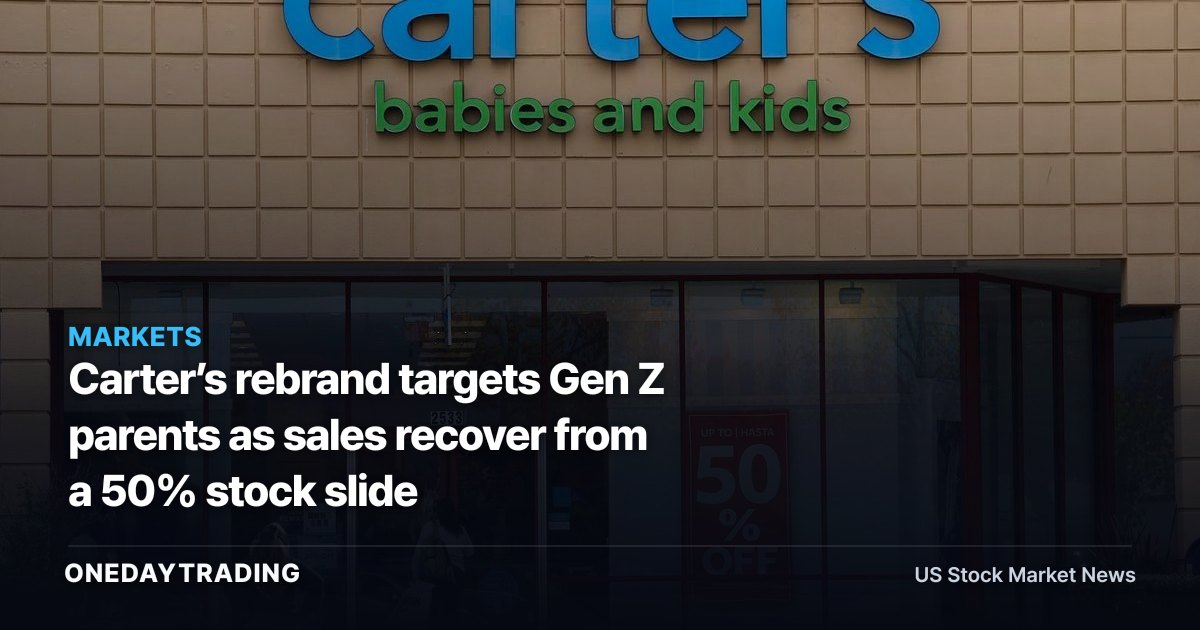
Carter’s Rebrand Tests Whether New Parents Can Rebuild the Retail Model
Carter’s is betting that a new logo and marketing campaign can convert a changing parent base into durable demand, giving investors a test of whether the 161-year-old children’s apparel company can turn a recent sales rebound into sustained earnings recovery. The rebrand was reported on September 15, 2026, with rollout across Carter’s channels during 2026 and additional retail and packaging elements planned for 2027, according to CNBC’s reporting.
The investment question is narrower than whether the branding looks newer. Carter’s must show that reaching Generation Z shoppers improves the economics of its Carter’s and OshKosh B’gosh brands across standalone stores and wholesale channels including Walmart, Target and Amazon. Comparable-sales momentum is encouraging, but the company’s lower profit base and reduced store footprint leave little room for an expensive repositioning that does not lift repeat purchasing.
What the Rebrand Changes for Carter’s Customers
A rebrand is a coordinated change to a company’s visual identity and customer communication. Carter’s confirmed that its program includes a new logo and marketing campaign, while the specific design and campaign execution have not been disclosed. That limitation matters: investors can assess the rollout schedule, but not yet the creative choices or their cost.
Chief Marketing Officer Sarah Crockett said the company sees meaningful differences among the parents it serves and an opportunity to connect with values entering today’s households. She also described a customer dynamic in which Gen Z parents may let children make more of their own clothing choices and use social media to crowdsource decisions. The commercial mechanism is straightforward: if those behaviors bring families to Carter’s digital and physical channels more often, the brand can expand customer acquisition beyond its traditional base.
Chief Executive Sharon Price John, formerly CEO of Build-A-Bear Workshop, characterized the operating changes as a “natural evolution” and said “more to be done.” Her framing places the logo within a broader retail reset rather than treating the campaign as a standalone fix. Carter’s has already reduced its store footprint and corporate headcount, so the new identity will be judged alongside those structural actions.
The Earnings Base Behind the Marketing Push
Carter’s reported adjusted net income of $126.1 million for the full 2025 fiscal year, down from $210.7 million in fiscal 2024. That decline defines the hurdle for the rebrand: a campaign can generate attention without restoring profitability if product, occupancy or channel costs absorb the sales benefit.
The company eliminated 15% of its corporate workforce and closed 150 North American stores last October as leases expired. Those steps can reduce fixed costs and concentrate demand in stronger locations, but they also shrink the physical network through which parents discover and replenish children’s clothing. The relevant test is whether remaining stores and digital channels produce enough productivity to offset the lost locations.
Carter’s stock has fallen 50% over the past three years, leaving the company with a market capitalization of about $1 billion at the time of the announcement. Wells Fargo analysts upgraded the shares from underweight to hold in June, describing the company’s changes as “driving fundamental improvements” while noting performance “isn’t perfect.” That stance reflects a recovery under observation, not a completed turnaround.
By the Numbers: Early Demand Is Better, Guidance Is Modest
In the first quarter of 2026, Carter’s U.S. comparable sales increased 10.5% and net sales rose 8.1%. Comparable sales measure performance from stores and channels open across the comparison period; the increase indicates stronger demand in the existing base, while the gap between comparable and total sales also highlights the importance of the company’s store and channel mix.
During the second quarter, Carter’s said new customers, including Generation Z shoppers, increased by a mid-teens percentage. The company did not provide the exact percentage or the quarter’s full financial results in the supplied reporting. Management expects full-year net sales growth of 2% to 3%, a range that leaves the market focused on conversion and retention rather than a one-quarter spike.
Carter’s also reported roughly $128 million in tariff refunds at its most recent earnings call. The refunds can support near-term cash flow after duties had pressured costs, but they are not the same as recurring merchandise margin improvement. Investors should separate the benefit from refunds from the underlying performance of the brands.
How the Consumer Channels Transmit the Impact
Carter’s sells through its own stores as well as Walmart, Target and Amazon. A stronger brand message can help the company attract shoppers across those channels, but the financial effect depends on where the incremental demand lands. Direct channels may provide more control over presentation and customer data, while retail partners extend reach; the supplied facts do not quantify the revenue or margin mix between them.
OshKosh B’gosh gives Carter’s a second major brand through which to apply the broader customer strategy. The company has not disclosed whether the new logo and campaign will change OshKosh’s positioning, so investors should avoid assuming that gains at the namesake brand automatically transfer across the portfolio.
The central operating link is behavior to income statement: a parent discovers the brand, completes a purchase, returns for another child-size cycle and does so at a margin that survives sourcing and tariff costs. The first-quarter comparable-sales increase and second-quarter new-customer growth support the demand side of that chain. The 2025 profit decline shows that demand alone has not yet proven sufficient.
Winners and Losers: Evidence, Not a Broad Retail Call
- Carter’s (CRI): The company is the direct beneficiary if the rebrand improves customer acquisition and repeat purchasing. Its 10.5% first-quarter U.S. comparable-sales increase and mid-teens growth in new customers provide operating evidence, while the 2% to 3% full-year sales outlook limits the near-term scale of the thesis.
- Walmart, Target and Amazon: These retailers carry Carter’s brands, so stronger brand traffic could add children’s-apparel activity within their channels. The facts do not establish the size of that effect or any change in their financial outlook, so they are distribution partners rather than direct rebrand beneficiaries in this analysis.
- Build-A-Bear Workshop: Sharon Price John’s prior leadership connects the companies through management experience, not through a reported financial impact from Carter’s rebrand. No separate stock read-through is supported by the supplied evidence.
Risk Check for Investors
- The exact logo, campaign content and spending are undisclosed, making it impossible to assess whether the creative reset will change purchasing behavior.
- Adjusted net income fell to $126.1 million in fiscal 2025 from $210.7 million a year earlier. A sales rebound could fail to translate into earnings if costs remain elevated.
- The company closed 150 North American stores and eliminated 15% of its corporate workforce. A smaller footprint may improve productivity, but it also reduces physical access to the brands.
- Tariff refunds of roughly $128 million provided relief at the most recent earnings call. Investors should test future results for operating improvement after that benefit rather than treating the refund as recurring profit.
What to Watch Through 2027
The next checkpoints are operational. Investors should compare subsequent U.S. comparable-sales growth with the 2% to 3% full-year net-sales expectation, track whether Generation Z customer gains persist beyond the second quarter, and examine adjusted net income for evidence that sales are reaching the bottom line. The 2026 channel rollout and the additional 2027 retail and packaging elements provide a timetable for judging execution.
Price John’s description of the work as “more to be done” is the appropriate frame for the stock. The rebrand can strengthen relevance if customer acquisition becomes repeat demand and the leaner store base supports margins. If the campaign produces visibility without durable sales or profit improvement, the 50% three-year share decline and reduced earnings base remain the more important signals.
📊 Analysis
Signal Neutral
Why The rebrand and improving sales offer a potential demand catalyst, but profit remains below the prior year and execution risks are unresolved.
This article was independently written by OneDayTrading from public reporting. Read the original (CNBC)